
Building a Realistic Backpacking Travel Budget
Build a realistic backpacking travel budget from trip-specific cost assumptions: for each cost environment, add transport, paid nights × nightly rate, and travel days × food and everyday daily costs, then add applicable activities, fees, and other one-off costs. Keep contingency separate from the base budget, and use separate trip segments when destinations or travel conditions have materially different cost levels.
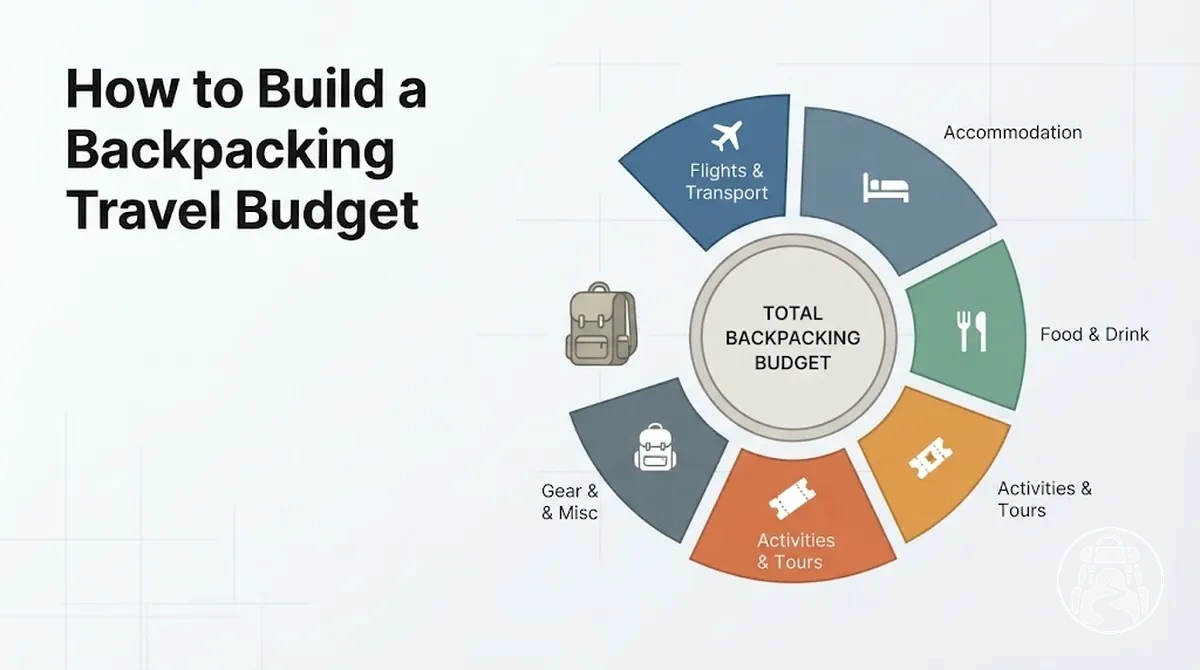
Budget estimator
Build the trip total from your own assumptions
Enter prices that match your destination, travel style, season, route, and booking conditions. The estimator supplies the arithmetic, not default prices, so it does not assume a universal backpacking daily rate.
Enter at least one trip segment, then calculate the budget.
- Segment costs
- —
- One-off costs
- —
- Base budget
- —
- Contingency
- —
- Estimated planning total
- —
Interpretation: this is a planning estimate, not a price forecast. Recalculate the affected segment when destination, season, exchange-rate assumptions, travel style, route, booking conditions, or trip length changes.
Destination or region sets the local price context, travel style changes spending intensity, trip length controls how long recurring costs accumulate, and travel pace matters when it changes the number of paid moves or transport frequency.
Because the result depends on those assumptions and on traveller choices, treat the total as conditional and revise the affected cost inputs when the trip conditions change.
Table of Contents
Set Cost Assumptions for Destination, Travel Style, and Trip Length
Destination or region, travel style, and trip length set the budget baseline before individual cost categories are estimated. These planning inputs define the trip conditions that shape local prices, spending patterns, and the duration of recurring costs.

- Destination or region
- Sets the local price level for comparable purchases and can change with conditions such as season. A higher local cost level raises the estimate; a lower local cost level reduces that baseline.
- Travel style
- Changes spending intensity through accommodation style, food choices, discretionary spending, and use of paid services. More spending-intensive choices raise the budget baseline; fewer or lower-cost paid choices reduce it.
- Trip length
- Controls how many days recurring costs accumulate. More days increase recurring-cost totals when the underlying daily assumptions remain the same.
- Travel pace
- Changes the estimate when it changes the number of moves, transport frequency, or pattern of paid travel days within the same trip length.
Make these assumptions explicit before category estimates are calculated, so each later cost value can be traced back to the trip condition that produces it.
Break the Backpacking Budget Into Major Cost Categories
A backpacking budget should be divided into major cost categories so missing expenses and double counting are easier to detect.
Grouping transport, accommodation, food and everyday costs, activities, and applicable one-off costs also makes the total estimate traceable to a clear estimate basis.

Recurring costs accumulate through repeated spending during the trip, while one-off costs are paid once or only when a particular condition applies.
Some categories can also be occasional or variable rather than strictly daily.
The table separates each category by cost pattern and the basis used to estimate it without assigning fixed percentages.
| Cost category | Cost pattern | Estimation basis |
|---|---|---|
| Transport | Recurring or variable by travel leg | Expected travel legs and applicable fares |
| Accommodation | Recurring by paid night | Paid nights and expected nightly rate |
| Food and everyday costs | Recurring daily, weekly, or occasionally | Expected frequency and local unit cost |
| Activities | Occasional or conditional | Planned paid activities and applicable fees |
| One-off fees and pre-trip costs | One-off or condition-specific | Applicable fee or pre-trip charge |
These backpacking budget categories are estimation buckets rather than fixed percentage allocations.
Their final amounts depend on the expenses that apply to the trip, so each category should contain only costs that have not already been counted elsewhere.
Transport and Accommodation Costs
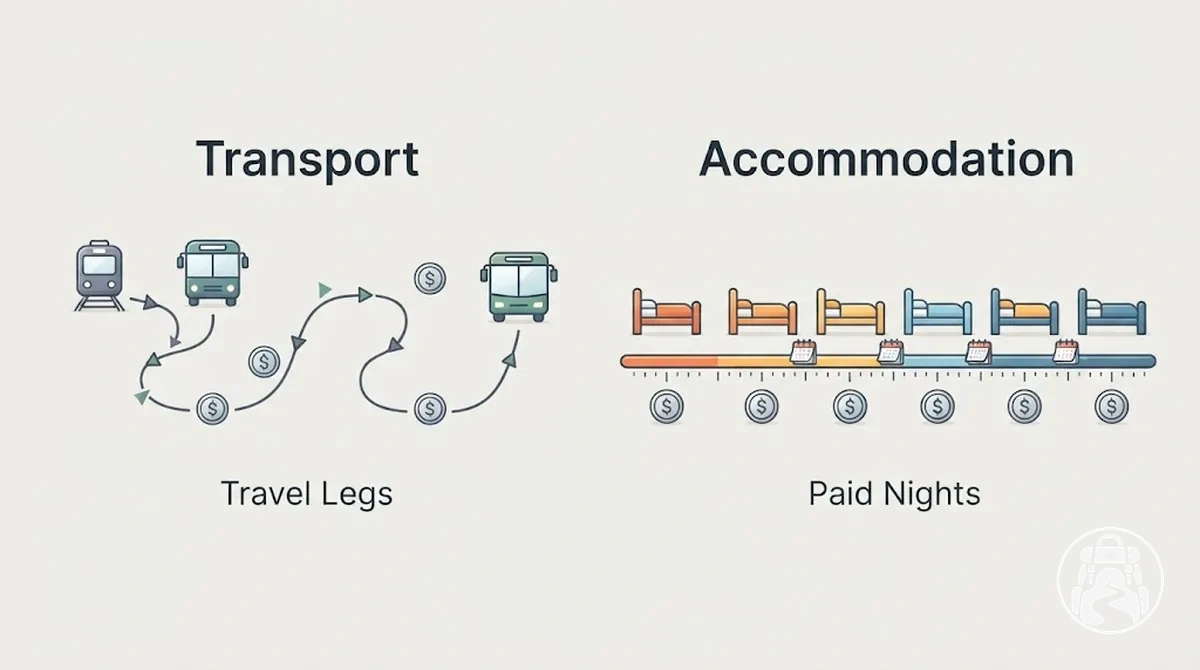
Transport costs are estimated from the necessary travel legs and the expected fare for each leg, while accommodation costs are estimated from paid nights multiplied by an expected nightly rate.
The image compares these two calculation bases so the different quantity units are clear before the category totals are estimated.
Transport
- Calculation basis
- Paid travel legs × applicable fares
- Quantity driver
- The number of required paid travel legs or moves.
- Fare drivers
- Destination price level, season, route conditions, booking conditions, and the transport choices used for each leg.
- Decision rule
- Budget the specific legs expected to require payment rather than applying one fare universally.
Accommodation
- Calculation basis
- Paid nights × expected nightly rate
- Quantity driver
- The number of nights that require paid accommodation.
- Rate drivers
- Accommodation style, destination price level, season, and booking conditions.
- Decision rule
- Use a nightly-rate assumption that matches the planned trip conditions rather than a universal rate.
Both totals rise when either the relevant quantity or unit cost rises, but the quantities are different: transport is driven by paid travel legs, while accommodation is driven by paid nights.
Food and Everyday Travel Costs
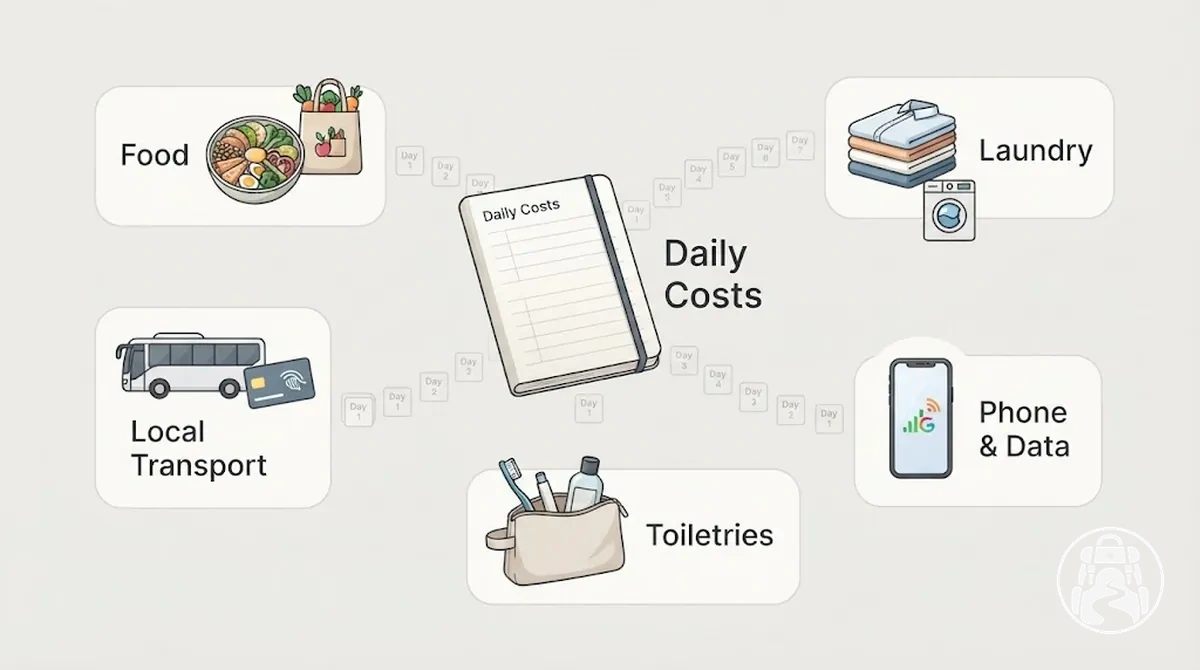
Food and everyday travel costs are recurring expenses best estimated from how often each item is paid for and its local unit cost.
The image groups routine costs that can accumulate across travel days, while the list separates items by payment frequency so they can be budgeted without duplicating transport or accommodation costs.
- Meals and groceries: Estimate the number of meals or grocery purchases expected each day or week and multiply that frequency by a realistic local unit cost.
- Local transport: Include local journeys only when they are not already counted elsewhere, using expected trip frequency and the applicable local fare or pass cost.
- Laundry: Treat laundry as a weekly or occasional cost based on how often it is needed and the local unit cost per wash or service.
- Phone or data: Budget phone or data according to the expected purchase or renewal frequency and the applicable local unit cost.
- Toiletries and small essentials: Include replacement purchases at the frequency they are likely to occur, using local unit costs rather than assuming a fixed daily amount.
- Discretionary spending: Optional small purchases belong in the estimate only when they reflect the traveller's expected spending pattern, with frequency and unit cost stated separately from essential expenses.
Essential spending may recur daily, weekly, or occasionally depending on the item, while discretionary spending is conditional on personal choices rather than a universal travel need.
Keeping frequency and unit cost explicit makes the daily or weekly budget effect traceable and helps prevent routine costs from being counted twice.
Activities, Fees, and Other One-Off Costs
One-off costs are irregular or pre-trip expenses that should be added separately from recurring daily spending because they may be paid once, per destination, or per activity.
The image groups expenses that apply only when a specific requirement or planned choice creates them.

- Activities: Planned tours, attractions, or similar experiences are optional when the traveller chooses to include them and are usually budgeted per paid activity.
- Entry fees: Entry fees are required only when a place or activity being visited charges them, so they should be counted per applicable destination, site, or activity rather than as a daily expense.
- Visa fees: Visa fees may be required when the traveller's destination and eligibility conditions require a paid application. When applicable, they belong in the budget as a destination-specific one-off cost rather than recurring spending.
- Travel insurance: Travel insurance may be required under particular trip conditions or selected voluntarily. When included, its premium is treated as a one-off or coverage-period cost rather than an assumed universal daily expense.
- Pre-trip costs: Essential documents, equipment, or other preparations should be included only when they are actually needed for the trip, usually as a single pre-departure expense rather than a recurring cost.
Required one-off costs belong in the budget when the relevant destination, activity, or trip condition makes them applicable, while optional costs belong only when the traveller plans to incur them.
Recording whether each item applies once, per destination, or per activity keeps its effect on the trip total explicit.
This separation prevents irregular expenses from being hidden inside a daily spending estimate or assumed to apply to every traveller.
Estimate Daily Costs and Scale Them to Trip Duration
A daily cost estimate becomes a trip estimate by multiplying recurring daily costs for each relevant trip segment by the number of days in that segment, then adding applicable one-off costs.
The base total is the sum of those duration-scaled costs and one-off costs, while contingency remains separate from that base total.
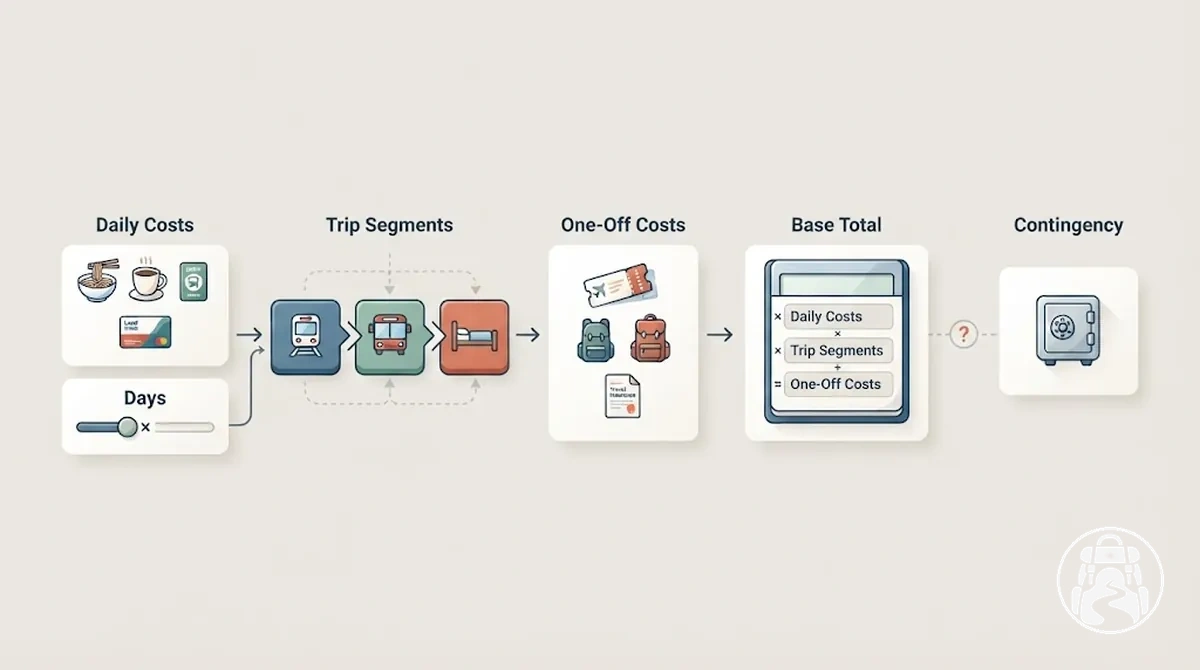
- Establish recurring daily costs: Combine the relevant recurring category estimates for each destination or trip segment to create a daily spending estimate that matches its travel conditions.
- Split different cost environments when needed: Use separate trip segments when destinations or regions have materially different cost levels instead of forcing one daily estimate across the entire trip.
- Multiply each segment by its days: Calculate each segment total as recurring daily costs multiplied by the number of days spent in that segment.
- Add applicable one-off costs: Add fixed or irregular expenses after the segment totals so they are included once, rather than being hidden inside the daily rate.
- Keep contingency separate: Treat the resulting amount as the base total and hold contingency outside it for the next planning layer.
A single all-trip average can obscure meaningful differences between destinations, so segmentation is useful when the underlying cost assumptions change enough to require a different daily estimate.
Each trip segment should use its own recurring daily costs and duration, and the segment totals can then be combined.
This keeps the effect of both destination cost level and trip duration visible in the calculation.
The final estimate remains conditional on the assumptions used because season, exchange-rate movement, and traveller choices can change the underlying prices or spending pattern.
Recalculate affected segments when those assumptions change rather than treating the first result as an exact cost.
Before accepting the base total, verify that no expense has been included in a daily rate and then added again as a one-off cost.
Add a Contingency Budget for Unplanned Travel Costs
A contingency budget is a separate reserve for plausible unexpected costs that are not part of routine planned spending. Optional upgrades, normal entertainment, and other discretionary spending belong in planned categories rather than the reserve.
What changes the reserve
A larger reserve becomes more relevant when
a disruption could create several additional charges, short-notice alternatives are costly, schedule flexibility is limited, or access to backup funds is limited.
A smaller reserve may be workable when
exposure to disruption is limited and reliable backup funds are readily accessible. This does not turn known planned expenses into contingency.
The main uncertainty sources below show how trip conditions can change the financial impact of an unexpected event.
- Transport disruption: A cancelled, missed, or changed connection may create additional transport or short-notice travel costs, increasing the reserve needed when the itinerary has limited alternatives.
- Unexpected extra nights: Delays or itinerary changes can add accommodation and routine costs for additional days, making a larger reserve more relevant when schedule flexibility is limited.
- Replacement purchases: Lost, damaged, or unusable essential items may require an unplanned replacement purchase, so the reserve should reflect the practical importance and replacement difficulty of essential belongings.
- Exchange-rate movement: A change in the exchange rate can increase the home-currency cost of expenses that have not yet been paid, which may increase the useful buffer on trips with substantial future foreign-currency spending.
- Access to backup funds: Limited access to backup funds increases the importance of keeping more money available within the travel reserve, while reliable access to separate funds may reduce the amount that needs to remain inside the trip budget itself.
Do not assume one universal contingency percentage. Size the reserve from exposure to disruption, the possible cost of those disruptions, trip conditions, and access to backup funds.
Keep the reserve separate from the base budget and use it for genuine unexpected costs rather than routine discretionary purchases.
Check Whether the Total Budget Is Realistic for the Planned Trip
A total budget is realistic only when it remains consistent with the trip's assumptions, daily costs, trip duration, category coverage, travel pace, and contingency treatment.
Matching a preferred spending limit does not by itself make the estimate plausible; the underlying cost drivers must support the final total.
Use the following checks to test distinct sources of budget error.
When a check fails, trace the gap back to the relevant assumption or cost driver and adjust that input rather than changing the total without explanation.
- Destination and travel-style assumptions: Check that the destination, season, travel style, current prices, exchange-rate assumptions, and other relevant trip conditions still match the planned trip. If an assumption is stale or no longer plausible, recheck the affected daily costs before treating the total as usable.
- Trip duration: Check that recurring daily costs were applied to the correct number of days for each relevant trip segment. If the duration is wrong, the corresponding segment total is understated or overstated.
- One-off costs: Check that each applicable one-off cost was included once and only once. If a fixed expense is missing or repeated, the total budget contains an omission or double counting.
- Major category coverage: Check that the budget accounts for the major costs that actually apply to the trip without adding the same expense under multiple categories. A failed check identifies either an omitted category or a duplicated cost driver.
- Travel pace and transport frequency: Check that the planned number of moves is compatible with the transport frequency assumed in the budget. If the itinerary requires more paid travel than estimated, transport costs need to be revised.
- Contingency separation: Check that contingency remains separate from planned spending and is not being used to make an understated base budget appear workable. If routine expenses depend on the reserve, those expenses belong in the planned categories instead.
A failed realism check does not automatically mean the whole budget is unusable; it identifies the specific assumption, arithmetic input, omission, or cost driver that needs correction.
The final amount is plausible only after those trip-specific inconsistencies have been resolved.
Reduce an Over-Budget Total by Adjusting the Biggest Cost Categories
Protect first, then test flexible levers
Protect
- Fixed costs under the current trip conditions.
- Required costs that cannot reasonably be removed.
- The contingency reserve for plausible unexpected costs.
Flexible levers to test
- Accommodation rate.
- Transport frequency or mode assumptions.
- Food and discretionary spending.
- Paid activities.
- Travel pace, when changing it alters transport costs.
Test one variable at a time so the contribution of each adjustment remains clear, and prefer a high-impact change over a low-impact cut when it produces a larger saving without making the trip unrealistic.
- Rank category contributions: Identify which categories account for the largest shares of the over-budget total so the largest cost drivers are considered first rather than assuming any particular category is always the main problem.
- Separate fixed from flexible costs: Mark fixed costs and required costs that cannot reasonably be reduced under the current trip conditions, then focus on flexible costs that can be adjusted without deleting necessary expenses or contingency.
- Change one high-impact variable: Test one adjustable assumption, such as a lower accommodation rate, reduced transport frequency, a different transport-mode assumption, lower discretionary spending, fewer paid activities, or a slower travel pace where that change fits the trip.
- Recalculate the total: Apply only that change and recalculate the affected category and overall budget. The adjustment is useful only when the revised assumption produces a measurable reduction in the total.
- Stop or repeat: If the revised total now fits the limit under realistic assumptions, keep the change and stop. If the plan remains over budget, return to the next highest-impact flexible cost driver and repeat the same one-variable test.
Recalculating after each adjustment prevents several simultaneous changes from hiding which cost driver produced the saving.
If realistic changes to flexible costs still do not bring the plan within its limit, the budget remains over target; it does not become viable by ignoring required costs or eliminating contingency.
Common Backpacking Travel Budget Mistakes to Avoid
Backpacking travel budget mistakes usually come from weak assumptions, omitted costs, double counting, or outdated comparisons rather than one universal spending error.
This section covers estimation errors that directly change the budget total or its usability, not general backpacking, packing, or hiking mistakes.
Each mistake below links the error to its likely consequence, a recognition cue, and a practical correction.
The aim is to identify which assumption or accounting choice is making the estimate less reliable without repeating the full budgeting method.
- Using one unrealistic daily rate everywhere: Applying the same daily rate across destinations with different cost levels can understate or overstate the total. The warning sign is a single assumption covering materially different locations or travel styles; the correction is to use destination- or segment-specific daily costs where conditions differ.
- Leaving out applicable one-off costs: Omitted costs such as relevant fees or other fixed trip expenses make the total artificially low. If a required or planned one-time expense appears nowhere in the estimate, the correction is to add it once in the appropriate one-off category.
- Double counting or missing categories: Recording the same expense in more than one category overstates the budget, while omitting an applicable category understates it. A duplicated or unexplained gap between category estimates is the recognition cue; the correction is to assign each expense to one place and include every relevant category once.
- Ignoring trip duration or travel pace: Daily costs applied to the wrong number of days distort the trip total, while a faster travel pace may increase transport frequency and related costs. If the budget does not match the planned trip duration or number of moves, the correction is to recalculate the affected costs using the actual trip assumptions.
- Relying on overly optimistic assumptions: Assuming unusually low accommodation, transport, food, or discretionary spending without matching those values to the planned trip can make the estimate less reliable. A budget that depends on several best-case prices is a recognition cue; the correction is to replace those assumptions with values that fit the destination, season, and travel style being planned.
- Failing to separate contingency: Treating contingency as ordinary spending or using it to cover known planned costs hides whether the base budget is complete. If expected expenses depend on the reserve, the correction is to move those planned costs into the base categories and keep contingency separate for plausible unexpected costs.
- Copying an outdated budget without checking its assumptions: An outdated budget or anecdotal comparison may no longer match current prices, exchange-rate conditions, trip duration, travel pace, or travel style. If the source conditions differ from the planned trip, the correction is to use the comparison only as context and recheck the underlying assumptions against current trip conditions.