
Choosing Destinations for an International Backpacking Trip
Choose international backpacking destinations by first eliminating options that fail your non-negotiable constraints—such as travel season, budget, usable trip time, safety requirements, or other traveller-specific needs—then compare only the viable options by experience level, backpacker logistics and trip priorities. The best choice is the destination with the strongest overall fit for your actual trip, not simply the most popular or cheapest place.

Destination shortlist decision assistant
Test one destination at a time. A failed non-negotiable condition makes it non-viable for the current trip; an unresolved condition should be verified before shortlisting. Once every viability gate passes, compare fit rather than assigning a universal score.
Destination suitability depends on how a destination's conditions align with your travel season, budget, available time, travel style, experience level, safety requirements, and practical backpacking conditions.
Destination suitability is a relationship between traveller constraints, trip priorities, and the conditions at each destination.
A place may suit one traveller but be less suitable for another when timing, affordability, access, experience requirements, or other practical conditions differ.
Within backpacking trip planning, destination selection establishes which places are realistic candidates before route sequencing begins.
Travel season affects the weather conditions you may encounter, while budget determines whether expected local costs fit what you can spend.
Available time, including access time relative to trip length, affects whether experiencing a destination is practical, while travel style and experience level influence which conditions are manageable or desirable.
No single criterion determines destination suitability; the combination of these factors narrows the set of candidate destinations.
At this stage, the goal is not to build the route or construct a detailed travel budget.
Broad destination options should first be filtered against the traveller's main constraints so that only viable candidate destinations proceed to closer comparison.
Table of Contents
Filter Destination Options by Your Core Trip Constraints
Filter candidate destinations by applying hard trip constraints before flexible preferences influence the comparison.
This removes options that conflict with non-negotiable requirements and prevents attractive but impractical choices from dominating the decision; the image illustrates how a broad destination set narrows as those constraints are applied.

Hard constraint or flexible preference?
Whether a factor is hard or flexible depends on the traveller's actual limits, not on a universal weighting system. A hard constraint rules out a destination when a non-negotiable condition cannot be met; a flexible preference reduces relative suitability while the trip remains workable.
Hard constraints
Failing one makes the destination non-viable for the current trip.
- Season: rule out the option when seasonal conditions or access conflict with a non-negotiable travel requirement.
- Affordability: rule it out when expected essential destination costs exceed the budget available for that part of the trip.
- Available time: rule it out when access and travel demands leave insufficient usable time for the traveller's purpose.
- Other non-negotiables: rule it out when another traveller-specific requirement cannot be met.
Flexible preferences
Weak alignment lowers relative fit but does not automatically make the trip unworkable.
- Travel style: reduce suitability when the destination does not closely match the preferred way of travelling but remains practical.
- Experience level: reduce suitability when conditions demand more independence, planning or adaptability than the traveller prefers without making the trip unworkable.
- Convenience: reduce suitability when transport, accommodation or day-to-day logistics require compromises the traveller is willing to accept.
Interpret the filter as a viability test rather than a ranking.
For example, suppose the same destination has seasonal access conditions that match one traveller's dates but conflict with another traveller's fixed dates; it remains viable for the first traveller and is ruled out for the second.
Only destinations that satisfy the relevant hard constraints should proceed to preference-based comparison.
Match Destinations to Your Travel Season
Travel season can materially change destination suitability because weather conditions, temperature, rainfall, daylight, access conditions, and seasonal operating conditions change through the year.
The effect can differ by region, so the same travel period may make one part of a destination practical while making another less suitable; the image illustrates how seasonal differences can change the backpacking experience.
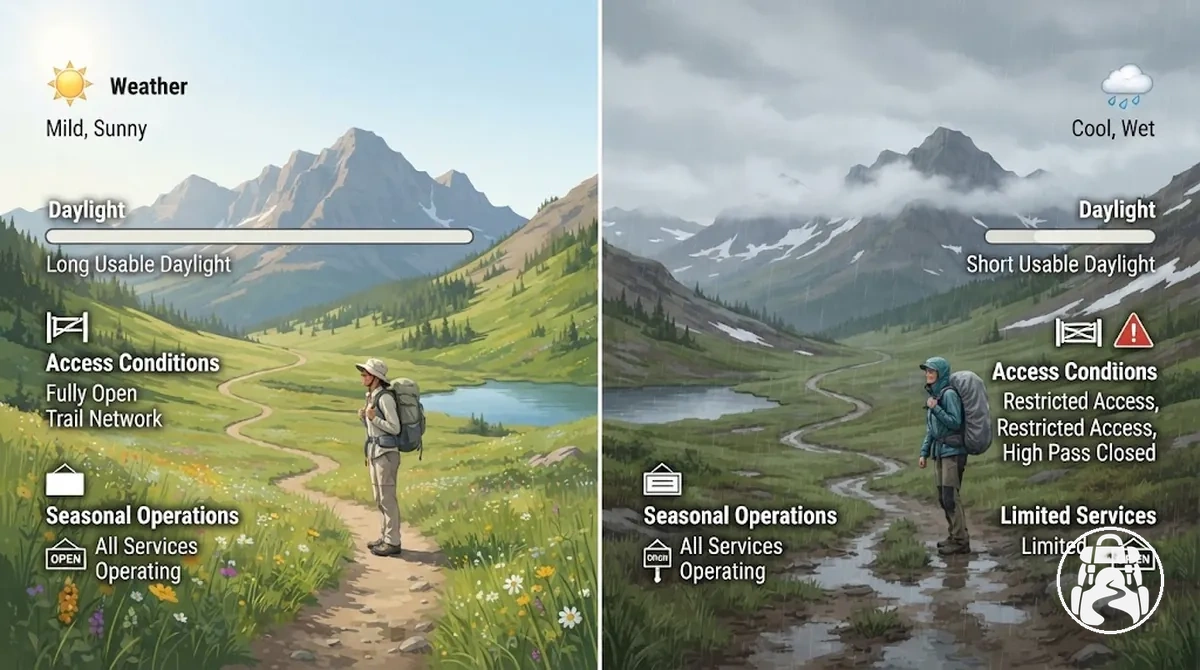
Seasonal conditions should be assessed at the regional level rather than assumed from a country-wide climate description.
Historical averages indicate likely patterns, but actual weather can be warmer, cooler, wetter, drier, or more variable during a particular trip.
The table groups the main seasonal factors by the condition to check and the resulting implication for destination suitability.
| Seasonal Factor | Condition to Check | Suitability Implication |
|---|---|---|
| Temperature | Whether expected seasonal temperatures fit the clothing, activities, and conditions the traveller is prepared to manage | Conditions outside the traveller's practical tolerance can reduce destination suitability for that travel period |
| Rainfall | Whether the season commonly brings wetter or drier conditions in the specific region | Periods with greater rainfall may reduce suitability when outdoor activities or reliable overland access are priorities |
| Daylight | Whether seasonal daylight provides enough usable daytime for the activities planned | Shorter daylight can reduce practical activity time, while longer daylight can increase scheduling flexibility |
| Access conditions | Whether roads, trails, passes, ferries, or other relevant access routes normally operate during the travel season | Seasonal restrictions or closures can make parts of a destination impractical for the intended trip |
| Seasonal operations | Whether the accommodation, transport, services, or activities the traveller relies on normally operate during that period | Reduced seasonal operation can lower suitability when those services are necessary for the planned stay |
For example, the same backpacking destination may be more suitable during a period with manageable weather, sufficient daylight, and open access routes, yet less suitable when heavier rainfall, shorter daylight, or seasonal closures conflict with the traveller's plans.
The relevant question is whether the likely seasonal conditions fit the intended trip.
Match Destination Costs to Your Budget Range
Destination affordability depends on the combined pattern of local costs fitting your available budget range, not on a single headline price.
Accommodation, local transport, food, and activities together shape the on-the-ground cost profile; the image shows how these categories combine within an overall backpacking budget frame.
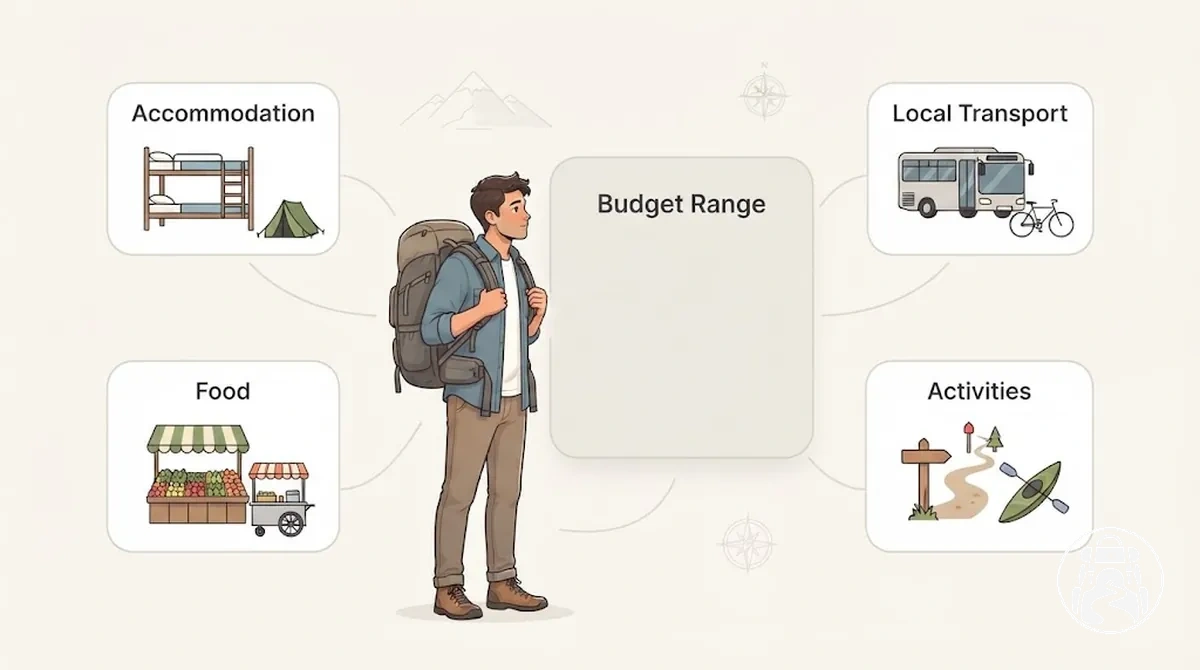
Accommodation, local transport, and food are recurring local costs, while activities and other discretionary spending can vary more with travel style.
Season, location within the destination, exchange rates, and travel choices can also shift affordability, so current prices should be checked for the intended travel period rather than treated as fixed.
The table organizes the main cost categories by what to assess and how each condition affects destination-level affordability without constructing a complete trip budget.
| Cost Category | What to Check | Budget Implication |
|---|---|---|
| Accommodation | Whether the expected cost of suitable hostels or other lodging fits the amount available for overnight stays | Higher recurring lodging costs consume more of the budget range and can reduce affordability |
| Local transport | Whether routine transfers and local travel needed for the intended stay fit the transport allowance | Frequent or costly local movement can raise destination costs even when other categories remain manageable |
| Food | Whether the traveller's usual eating style can be maintained within the available spending range | Higher recurring food costs reduce the budget remaining for other necessary or optional expenses |
| Activities | Whether planned paid activities are essential to the trip or can be reduced, substituted, or skipped | Optional activity costs can reduce flexibility without necessarily making the destination unaffordable |
| Cost variability | Whether season, location, exchange rates, or travel style are likely to shift the expected local cost profile | Greater cost variability requires more budget flexibility before affordability can be judged confidently |
For example, one destination may have lower recurring accommodation, local transport, and food costs but higher optional activity spending, while another may have higher recurring costs and fewer discretionary expenses.
Either destination can remain suitable when its overall cost profile fits the traveller's budget range; lower cost alone does not determine destination suitability.
Match Destinations to the Time Available for Your Trip
A destination is practical when enough usable time remains after access time and internal travel are taken from the total trip duration.
Available time should therefore be judged by the time left for the destination itself, not by calendar trip length alone; the image shows how a finite backpacking trip is divided between reaching the destination, moving within it, and usable stay time.

Total trip duration sets the time budget, while access time and internal travel consume part of it before the intended destination experience can occur.
A distant destination is not automatically unsuitable; it becomes less practical when those travel-time burdens leave less usable time than the traveller considers worthwhile for the intended experience.
Because that minimum worthwhile stay depends on traveller priorities and what they want to do, it should be treated as a trip-specific condition rather than a universal number.
The criteria below separate the main time demands that affect destination suitability before route sequencing begins.
- Trip duration: identify the total available time that can be divided between travel demands and the destination stay.
- Access time: consider the meaningful time consumed reaching the destination and departing from it.
- Internal travel: account for movement within the destination when distance or transfers consume time that would otherwise be usable at the places relevant to the trip.
- Usable time: assess how much available time remains after access and internal travel demands are considered.
- Minimum worthwhile stay: determine whether that remaining usable time is sufficient for the traveller's intended experience without applying a universal minimum-day threshold.
The same destination may be less practical for a short trip when access time and internal travel consume a large share of the available time, yet become more practical on a longer trip because more usable time remains after those demands.
Destination suitability should be resolved at this level before detailed travel-pace planning allocates time among places.
Match Destinations to Your Backpacking Style and Trip Priorities
One traveller may prioritise social interaction and activity intensity, while another may value quieter experiences and greater independence.
The same destination can therefore have different levels of suitability because its attributes align differently with each traveller's travel style and trip priorities; the image contrasts how those priorities change destination fit.

Backpacking style changes which destination attributes matter most rather than creating a universally superior destination type.
Comfort level, social preference, preferred activities, desired convenience, and tolerance for independent travel can shift the importance of cities, nature, social accommodation, cultural depth, or logistical simplicity.
The scenarios below show how contrasting priority sets can change suitability without implying that either approach is better.
- Social and activity-focused priorities: a traveller who values frequent activities, social interaction, and convenience may find destinations with active urban areas, social hostels, accessible local transport, and a broad choice of organised experiences more suitable.
- Quiet and independent priorities: a traveller who values nature, quieter travel, cultural depth, and independence may find destinations with less intensive social settings, access to natural areas, and conditions that support self-directed travel more suitable.
A destination that aligns strongly with one set of traveller priorities can become less suitable when the preferred experience, comfort level, social preference, or desired degree of convenience changes.
Destination fit should therefore be judged by how well the relevant destination attributes support the intended experience, not by demographic labels or a single idea of the ideal backpacking style.
Compare the Remaining Destinations by Backpacking Suitability
Compare shortlisted destinations using the same comparison criteria so popularity or one attractive feature does not dominate the decision.
Backpacking suitability depends on relative fit across constraints, experience level, practical backpacker conditions, and trip priorities, with the importance of each dimension changing according to the traveller's situation.
The image reinforces that every remaining option should be viewed through the same comparison basis rather than as part of a ranking.
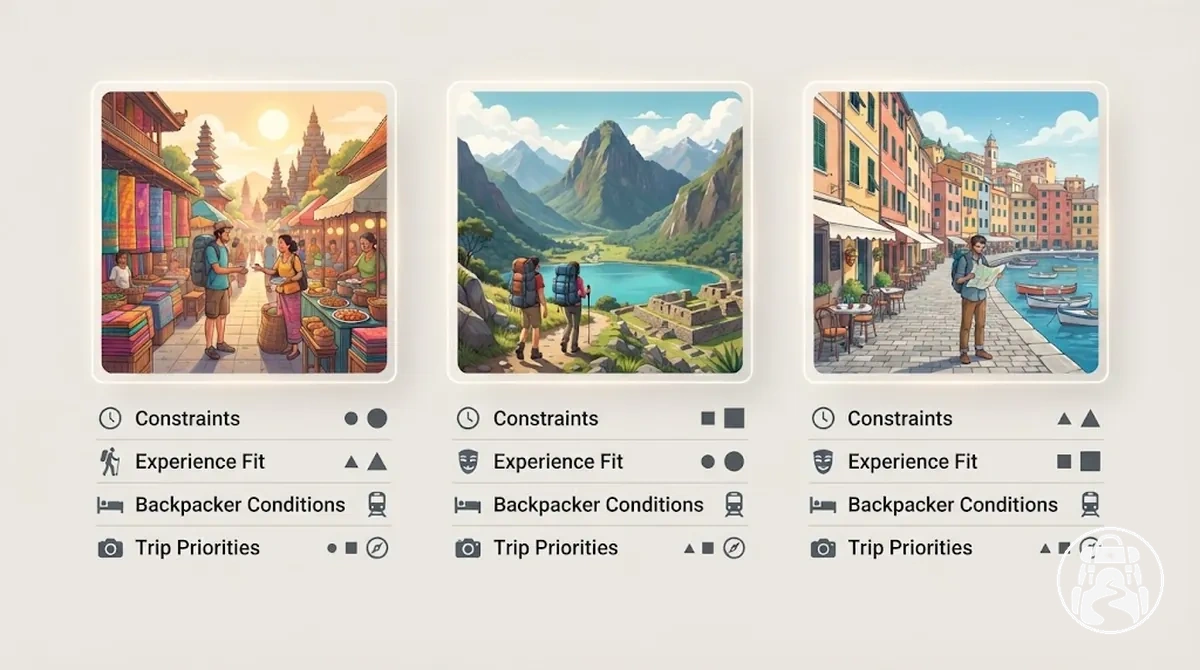
Consistent comparison criteria make differences between viable destinations easier to interpret without assigning artificial scores.
A traveller who values easier independent travel may give more weight to conditions that align with their experience level, while another may place greater weight on specific trip priorities or other constraints.
The table applies the same dimensions to generic shortlisted destinations so that strengths, weaknesses, and trade-offs remain comparable.
| Destination Option | Constraint Fit | Independent-Travel Fit | Backpacker Conditions | Priority Fit | Key Trade-Off |
|---|---|---|---|---|---|
| Option A | Fits the traveller's non-negotiable constraints with few compromises | Conditions align well with the traveller's current confidence and independence | Practical conditions support straightforward backpacking | Strong alignment with the traveller's highest-priority experiences | Some lower-priority preferences may be less well supported |
| Option B | Fits the essential constraints but requires acceptable compromises | Greater independence or adaptability may be needed for the intended trip | Backpacking remains practical when the traveller is comfortable with added complexity | Strong alignment with selected priorities but weaker alignment with others | A valued experience may justify greater practical effort when that experience has higher priority |
| Option C | Fits the essential constraints under the traveller's intended conditions | Travel demands remain compatible with the traveller's experience level | Practical backpacker conditions are workable but may offer less convenience | Moderate alignment across several priorities rather than a particularly strong fit on one | Broader compatibility may come with fewer standout advantages for the traveller's main priority |
A weakness in one dimension does not make a destination less suitable overall when that weakness concerns a lower-priority factor and the option fits higher-priority criteria more closely.
Conversely, a strong feature should not outweigh a meaningful mismatch with important constraints or trip priorities.
Interpreting these trade-offs consistently produces a shortlist based on conditional suitability rather than a universal ranking.
Assess Safety and Ease of Independent Travel for Your Experience Level
Destination suitability depends on both current risk conditions and how much independent-travel complexity the traveller can reasonably manage at their experience level.
A destination can present manageable practical difficulty without being inherently unsafe, while genuine safety concerns should not be dismissed as simple unfamiliarity or inconvenience.
Keep two questions separate
Safety conditions
Current risk conditions, recurring traveller problems with genuine safety consequences, and access to help affect whether a destination meets the traveller's safety requirements. Easy transport or communication does not by itself establish favourable risk conditions.
Independent-travel complexity
Transport legibility, communication friction and planning demands mainly affect practical ease. Greater complexity can reduce suitability for a traveller's current experience level without making the destination inherently unsafe.
- Current risk conditions: check up-to-date, reliable information about conditions that could materially affect traveller safety; evidence of an active or elevated concern can reduce suitability regardless of how easy the destination is to navigate.
- Common traveller problems: distinguish recurring issues that carry a genuine safety consequence from problems that mainly create inconvenience, delay, or additional planning.
- Access to help: assess whether the traveller can reasonably reach appropriate assistance when a serious problem occurs; limited support access can increase the experience or preparation needed for independent travel.
- Transport legibility: consider whether routes, transfers, ticketing, and wayfinding can be understood without extensive local knowledge; lower legibility increases travel complexity but does not by itself indicate greater danger.
- Communication friction: consider how easily the traveller can obtain directions, clarify arrangements, and ask for help when needed; greater friction can reduce practical ease and may require more confidence or preparation.
- Experience level: judge whether the combined safety conditions and practical demands match the traveller's ability to make decisions, recover from mistakes, and manage unfamiliar situations independently.
For example, the same destination may remain suitable for a traveller experienced with complex transport and communication barriers while being less suitable for a less experienced independent traveller if those demands exceed their current confidence or capability.
That difference reflects independent-travel complexity rather than a claim that the destination is either risk-free or inherently unsafe.
Assess Backpacker Infrastructure and Basic Travel Logistics
Backpacker infrastructure is the set of destination-level services and access conditions that support independent travel, including budget accommodation, public transport, payments, connectivity, traveller information, and basic services.
Within destination selection, these basic travel logistics matter because their availability, reliability, and accessibility influence how much practical friction a backpacker is likely to manage.
Established infrastructure can make basic logistics more predictable, while lower-infrastructure conditions may require more preparation, flexibility, or independent problem-solving.
Practical suitability therefore depends on whether the available support matches the traveller's needs rather than on infrastructure quantity alone.
The attributes below organize the main destination-level conditions that affect independent backpacking without extending into provider selection, booking, or transport scheduling.
- Budget accommodation: consistent availability and practical accessibility give backpackers more workable options for overnight stays, while limited availability can increase advance-planning needs.
- Public transport: useful coverage and reliable operation support independent movement between relevant places, whereas limited or inconsistent services can increase logistical complexity.
- Payments: accessible payment methods support routine transactions, while limited acceptance of the traveller's available payment options can create additional preparation needs.
- Connectivity: dependable access to mobile or internet services can support navigation, communication, and access to travel information, while inconsistent connectivity may increase reliance on offline preparation.
- Traveller information: clear and accessible information about transport, services, and local procedures reduces uncertainty, while fragmented or difficult-to-access information can make independent travel harder to organise.
- Service reliability: consistent operation of basic travel services reduces day-to-day uncertainty; lower reliability increases the need for contingency and flexibility rather than automatically making a destination unsuitable.
Weigh Trade-Offs Between Shortlisted Destinations
No shortlisted destination needs to be strongest on every criterion to be a suitable choice.
Destination trade-offs matter because one option may offer a meaningful gain on a high-priority attribute while requiring a sacrifice on another, so the decision should reflect which compromises the traveller is most willing to accept.
Priority weighting changes how those gains and sacrifices are interpreted.
A traveller who gives greater priority to affordability may accept less convenience, while another may accept higher costs when easier logistics matter more.
The same logic applies to seasonal conditions, crowding, remoteness, infrastructure, novelty, and ease: none of these trade-offs is universally preferable.
The table shows what each trade-off can provide, what may be given up, and the suitable context in which that compromise may align with the traveller's priorities.
| Trade-Off | What You Gain | What You Give Up | When It May Fit |
|---|---|---|---|
| Affordability versus convenience | Lower expected destination costs | Some logistical simplicity, service access, or time-saving convenience | When affordability has greater priority than minimizing practical friction |
| Favourable seasonal conditions versus crowding | Conditions that better align with the intended activities or experience | A quieter experience when the same period attracts more visitors | When seasonal suitability matters more than avoiding busier conditions |
| Remoteness versus infrastructure | Greater separation from heavily serviced or highly developed travel settings | Some accessibility, transport coverage, or practical support | When remoteness is a priority and the traveller is prepared for increased logistical demands |
| Novelty versus ease | A less familiar or more distinctive travel experience | Some predictability and practical ease | When novelty has greater priority than minimizing unfamiliarity or complexity |
For example, a traveller choosing between two already-suitable destinations might prefer the more affordable option when budget flexibility is the higher priority, yet reasonably prefer the more convenient option when reducing logistical effort matters more.
The stronger fit is therefore the shortlisted destination whose particular gain-and-sacrifice pattern most closely matches the traveller's current priorities.
Build a Practical Destination Shortlist Before Route Planning
A practical destination shortlist is a manageable set of viable destinations that have passed the traveller's hard constraints and still offer a strong overall fit with their priorities.
The shortlist should preserve realistic choices for the next planning stage rather than repeat the original longlist or include destinations only because they are popular or aspirational.
For each candidate, retain the reason for inclusion, the relevant constraints it satisfies, its strongest priority alignment, and the main trade-off the traveller would be accepting.
Where an important uncertainty remains but does not amount to an unresolved hard constraint, an alternative can be kept so the decision does not depend on one fragile assumption.
The steps below convert the completed filtering and comparison work into a shortlist without beginning route planning.
- Remove failed options: exclude any destination with an unresolved hard constraint that makes it non-viable under the traveller's actual trip conditions.
- Retain the strongest overall fits: keep viable destinations whose combination of conditions and attributes aligns most closely with the traveller's higher-priority requirements rather than relying on a single attractive feature.
- Record the main trade-off: note the most important gain and sacrifice attached to each shortlisted destination so its reason for inclusion remains explicit.
- Keep an alternative when needed: retain another viable option when uncertainty could materially change the preferred choice, provided that alternative also satisfies the relevant constraints.
- Verify the shortlist: confirm that every remaining destination has a clear reason for inclusion, no unresolved hard constraint, and enough distinct relevance to justify continued comparison.
Verification is complete when the shortlist is small enough to compare as a practical decision set and every shortlisted destination remains defensible against the traveller's constraints, priorities, and accepted trade-off.
At that point, destination selection can stop and route planning can begin without yet deciding the transport sequence, travel legs, or time allocation between stops.
Avoid Common Destination-Selection Mistakes
A destination-selection mistake usually occurs when one appealing signal is overweighted or a major constraint is skipped during evaluation.
The consequence is a shortlist that may look attractive but is less realistic, less suitable, or harder to use, so the corrective principle is to return each option to the established suitability criteria.
A weak selection decision can often be recognized when the reason for keeping a destination rests on one dominant feature, while conflicting season, cost, available time, safety, or shortlist evidence remains unresolved.
The bullets below identify recurring mistake patterns, their consequence, a recognition cue, and the corrective direction needed to restore a balanced decision.
- Choosing by popularity alone: popularity can overweight social proof while leaving traveller-specific suitability untested; the recognition cue is that the main reason for inclusion is how widely recommended or well known the destination is, and the corrective direction is to reassess it against the traveller's actual constraints and priorities.
- Ignoring season: overlooking the intended travel period can leave a destination on the shortlist even when seasonal conditions conflict with the planned experience; recognize the mistake when suitability has been judged without reference to the trip dates, then correct it by checking whether the expected seasonal conditions remain compatible with the traveller's requirements.
- Treating low cost as the only criterion: a lower expected cost can obscure weaknesses in other high-priority areas; the recognition cue is that affordability alone justifies inclusion, and the corrective direction is to compare cost with the destination's overall fit rather than treating price as a complete decision.
- Overestimating what fits the available time: keeping a destination despite substantial access or internal travel demands can reduce the usable time left for the intended experience; recognize this when calendar trip length is considered without the travel time required, then correct the decision by judging the destination against the usable time that would remain.
- Confusing easy logistics with safety: straightforward transport, communication, or service access can reduce practical friction without guaranteeing favourable current risk conditions; the recognition cue is that convenience is being used as evidence of safety, and the corrective direction is to assess safety-related evidence separately from independent-travel ease.
- Carrying too many marginal options forward: retaining destinations with weak inclusion reasons makes the shortlist harder to compare and delays a clear decision; recognize this when several options remain despite unresolved trade-offs or limited priority alignment, then correct it by removing marginal candidates that do not have a defensible reason for inclusion.
The shortlist is stronger when every remaining destination has a clear reason for inclusion, satisfies the relevant constraints, and has been evaluated through the same suitability criteria.