
Planning Transport Between Backpacking Destinations
Plan each backpacking transport leg separately: confirm the exact departure and arrival points and usable travel window, then compare only workable services by door-to-door time, transfers, fare conditions, frequency, route coverage, flexibility, and comfort. For connections and booking timing, use more contingency and commit earlier when transfer complexity, scarcity, or weak recovery options make disruption more consequential.

Plan one transport leg in five checks
Work through these checks in order. A service must first satisfy the leg's fixed constraints; only then should its trade-offs be compared with other workable options.
-
Fix the endpointsConfirm the exact station, terminal, or airport at both ends, including any local access needed before departure or after arrival.
-
Set the usable travel windowDefine the travel date plus practical departure and arrival limits around accommodation, activities, and onward plans.
-
Compare viable services consistentlyUse the same basis for each option: door-to-door time, transfers, fare and ticket conditions, service frequency, route coverage, flexibility, and comfort.
-
Test the connection riskMake sure the available connection window covers the physical transfer work plus contingency for delay or uncertainty, with extra caution when recovery options are weak.
-
Choose the booking commitmentBook earlier when reservations, limited capacity, few alternatives, or a fixed date make losing the service costly; stay flexible when workable alternatives remain available.
Decision rule: reject services that fail fixed endpoint or timing constraints, then choose among the remaining options by the trade-offs that matter for that specific leg.
Treat endpoints and fixed timing as feasibility constraints; treat cost, transfer complexity, booking flexibility, service frequency, and comfort as choice criteria whose importance can change from one leg to the next. That is why no transport mode is best in general.
Table of Contents
Set the Requirements for Each Transport Leg
A workable transport leg starts with defined requirements before transport options are compared.
The origin, destination, and travel timing establish the essential feasibility constraints, while transfer tolerance, budget sensitivity, and flexibility determine which otherwise workable services fit the traveller's priorities.
The diagram maps these planning inputs onto one transport leg so their relationship is clear before individual criteria are applied.

Treat the required origin, destination, travel date, departure window, and arrival window as fixed constraints once they are known; treat transfer complexity, budget sensitivity, and booking flexibility as negotiable preferences when the trip allows adjustment.
These leg-level requirements sit within broader backpacking trip planning, but here they are used only to decide whether an option is workable for one transport leg.
Apply each requirement as a condition with a clear feasibility implication:
- Origin and destination: Define the two points the transport leg must connect; an option that does not serve the required origin and destination is not feasible for that leg.
- Travel date: Specify the required date or acceptable travel window; a service is workable only if it operates within that period.
- Departure and arrival windows: Set any required departure window and arrival window around commitments or onward plans; services outside a fixed window do not meet that timing constraint.
- Transfer complexity: State how much connection complexity is acceptable; additional transfers can increase waiting, coordination, and exposure to connection disruption.
- Budget sensitivity: Identify whether fare level or fare conditions materially constrain the choice; tighter budget limits narrow the set of acceptable options, while a more flexible budget leaves more room to prioritise other requirements.
- Flexibility: Define how much freedom is needed to change the travel date, departure time, or booking; restrictive conditions may be unsuitable when booking flexibility is important.
Where any requirement remains uncertain, keep it conditional until the relevant schedule, fare condition, or connection rule is confirmed.
Confirm the Departure and Arrival Points
Confirm the exact departure point and arrival point before evaluating a transport schedule, because a city name alone does not identify the station or terminal a service uses.
Services serving the same city may use different transport hubs in relation to the city centre, which can change access time and local-transfer requirements.

The practical journey therefore depends on the physical endpoints as well as the city labels.
Check where each station or terminal sits relative to the intended city stop and whether reaching or leaving it requires another local transfer.
Verify these endpoint details before comparing schedules:
- Departure point: Confirm the exact station or terminal used by the service rather than assuming the city name identifies the boarding location.
- Access to departure: Check whether reaching the departure point requires a local transfer and how that additional movement affects access time.
- Arrival point: Confirm the exact station or terminal where the service arrives and whether it corresponds to the intended destination area.
- Onward local movement: Check whether leaving the arrival point requires another local transfer to reach the intended city stop.
With the departure and arrival points verified, schedule comparisons can reflect the practical journey between usable endpoints rather than city names alone.
Set the Travel-Day Timing Requirements
A transport service is suitable only when its timing fits the travel-day requirements for that leg.
The timeline organizes the departure window, transfer window, total journey time, and arrival window so the service can be judged against the usable travel day.
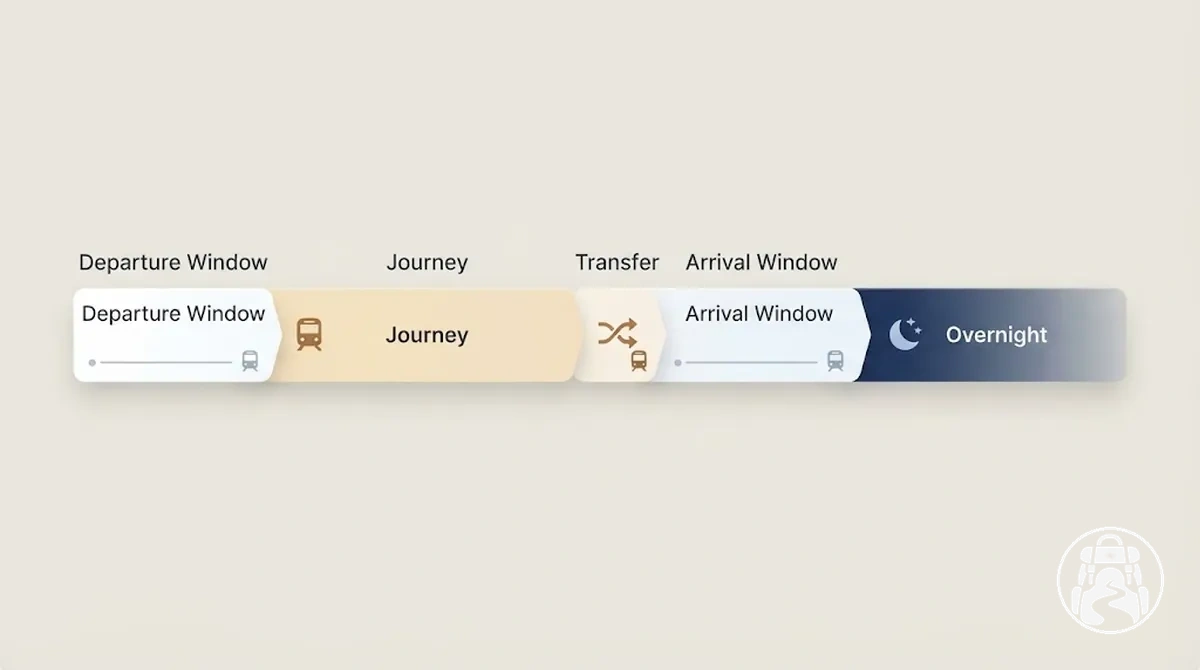
Fixed timing constraints can rule out an otherwise available service, while tolerable timing preferences may leave room for an early departure, late arrival, or overnight service.
Departure, transfer, journey, and arrival timing should therefore be evaluated together rather than against a universal journey-time limit.
Use these criteria to determine whether the schedule fits the transport leg:
- Departure window: Set the earliest practical departure and any latest acceptable departure; a service outside a fixed departure window does not fit the travel day.
- Transfer window: Check whether each scheduled connection leaves a workable transfer window for the itinerary; additional waiting or tightly timed transfers can increase the travel-day burden.
- Total journey time: Compare the complete scheduled journey with the time available for that travel day rather than applying one universal maximum duration.
- Arrival window: Set the latest acceptable arrival around onward plans; a late arrival may be workable when nothing time-sensitive follows but unsuitable when the itinerary requires an earlier arrival.
- Early, late, or overnight timing: Treat an early departure, late arrival, or overnight service as condition-specific because its suitability depends on how it affects the surrounding day; the same timetable can fit one itinerary and fail another when those timing constraints differ.
Compare Transport Modes for Each Leg
Compare transport modes for the same leg using the same criteria rather than judging train, bus, flight, or shuttle by reputation.
The comparison graphic shows the main mode categories alongside time, transfers, flexibility, and frequency without ranking one mode above another.
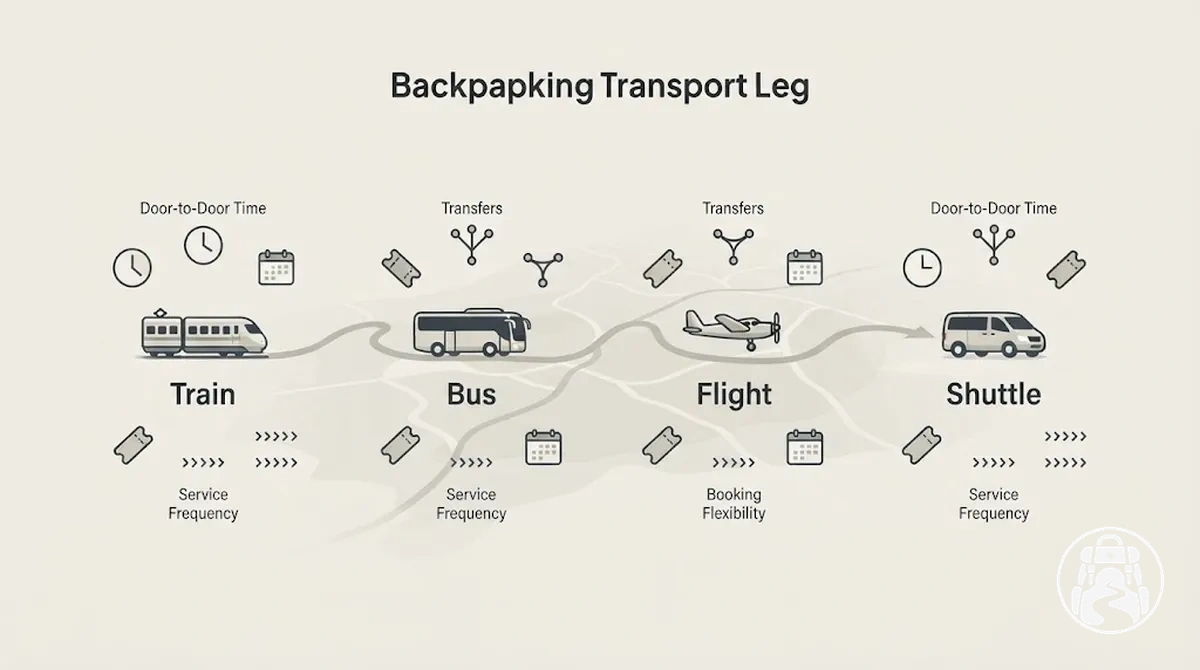
Only compare a mode when a service actually connects the required origin and destination.
For each viable option, assess door-to-door time, transfers, fare and booking conditions, service frequency, booking flexibility, route coverage, and comfort using the same leg-specific basis.
| Option | Door-to-Door Time | Transfers | Fare and Booking Conditions | Service Frequency | Route Coverage | Comfort | Suitable Context |
|---|---|---|---|---|---|---|---|
| Train | Include station access, waiting, rail travel, and onward movement. | Direct or involving rail interchanges, depending on the service. | Check the fare plus change, refund, and fixed-departure conditions. | Use the actual timetable to identify workable departures. | Relevant only where rail services connect the required endpoints. | Assess seating, space, facilities, and the burden of any interchanges. | Suitable when the rail service fits the required endpoints, timing, transfers, and booking conditions. |
| Bus | Include terminal access, waiting, road travel, and onward movement. | Direct or involving an interchange, depending on the route. | Check the fare plus change, refund, and departure conditions. | Use scheduled departures to judge availability and alternatives. | Relevant only where scheduled road services connect the required endpoints. | Assess seating, facilities, journey length, stops, and transfer burden. | Suitable when the road service, stop locations, schedule, and booking conditions fit the leg. |
| Flight | Include airport access, pre-departure processing, flight time, arrival processing, and onward ground travel. | Direct or connecting, plus any ground transfers to and from airports. | Check the fare plus change, refund, baggage, and flight-specific conditions. | Use the actual flight schedule to identify workable departures. | Relevant only where suitable airports and scheduled flights serve the leg. | Assess the complete airport process, seating conditions, and any connection burden. | Suitable when the complete airport journey, schedule, transfers, and booking conditions fit the leg. |
| Shuttle | Include pickup access, road travel, intermediate stops, and movement from the drop-off point. | Direct or involving shared pickups, drop-offs, or another transfer. | Check the fare plus change and cancellation conditions. | Confirm that departures are available when the leg is required. | Relevant only where the shuttle operates between the required locations. | Assess vehicle space, shared occupancy, stops, and journey conditions. | Suitable when pickup, drop-off, timing, transfers, and booking flexibility match the leg. |
No transport mode is preferable for every leg.
The suitable option is the one whose trade-offs in time, transfers, fare conditions, service frequency, route coverage, booking flexibility, and comfort best match the constraints of that specific journey.
Compare Door-to-Door Journey Time and Transfers
Scheduled travel time is only one part of door-to-door journey time.
The practical total also includes access time before departure, waiting time or check-in where applicable, transfer time, and the arrival logistics needed to reach the next usable location.
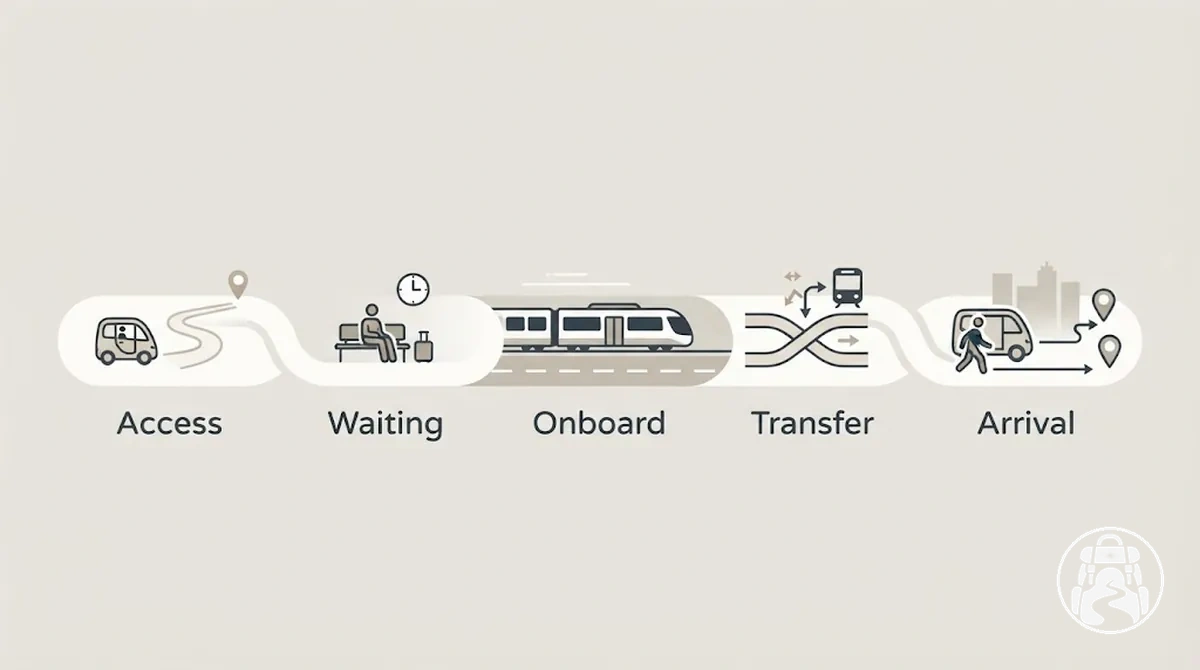
Door-to-door time should therefore be compared as the full physical journey rather than as onboard time alone.
The duration of each component varies by service and location, so break the total practical journey into these stages before comparing options:
- Access time: Include the time needed to reach the departure point, including any local transfer required before the main service begins.
- Waiting time and check-in: Include waiting before boarding and any check-in or pre-departure process required by the service.
- Onboard time: Use the scheduled time spent on the main train, bus, flight, shuttle, or other service as one component rather than the complete journey.
- Transfer time: Include time spent changing services and waiting at an interchange when the journey requires a connection.
- Arrival logistics: Include the time needed to leave the arrival station, terminal, or airport and continue to the next usable location. An option with a longer scheduled duration can therefore have a similar or shorter door-to-door time when another option adds more access, waiting, or transfer overhead.
Compare Fare Cost and Booking Flexibility
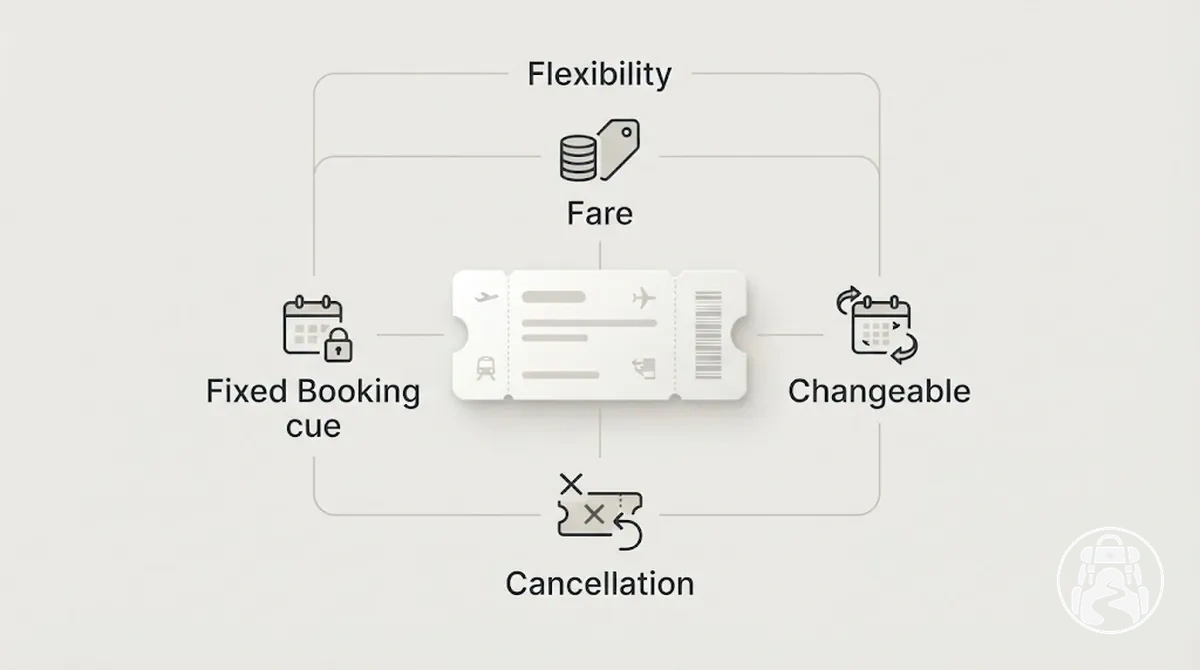
A lower fare and greater booking flexibility are separate attributes, so the lowest displayed fare is not automatically the most suitable option for a transport leg.
Compare the fare and any booking fee with the change condition, refund condition, cancellation rules, and commitment attached to a fixed departure.
Compare Route Coverage and Service Frequency
A transport mode is useful for the current leg only if its route coverage connects the required origin and destination at workable times.
A direct connection may simplify the journey, while an indirect connection can still be feasible when the required transfer and departure pattern fit the leg.
Service frequency affects both immediate feasibility and the options available if plans change.
More usable departures within the required time window can provide an alternative service and a practical recovery option, while low frequency reduces flexibility and can make a missed service more consequential.
Evaluate coverage and frequency together using these criteria:
- Route existence: Confirm whether the mode provides a direct connection between the required origin and destination or an indirect connection that requires a transfer.
- Service frequency: Check the timetable for the relevant date and identify which departures fall within the required travel window rather than assuming frequent service from the mode's general presence.
- Alternative departures: Determine whether another usable departure exists if the preferred service is unavailable or no longer fits the plan; the practical value of an alternative depends on its timing and connection requirements.
- Recovery options: Assess whether a later alternative service could still complete the leg if the intended departure is missed. Broad route coverage with few departures can offer less flexibility than frequent service with an additional transfer, while frequent departures do not compensate for a connection that fails to reach the required destination.
Consider Comfort on Longer Journeys
Comfort becomes more decision-relevant as journey duration and physical burden increase, but it remains secondary when feasibility, timing, or connection reliability determines whether the leg works at all.
Plan Realistic Connection Times Between Services
A realistic connection time combines the transfer work required between services with contingency for uncertainty and the available recovery options if the onward service is missed.
There is no universal connection buffer that is appropriate for every station, terminal, mode, or ticketing arrangement.
- Identify the scheduled arrival: Record when the incoming service is scheduled to arrive and when the onward service is scheduled to depart. The difference establishes the available connection window before transfer work or contingency is considered.
- Determine the transfer work: Account for the actions needed to move from the arriving service to the onward service, such as leaving the arrival point, reaching the next boarding location, completing any required boarding process, and managing luggage. More transfer work requires a larger share of the connection window.
- Assess reliability and uncertainty: Consider whether the incoming service may arrive later than scheduled and whether the transfer process itself has uncertain timing. Add a buffer that reflects those conditions rather than assuming timetable punctuality or applying one fixed allowance to every connection.
- Check service frequency and recovery options: Determine when the next usable departure operates if the planned onward service is missed. Higher service frequency can provide a practical recovery option, while a long wait for the next departure increases the consequence of a missed connection and may justify a more conservative buffer.
- Verify the complete connection: Confirm that the scheduled arrival, transfer work, contingency buffer, and onward departure form a connection window that is workable under the expected conditions. The connection should also leave the remaining journey compatible with the planned travel day.
Use the connection only if the resulting window remains workable and the onward journey still fits the travel day; otherwise, choose a different onward service or connection window rather than reducing the buffer simply to make the timetable fit.
Allow Time for Station and Terminal Changes
A station change or terminal change adds transfer tasks that may not appear in the headline timetable, so the connection window must account for the actual movement required between services.
A simple platform change can involve less transfer work than moving between separate buildings, stations, or terminals.
Verify the physical tasks before judging whether the connection is workable.
Walking time, a local transfer, another boarding process, and navigation through an unfamiliar interchange can each add time or uncertainty depending on the location and service arrangement.
- Platform change: Check whether the traveller must walk between platforms, use stairs, lifts, passageways, or another internal route; the required movement reduces the time available for the onward service.
- Terminal change: Confirm whether the connection requires movement between different terminal buildings or sections; a more complex terminal transfer can require a larger connection window than remaining in the same area.
- Station change or local transfer: Verify whether the traveller must leave one station and reach another by walking or local transport; this adds an external transfer task whose duration depends on the actual route and conditions.
- Boarding process: Check whether the onward service requires another check-in, security, ticket validation, boarding queue, or other pre-departure process; any required step must fit inside the connection window.
- Interchange navigation: Consider whether an unfamiliar interchange, unclear platform location, or complex route through the facility could increase walking or navigation time; where these tasks are more demanding, allow a larger buffer rather than assuming the nominal transfer interval is sufficient.
Add Buffers Between Separate Services
Separate services need a buffer based on uncertainty and recovery options rather than one fixed number, particularly when a missed connection may not be automatically protected under the booking arrangement.
The appropriate contingency time depends on how likely delay or variation is and how serious a missed connection would be for the onward service.
Assess transfer complexity, expected variability, onward-service frequency, the availability of a later departure, and the practical consequence of missing the connection.
Keep physical transfer time separate from the extra buffer added for uncertainty, then adjust that contingency according to these conditions:
- Transfer complexity: When the connection involves more steps or coordination, allow a larger buffer because greater complexity creates more opportunities for the transfer to take longer than expected.
- Variability: Increase contingency time when the incoming service or connection process has greater timing uncertainty; where timing is more predictable, a smaller buffer may be reasonable if other conditions remain favourable.
- Onward-service frequency: A frequent onward service can reduce the consequence of a missed connection when another usable departure follows soon enough to preserve the travel plan.
- Later departure availability: If few later departures exist, or the planned service is the last practical option of the day, use a more conservative buffer because the available recovery option is weaker.
- Missed-connection consequence: Consider the travel-day cost of failure as well as the benefit of extra contingency time. A recoverable connection with frequent alternatives may justify less buffer than a scarce onward service whose loss would materially disrupt the journey, while an excessively large buffer can also consume useful travel time.
Decide How Far Ahead to Book Each Transport Leg
Booking lead time for a transport leg should depend on reservation rules, scarcity, available alternatives, and travel-date certainty rather than one universal schedule.
A leg with limited capacity or few substitutes may justify earlier commitment, while a leg with frequent alternatives and an uncertain travel date may be better left flexible.
Assess the reservation requirement, capacity, service frequency, availability, flexibility, and any stated fare behaviour for the specific service.
The value of booking earlier increases when losing the preferred departure would materially disrupt the trip, but waiting can preserve flexibility when the travel date is not fixed and alternative departures remain practical.
Use the following sequence to decide when the leg should become fixed:
- Reservation requirement: If the service requires an advance reservation or restricts when reservations can be made, use those rules to define the practical booking window; if no reservation is required, continue to the scarcity check before committing.
- Capacity and scarcity: Assess whether capacity is limited for the required service and date. Where limited capacity makes the preferred departure more vulnerable to becoming unavailable, earlier commitment can be justified; where meaningful capacity constraints are not established, scarcity alone should not be assumed.
- Service frequency and alternatives: Check whether another suitable alternative departure exists within the required travel window. Frequent usable alternatives support greater flexibility, while few practical departures increase the consequence of waiting.
- Travel-date certainty: If the travel date is fixed, an advance reservation can support itinerary certainty when the preferred service matters. If the date may still change, keeping the leg open can preserve flexibility unless reservation rules or scarcity create a stronger reason to commit.
- Consequence of unavailability: Consider what happens if the preferred departure is no longer available. Fix the leg earlier when losing it would leave no practical alternative or materially disrupt the itinerary; allow the booking to remain open when another acceptable service can still complete the leg without significant consequence.
The appropriate booking timing is service-specific: commit earlier when reservation constraints, limited capacity, few alternatives, a fixed travel date, and a high consequence of unavailability combine; otherwise, the leg can remain flexible until those conditions change.
Book Limited or Reservation-Required Services Earlier
Earlier booking is more justified when a reservation is required, capacity is limited, departures are scarce, the travel date is fixed, or losing the preferred service would have a significant consequence.
These conditions increase the risk that waiting could remove a workable transport option, but they do not mean that earlier booking is always cheaper or guarantees availability.
Reservation rules define when a booking can be made, while limited capacity and few alternatives make availability more consequential.
A fixed travel date also reduces flexibility because another day may not be practical if the preferred departure becomes unavailable.
- Reservation required: If the service requires an advance reservation, plan the booking within its stated booking window rather than assuming the place can be secured at departure.
- Limited capacity: When capacity is constrained for the required service or date, earlier booking can reduce the risk of losing that specific workable option.
- Scarce departure: If only a few viable departures fit the leg, the loss of one departure leaves fewer alternatives and supports earlier commitment.
- Fixed travel date: When the travel date cannot move, waiting carries a greater availability risk because shifting the journey to another date may not be suitable.
- High consequence of unavailability: If losing the preferred service would leave no practical alternative or materially disrupt the itinerary, earlier booking is more justified. In every case, “earlier” means earlier within the actual service booking window and according to its current availability conditions, not a universal advance period.
Keep Frequent Services Flexible When Availability Allows
Frequent services can remain flexible only when service frequency, alternative departures, and expected availability make waiting to book an acceptable risk.
High frequency alone does not guarantee capacity or availability, so flexible booking should depend on the actual conditions for that transport leg.
Assess how many workable departures exist, whether capacity appears constrained, how certain the schedule and travel date are, and what would happen if the preferred service became unavailable.
These conditions determine whether deferring commitment preserves useful itinerary flexibility or increases the risk of losing a workable option.
- Service frequency: Frequent departures support flexibility when several services fall within the usable travel window; limited frequency makes waiting to book more consequential.
- Alternative departure: If another suitable departure can complete the same leg without materially disrupting the itinerary, keeping the booking open carries less practical risk.
- Availability and capacity: Flexible booking is more suitable when current availability remains workable and there is no clear capacity constraint; signs of limited capacity increase the risk of waiting to book.
- Schedule certainty: When the travel date or departure time may still change, a changeable booking or deferred commitment can preserve flexibility; when the schedule is fixed, that benefit is smaller.
- Consequence of waiting: Leave the leg open only when losing the preferred departure would still leave a practical recovery option. If waiting could remove the last workable service or leave few alternatives, earlier commitment becomes more appropriate.
A high-frequency leg with several usable alternatives can often remain flexible when availability allows, while a scarce service with few recovery options carries a greater consequence if booking is delayed.
Common Backpacking Transport Planning Mistakes
Backpacking transport plans become fragile when hidden journey time, connection risk, availability, or booking conditions are ignored.
These planning mistakes can reduce feasibility, create unrealistic timing, limit flexibility, or increase the consequence of disruption.
Recognize each transport mistake by checking whether the plan relies on headline travel time alone, omits a known station transfer, uses a tight connection without enough contingency, assumes service frequency without checking departures, or creates unnecessary booking rigidity.
The table links each recognition cue to its likely consequence and corrective action.
| Mistake | Consequence | Recognition Cue | Corrective Direction |
|---|---|---|---|
| Comparing only headline travel time | Hidden access, waiting, transfer, or arrival time can make the practical journey longer than the headline duration suggests. | The comparison uses onboard or scheduled travel time but excludes other journey stages. | Compare complete door-to-door journey time rather than headline travel time alone. |
| Ignoring a station transfer or terminal change | Required movement between platforms, buildings, stations, or terminals can reduce the usable connection window. | The itinerary shows consecutive services but does not account for the known station transfer or terminal movement between them. | Verify the physical transfer task and include its time implication before accepting the connection. |
| Planning an unrealistically tight connection | Small delays or transfer variability can increase the risk of a missed service and reduce recovery options. | The connection window leaves little contingency beyond the expected transfer work. | Add a buffer that reflects uncertainty, transfer complexity, and the consequence of a missed connection. |
| Assuming service frequency or availability | Few usable departures can leave no suitable alternative if the intended service is unavailable or missed. | The plan assumes another departure will be available without checking the timetable for the relevant date and route. | Verify actual service frequency, availability, and the next practical recovery option. |
| Using the wrong balance of booking rigidity and flexibility | Overcommitting can reduce useful flexibility, while waiting too long can increase availability risk for constrained services. | The booking conditions do not match the certainty of the travel date, capacity constraints, or availability of alternative departures. | Match booking rigidity and flexibility to reservation requirements, scarcity, alternatives, and date certainty. |
Correct these errors by applying the same leg-specific planning principles already used for journey time, transfers, connections, service frequency, and booking conditions rather than relying on assumptions about how the transport leg should work.