
International Backpacking Travel Packing Checklist
Pack for international backpacking by matching every item to a necessary trip function and the conditions that make it useful. Use laundry access, drying time and realistic rewear to set clothing quantity; add climate-, activity- or personal-need items only when those conditions apply, and remove duplicates that add weight or bulk without a distinct function.
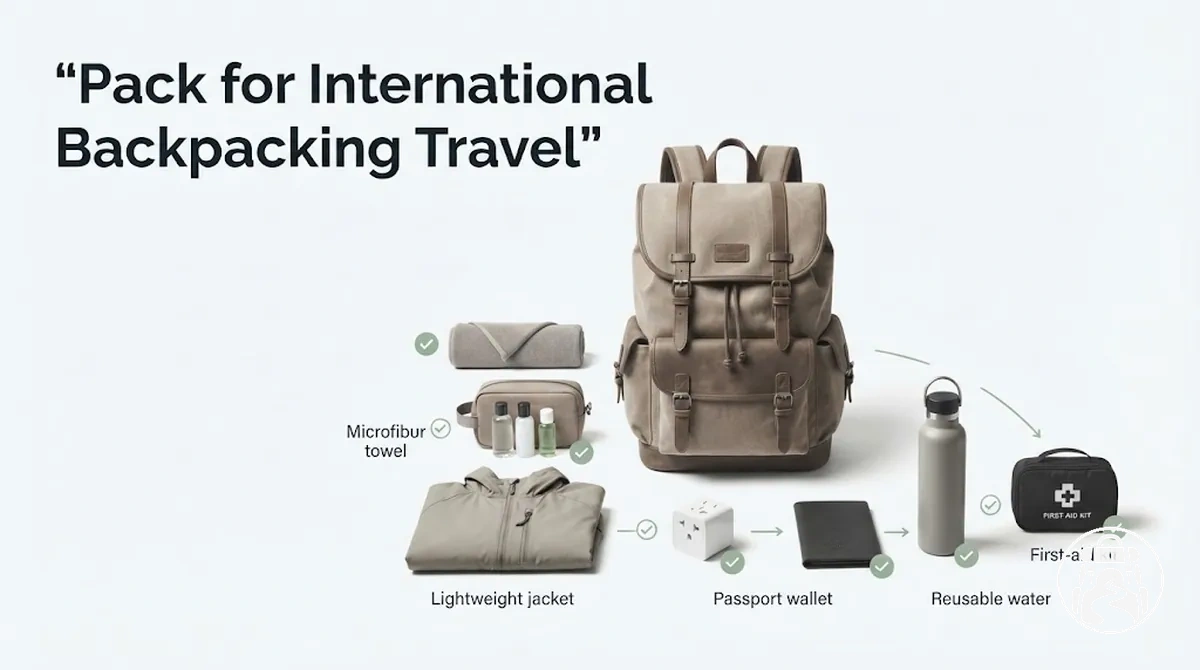
Backpacking packing decision filter
Run each item through the same four checks before it earns backpack space. The result should be a pack that covers real trip functions without carrying duplicate capability.
-
FunctionWhat necessary or repeatedly useful job does the item perform?
-
ConditionIs that need created by the itinerary, climate, activity, personal needs, laundry or resupply gap, or equipment compatibility?
-
CoverageIs the same function already adequately covered by another packed item?
-
Carry costDoes likely use justify the item's weight, bulk, charging burden or organisation complexity?
- Clothing quantity
- Cover the realistic interval between washes, including drying time, then adjust for acceptable rewear, climate and activity.
- Layering
- Use modular base, mid and outer functions; add insulation or weather protection only when expected conditions require them.
- Backpack space
- Compression can reduce volume, not weight. An item still has to justify being carried even when it fits.
Table of Contents
What to Pack for International Backpacking Travel
A practical international backpacking packing list should first secure trip-access essentials such as valid identity and entry documents, usable payment access, and necessary medication, then cover four reusable-kit functions: clothing and footwear, toiletries and personal care, essential electronics and charging, and organisation items.
Optional items should earn backpack space by serving a real trip function under the expected climate, activities, personal routine, or travel conditions.
The image below illustrates representative reusable packing items; it does not define a complete trip-access checklist or exact quantities.
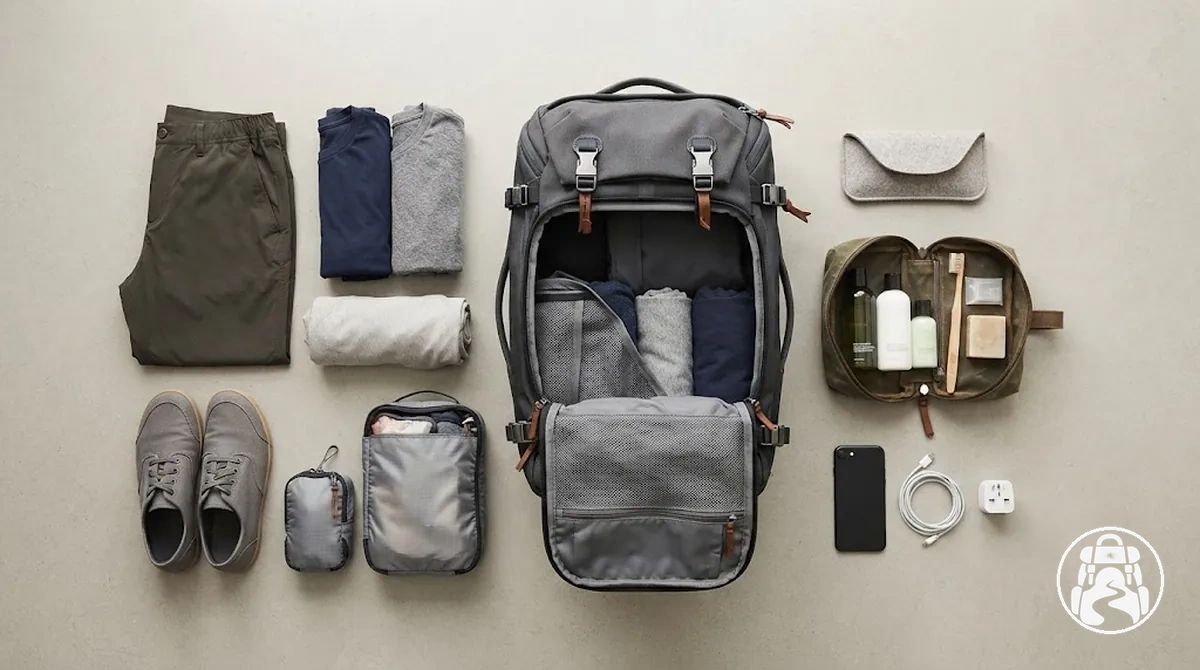
Treat an item as essential when it performs a necessary trip function or protects another necessary function; treat it as conditional when its usefulness depends on climate, activity, personal routine, or availability during travel.
For each category, check the function first, then the condition that creates the need, and finally whether carrying the item adds useful coverage or unnecessary duplication.
This checklist verifies functional coverage rather than providing a complete item inventory.
- Travel documents and payment access: carry the valid identity and entry documents required for the route, plus payment access that works for the trip; verify destination-specific entry requirements before departure rather than assuming one rule applies everywhere.
- Health and medication: carry necessary prescription or routine medicines in the amount needed for the planned travel period and any documentation required to transport them; storage, border and carrier rules can vary by route and jurisdiction.
- Clothing and footwear: cover everyday wear, walking, comfort, and weather protection appropriate to the expected climate and activities; leave out pieces that duplicate the same use without serving a different condition.
- Toiletries and personal care: cover the hygiene and routine functions required during the trip; routine consumables can remain conditional when suitable refill or resupply is realistically available.
- Electronics and charging: carry devices and charging equipment that support necessary functions such as communication, navigation, documentation, or required work; leave out electronics that mainly duplicate functions already covered by another device.
- Organisation items: use organisers when they improve containment, access, separation, or protection inside the backpack; leave them out when they add bulk or complexity without solving a specific packing problem.
Clothing and Footwear
Clothing and footwear for international backpacking are functional components selected according to how and where they will be used, rather than by fashion category.
Each garment or pair of shoes should cover a practical need created by the expected activity, climate, or daily routine.
Activity and climate determine the functions clothing must cover, while comfort, drying behaviour, repeat wear, and versatility determine how well each piece works across the trip.
The illustration groups representative clothing and footwear by travel function and condition rather than implying fixed quantities.
Favour versatile garments and footwear that cover distinct needs instead of duplicating the same role.
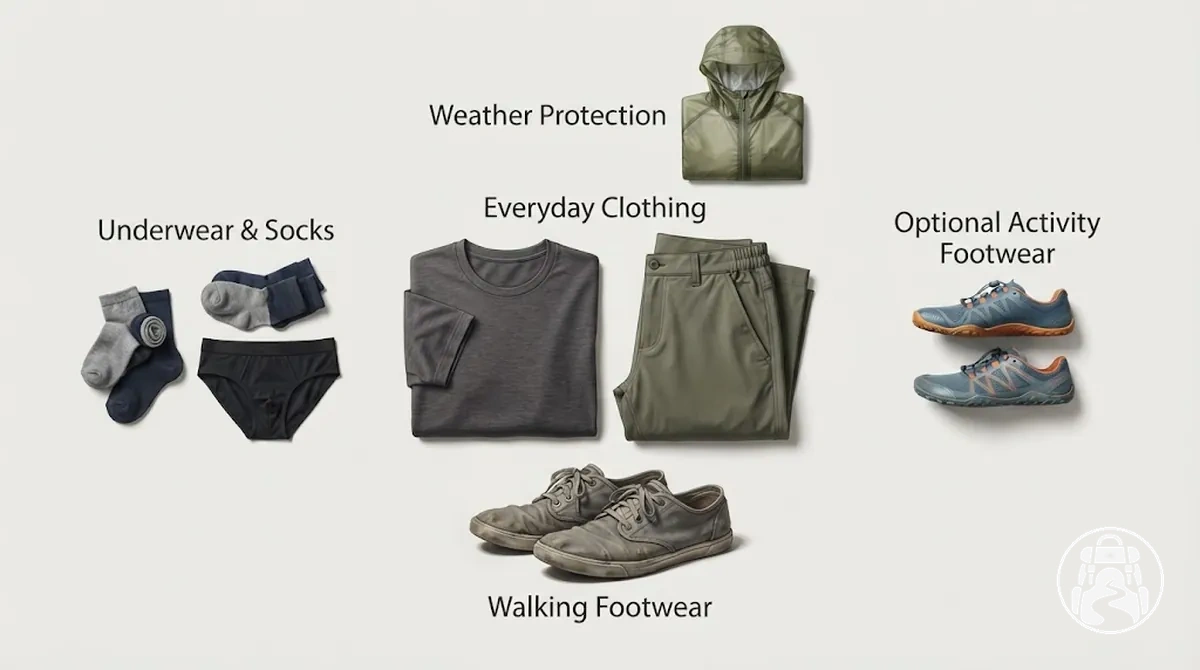
- Everyday tops: cover regular travel and casual activity; prioritise pieces that remain comfortable during repeat wear and suit the expected climate, with drying behaviour affecting how quickly they can return to use after washing.
- Everyday bottoms: support routine walking, transit, and daily activities; they are more useful when comfortable across several situations rather than limited to one narrow purpose.
- Underwear and socks: support hygiene and comfort during frequent use; repeat wear, washing opportunities, and drying behaviour determine how they fit into the clothing rotation.
- Sleep or recovery clothing: becomes relevant when separate clothing improves comfort, warmth, or separation from frequently worn daytime garments; it can be left out when existing clothing performs the same function appropriately.
- Weather protection: earns space when the expected climate creates a need for protection from rain, wind, cold, or strong sun; protection that does not match realistic trip conditions adds unnecessary bulk.
- Practical footwear: should support the main walking and daily activity demands of the trip with suitable comfort and versatility. A second activity-specific pair is justified only when it performs a genuinely different function that everyday footwear cannot reasonably cover.
Toiletries and Personal Care
Toiletries and personal-care items for international backpacking should cover the hygiene and daily routine functions that are actually needed during the trip, rather than reproduce full household quantities.
Each item should have a trip-specific need based on its function and expected frequency of use.
Items needed from the start should cover functions required before a realistic replacement opportunity, while routine consumables can be refilled or resupplied when suitable replacements are realistically available.
Container size should match expected use and practical transport constraints, which can differ by carrier, route, and jurisdiction.
The image demonstrates compact coverage of routine hygiene functions while leaving exact quantities conditional on personal use and resupply conditions.
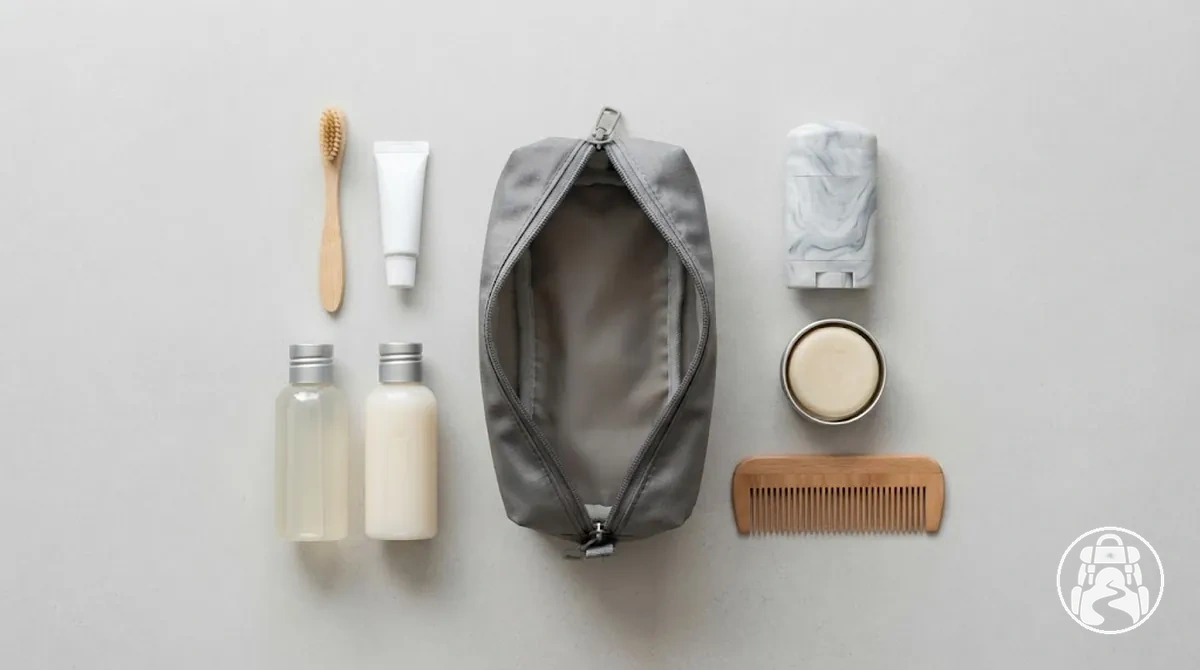
- Oral hygiene: carry the toothbrush, toothpaste, or other routine items needed to maintain normal oral-care functions; consumable quantity should reflect frequency of use and whether replacement is realistically available before it runs out.
- Washing and body care: carry the soap, cleanser, deodorant, or equivalent routine products actually used for hygiene; smaller containers can reduce bulk when their capacity covers the expected interval before a reliable refill or resupply opportunity.
- Hair care: include shampoo, conditioner, or other routine items only when they serve a personal need during the trip; carried quantity can be reduced when suitable resupply is expected, but should not rely on availability that has not been checked.
- Personal routine and grooming: include items tied to an established daily routine or trip-specific need, while leaving out duplicate or rarely used products that do not protect an essential function.
- Refillable consumables: use refill or replacement planning for products that are consumed gradually, while keeping transport constraints and container size specific to the journey. For example, decanting a routinely used cleanser into a smaller refillable container can reduce bulk when the carried amount still covers use until the next realistic resupply point.
Electronics and Charging Essentials
Electronics and charging essentials for international backpacking should be selected by device function: communication, navigation, documentation, necessary work, and charging continuity.
A device earns backpack space when it performs one of those functions without adding unnecessary duplication or charging burden.
Evaluate each device by redundancy, compatibility with its charger, cable, and any required adapter, expected charging frequency, and weight.
Check each charger's input-voltage rating and the destination's plug or socket type before departure. A plug adapter changes physical connector compatibility; it does not convert voltage, so equipment that does not support the local supply may require an appropriate voltage converter or transformer.
The image shows a compact setup so device functions, charging dependencies, and redundancy can be checked visually.
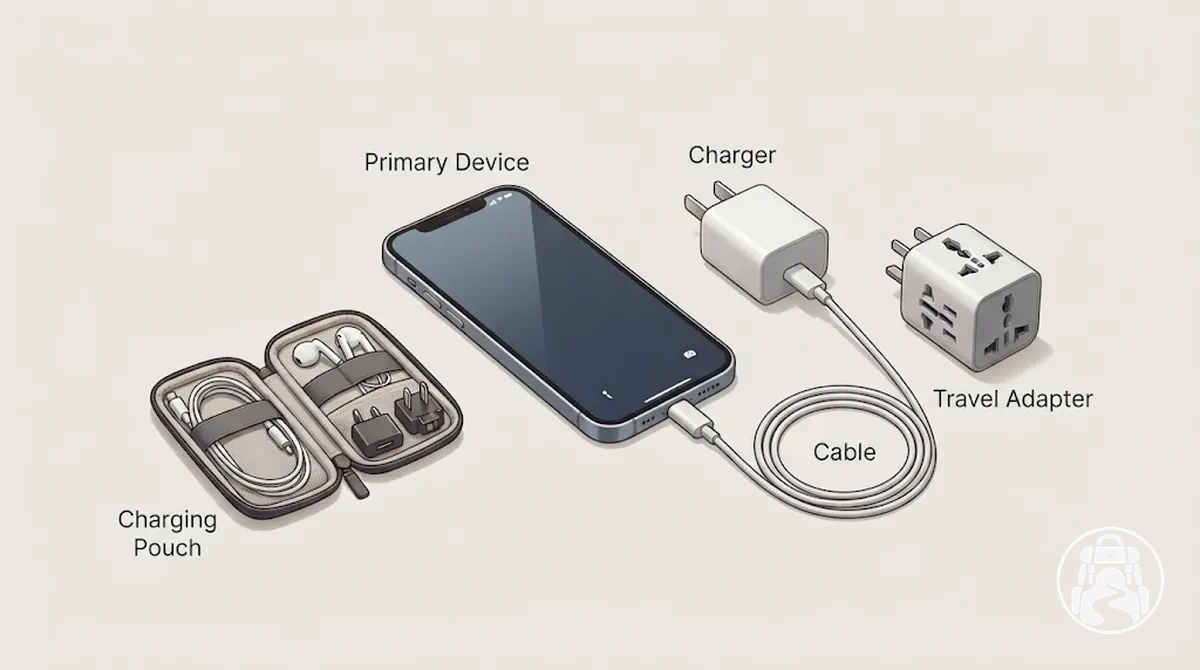
- Device function: identify whether each electronic item supports communication, navigation, documentation, necessary work, or another defined travel function; leave it out when the same function is already adequately covered.
- Charging dependency: check which charger and cable each device requires and whether those accessories support the planned charging routine; a device that needs separate charging gear adds both weight and another dependency.
- Adapter and compatibility: carry an adapter when the trip conditions require one, but verify compatibility for the specific destination and equipment rather than assuming that one adapter or charging setup works everywhere.
- Charging frequency: consider how often the device is expected to need power and whether the planned access to charging can support that frequency; devices requiring frequent charging create a greater power-continuity burden.
- Weight and redundancy: compare the function gained with the combined weight of the device and its charging gear. One multi-function device can reduce duplicated functions when it already covers the required tasks, while a second device is more defensible when it provides a genuinely different necessary function.
Packing and Organisation Items
Packing and organisation items are useful when they improve containment, separation, weather protection, or access inside a backpack.
Packing cubes, pouches, compression or stuff sacks, and protective bags are optional components that should be carried only when they solve one of those specific organisation problems.
Each organiser should provide a clear benefit in access, separation, protection, or volume control that justifies its added weight and complexity.
Compression can reduce the volume occupied by compressible items, but it does not reduce their actual weight or make unnecessary items more necessary.
The image shows how a small number of organisers can separate existing essentials and keep frequently used or protected items accessible without turning organisation into extra gear.
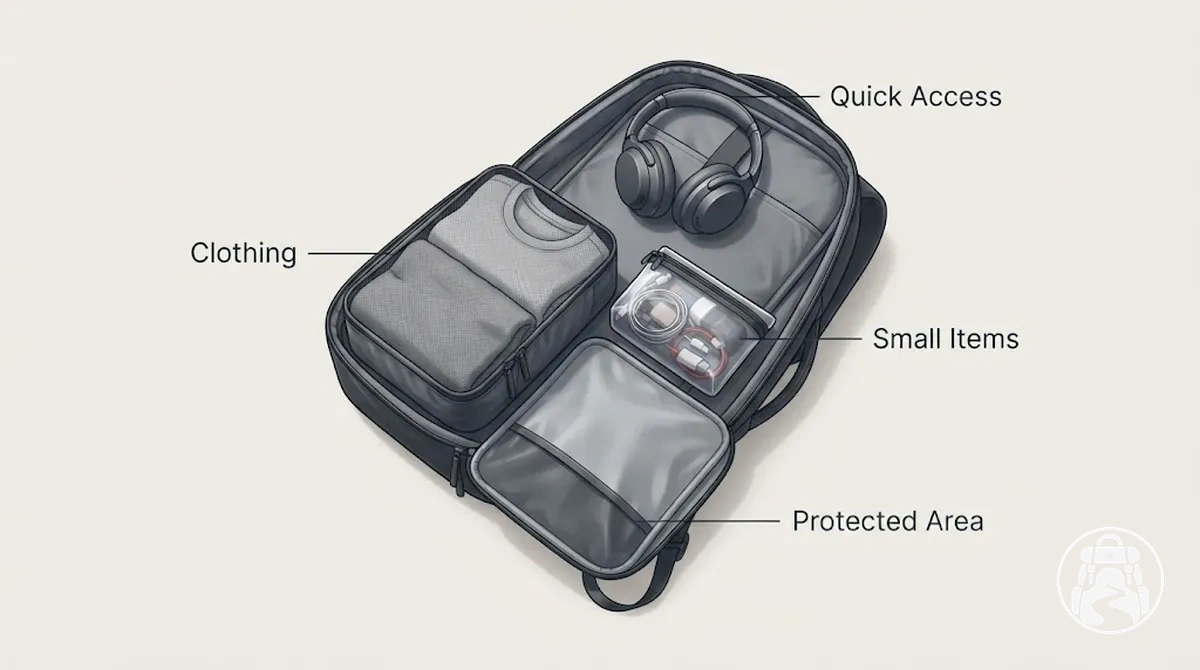
- Packing cubes: provide containment for clothing or similar items and can make categories easier to locate inside the backpack; they are useful when improved access and separation justify the extra organiser and its weight.
- Pouches: keep small related items together so they are easier to find and less likely to become scattered; extra pouches add complexity when they create more categories than the traveller needs.
- Compression or stuff sacks: can reduce the volume or bulk of compressible contents when backpack space is constrained, but the contents retain their weight and should still justify being carried.
- Protective bags: provide separation or weather protection when an item needs to stay isolated from moisture, dirt, or other pack contents; they are unnecessary when the backpack or another existing container already provides sufficient protection.
- Access-based organisation: place frequently used items where they can be reached without unpacking unrelated contents. For example, separating a damp garment from dry clothing or keeping a regularly used small item near the pack opening solves a specific access or separation problem rather than adding an organiser by default.
Plan Clothing Quantities Around Rewear and Laundry
Clothing quantity should follow the practical wash-and-rewear cycle more than the total number of travel days.
Plan enough of each clothing category to cover the realistic interval between washes, including the time garments need to dry and return to the clothing rotation.
The main planning variables are laundry access, wash interval, drying time, climate, activity, comfort, and trip duration.
Reliable laundry access can shorten the period the rotation must cover, while slow drying can keep washed garments unavailable for longer.
Climate and activity affect how comfortable or practical rewear is, so the same garment may remain usable for different intervals under different conditions.
The illustration shows how a small clothing rotation moves through wear, washing, drying, and reuse rather than assigning a separate outfit to every travel day.
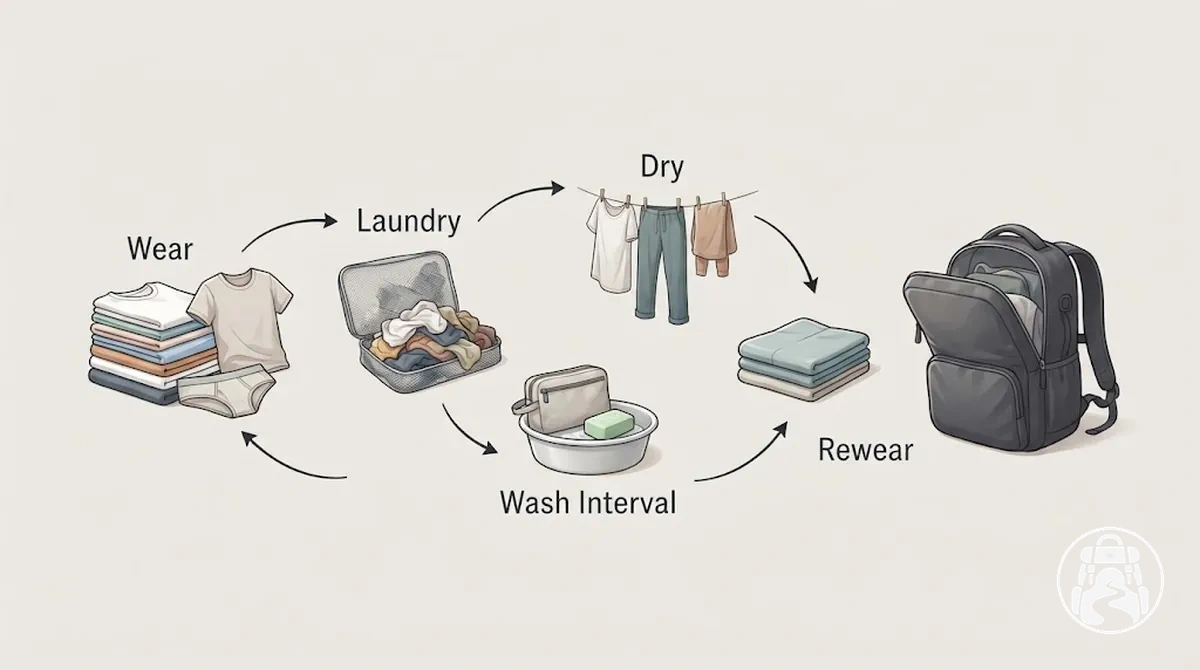
These variables determine the minimum practical quantity by changing how much clothing must remain available while other garments are being worn, washed, or dried.
For the same trip duration, reliable frequent laundry can support a smaller clothing rotation, while infrequent laundry can require a larger buffer because more clothing must remain usable between washes.
The wash interval is the practical bridge between total trip duration and clothing quantity.
- Laundry access and wash interval: frequent, reliable laundry access tends to reduce the clothing buffer because garments can re-enter the rotation sooner; infrequent or uncertain access increases the practical quantity needed to cover the longer interval between washes.
- Drying time: garments that dry slowly under the expected conditions remain outside the usable rotation for longer and can increase the required buffer. Faster drying can support a smaller rotation when washing opportunities are otherwise reliable.
- Rewear: clothing that remains comfortable and suitable for repeated use before washing can reduce the amount needed in rotation. Rewear should remain conditional on the garment, activity, climate, hygiene needs, and personal comfort rather than treated as a fixed number of uses.
- Climate: conditions that make clothing damp, dirty, or uncomfortable sooner can shorten realistic rewear intervals and increase the buffer; conditions that allow comfortable repeated use may leave the rotation smaller.
- Activity and comfort: activities that soil clothing quickly or make repeated wear uncomfortable can increase washing frequency and clothing need, while lower-impact routines may allow more reuse without changing the trip duration.
- Trip duration: a longer trip does not automatically require a proportionally larger clothing rotation when the same dependable wash-and-rewear cycle repeats. The wash interval is the practical bridge between total trip duration and clothing quantity.
How Much Clothing to Pack
Pack enough clothing to cover the realistic days between washes, plus any extra clothing class needed for the expected climate or activity mix.
The practical quantity should therefore follow laundry opportunities and acceptable rewear rather than the total trip length alone.
Common Packing Rules as Flexible Clothing Guidelines
Number-based packing rules such as 5-4-3-2-1, 3-3-3 and 3-5-7 are best treated as heuristics, not universal standards. Their labels are used inconsistently across packing advice, so confirm the version you intend to follow before mapping the numbers to garment categories or counts.
How Laundry Access Changes Clothing Quantity
Reliable, frequent laundry access usually allows a smaller clothing buffer because garments can return to the clothing rotation sooner.
Limited washing opportunities or long drying time usually require more spare clothing to cover the longer interval before reuse.
The practical effect depends on wash frequency, laundry availability, turnaround time, fabric drying behaviour, and how reliable each washing option is under the trip conditions.
Accommodation laundry, a laundromat, or hand washing can each create a laundry opportunity when that method is realistically available and returns clothing to use soon enough.
Slow drying or uncertain access can lengthen the effective wash interval even when washing itself is possible.
Use these conditions to judge whether laundry access genuinely supports a smaller clothing rotation.
- Wash frequency: more frequent realistic washing opportunities tend to reduce the buffer because repeated garments can be cleaned and reused sooner; longer gaps between washes increase the rotation needed to remain covered.
- Laundry reliability: dependable access can support carrying fewer repeated garments, while uncertain availability makes a larger buffer more practical because the planned wash may not occur when needed.
- Drying time: fast enough drying returns washed clothing to the rotation sooner, while slow drying keeps garments unavailable for longer and can increase the clothing buffer even when wash frequency is high.
- Turnaround time: accommodation laundry or a laundromat is useful for quantity planning only when the expected turnaround fits the clothing rotation; a longer return time means more garments must remain available while others are being cleaned.
- Method availability: hand washing can provide an additional laundry opportunity when suitable washing and drying conditions exist, but it should not be assumed to provide the same turnaround in every situation. For example, reliable washing that returns garments to use the same day can support a smaller rotation, while limited washing combined with slow drying calls for a larger buffer before garments can be reused.
Pack for Multiple Climates With a Layering System
A layering system uses adaptable garments in combinations so one wardrobe can respond to multiple climates without requiring a separate outfit set for every condition.
A base layer, mid layer, and outer layer can be worn separately or together as temperature and weather conditions change, making the clothing system modular rather than fixed.
The useful combination depends on temperature range, rain, wind, activity level, drying needs, and the bulk each garment adds to the backpack.
Colder or less active conditions can justify more insulation, while higher activity levels or warmer conditions can call for fewer layers or greater breathability.
Rain or wind exposure can make protective clothing more important, while limited drying opportunities favour a smaller set of versatile layers that can return to use reliably.
Choose garments for versatility across several conditions, but avoid adding so many overlapping layers that the system loses its packing advantage through unnecessary bulk.
For example, a trip that moves between a warm city, a cooler destination, and wet weather can use the same core clothing with different layer combinations rather than three separate wardrobes.
The traveller might use fewer layers in warm conditions, combine adaptable layers as temperature falls, and add suitable outer protection when rain or wind becomes relevant.
This condition-driven adjustment preserves versatility while keeping climate-specific additions limited to functions the trip actually requires.
Base, Mid, and Outer Layers
Base, mid, and outer layers perform different functions within the same layering system.
The table maps each layer to its primary function, useful garment properties, and the conditions that make that layer more or less important.
| Layer | Primary function | Useful garment properties | Relevant conditions |
|---|---|---|---|
| Base layer | Supports next-to-skin comfort and moisture management. | Comfortable against the skin and able to manage moisture and dry effectively for the expected activity. | More important when activity or conditions increase perspiration and next-to-skin comfort becomes a greater concern. |
| Mid layer | Adds insulation when extra warmth is needed. | Insulating properties with enough versatility to be added or removed as warmth needs change. | More important in cooler conditions or during lower activity levels; less important when temperature or activity already provides sufficient warmth. |
| Outer layer | Provides protection from wind or rain. | Protective garment properties matched to the expected wind and rain exposure while remaining practical over other layers. | More important when wind or rain creates a need for weather protection; less important when those conditions are absent. |
Layer combinations change with conditions rather than following a universal layer count.
For example, a traveller may add a mid layer as temperature falls, add an outer layer when wind or rain develops, or remove insulation as activity increases, adjusting the same clothing system without packing a separate outfit for each condition.
Adjust Layers for Hot, Cold, and Wet Conditions
Layer adjustment should change with the conditions rather than replacing the entire core wardrobe.
The comparison below keeps hot conditions, cold conditions, and wet conditions parallel by showing the clothing property that matters, the layer adjustment it suggests, and the resulting packing implication.
- Hot conditions: prioritise lightweight clothing and breathability, using fewer layers when extra insulation is unnecessary. The packing implication is to favour versatile garments that remain comfortable at a higher activity level without adding avoidable bulk, while retaining outer protection if rain is also possible.
- Cold conditions: prioritise insulation by adding an appropriate mid layer or combining layers when more warmth is required. The core wardrobe can remain the same, with the layer adjustment adding insulating capacity for colder or less active conditions without relying on an exact temperature cutoff.
- Wet conditions: prioritise outer protection from rain and clothing that can return to use after practical drying. Wet and cold conditions can overlap, so rain protection may need to work with added insulation rather than replacing it.
For example, one multi-climate route can use the same core wardrobe with lighter, more breathable combinations in warm weather, added insulation in colder conditions, and an outer layer when rain becomes relevant.
The wardrobe is modified by condition-specific layers rather than replaced with a separate clothing set for each climate.
Pack Light Without Removing High-Use Essentials
Packing light means reducing redundancy, weight, and bulk while preserving the functions provided by high-use essentials.
The goal is not to remove useful items indiscriminately, but to retain what is repeatedly needed and question what adds little functional value.
Start with a realistic carrying limit based on the backpack, trip conditions, expected transport, and what can be carried comfortably rather than a universal weight or carry-on target.
Use that limit as a review boundary, not as a reason to remove safety- or condition-critical items.
The sequence below reduces the pack by testing function before removal.
- Set the carrying limit: define the practical space and weight the trip can support, then identify where excess bulk is creating pressure. Adjust the limit to the journey rather than forcing every trip into the same target.
- Identify each item's function: state what each item does and how often that function is expected to be used. Retain high-use essentials and condition-critical items when their function is not adequately covered elsewhere.
- Check for redundancy: compare items that perform the same or closely overlapping functions and remove duplicate items when one item can provide sufficient coverage. Apply the same test to technology by checking whether multiple devices, cables, chargers, or accessories duplicate functions already covered.
- Test versatility: favour items that can serve several realistic trip situations without compromising a necessary function. For example, a pack containing separate single-purpose tops for casual wear and transit can become a smaller set of versatile garments when those garments adequately cover both uses, preserving the same travel functions with fewer pieces.
- Check reuse and drying: consider whether clothing can be reworn or returned to use after washing before adding more pieces to the rotation. Quick-drying garments can support reuse where that property suits the trip, but they should not replace clothing required for a different climate, activity, or protection need.
- Assess space and weight: review the remaining items by the bulk and weight they add relative to the function they provide. Scrutinise low-use or worst-case items especially closely when their purpose is speculative and another retained item already covers the realistic need.
- Verify essential coverage: check that communication, clothing, hygiene, charging, weather protection, activity-specific, and other necessary trip functions still have adequate coverage after removals. If a reduction creates an uncovered high-use or condition-critical function, retain or restore the item that provides it.
The final pack should be lighter because redundant or low-use bulk has been removed, not because essential functions have disappeared.
A successful review preserves high-use needs while making every remaining item's function, versatility, reuse value, and space or weight cost defensible.
Remove Duplicates and Low-Use Items
Remove duplicate and low-use items when their function is already covered or their expected use is too limited to justify the added weight or volume.
The audit should reduce redundancy without removing the capability provided by genuinely necessary items.
Evaluate each candidate by its unique function, realistic frequency of use, versatility, replaceability, climate relevance, and overlap with another packed item.
No single criterion decides removal by itself: an item with limited use may still need to stay when its function is necessary and not reliably covered or replaced.
Use the following questions to distinguish useful capability from redundant burden.
- Does it provide a unique function? Keep an item when it supplies a required capability that no other packed item adequately covers; reconsider it when its function is already duplicated.
- What is its expected frequency of use? High-frequency items have a stronger case for retention, while a low-use item deserves closer scrutiny when the need is unlikely and the consequence of leaving it out is minor.
- Does another item overlap with it? Compare items by function rather than appearance or category. When two items provide sufficient coverage for the same realistic need, carrying both can create redundant weight or bulk.
- Can a more versatile item cover the same need? Prefer versatility when one retained item can perform several realistic roles without weakening an essential function; do not remove specialised equipment when the trip genuinely requires that capability.
- Is practical replaceability reliable enough? An item can be a stronger removal candidate when a suitable replacement is realistically accessible if needed, but do not assume replacement availability. Identity, health, safety, or similarly critical items should not be removed solely because a replacement might exist.
- Does climate relevance justify keeping it? Retain weather-related items when expected conditions create a real protective need, even if their frequency of use may be low. For example, several similar tops with overlapping functions may be reduced to fewer versatile pieces that cover the same routine uses, while a distinct weather-protection garment remains because removing it would eliminate a required capability.
Manage Bulky Items and Backpack Space
Once the essential item set has been chosen, managing backpack space becomes a placement and volume-control task rather than another item-selection audit.
Review bulky items by their volume, compressibility, access frequency, and protection needs so the existing pack remains practical to use.
- Review the largest items first: identify which already-approved items occupy the most backpack space and whether their bulk can be managed through different placement. For example, a necessary bulky jacket may be worn during transit when practical or positioned where its shape uses available pack space efficiently.
- Position bulky garments and footwear deliberately: place large, less-compressible items where they fit without blocking frequently used items or damaging contents that need protection. Wearing a large travel garment can temporarily free volume when conditions and comfort make that practical, but it does not change the item's actual weight.
- Compress suitable soft items: use the compressibility of clothing or other soft contents to reduce packed volume when doing so does not compromise their function or protection needs. Compression can create more usable space, but it does not reduce the weight being carried.
- Group small related items: keep small items together when grouping improves organisation and prevents them from filling scattered gaps that make access harder. Use only as much organisation as needed to control placement, because an organiser changes containment rather than proving its contents are necessary.
- Prioritise access and protection: use access frequency to place frequently used items where they can be reached without unpacking unrelated contents, while keeping fragile, moisture-sensitive, or otherwise protected items secure. Verify the final placement by confirming that essential items remain accessible, protected, and stable within the available backpack space.
Reducing volume can make bulky items fit more efficiently, but it does not reduce their actual weight or carrying burden.
Efficient space management therefore changes placement and accessibility without turning unnecessary weight into necessary gear simply because it fits.
Packing Mistakes and What to Leave at Home
Packing mistakes usually create unnecessary weight, wasted space, redundancy, or poor readiness for the actual trip conditions.
Overpacking is easier to correct when each mistake is matched to its consequence, a recognition cue, and a corrective decision about what can reasonably be left at home.
| Mistake | Consequence | Recognition cue | Corrective direction |
|---|---|---|---|
| Too much duplicate clothing | Similar garments add bulk and unnecessary weight without adding a distinct travel function. | Several tops or bottoms cover the same situations, while planned laundry or repeat wear can return existing pieces to use. | Leave lower-value duplicates at home and retain fewer versatile pieces that still cover the expected climate, activities, and laundry interval. |
| Redundant footwear | Extra pairs can consume substantial backpack space while duplicating the same walking, casual, or activity function. | Two or more pairs are suitable for essentially the same expected use and no separate activity requires them. | Retain the footwear that covers the realistic functions and leave an overlapping pair at home unless it serves a distinct condition or activity. |
| Redundant electronics | Duplicate devices and their chargers or cables add weight, bulk, and charging dependencies. | One device already performs the communication, navigation, documentation, or work function of another packed device. | Remove overlapping technology when the remaining setup adequately preserves the required function and charging capability. |
| Full-size consumables | Large containers or excessive quantities use space that may exceed what the traveller expects to consume before a realistic refill or resupply opportunity. | The packed quantity substantially exceeds expected use, or the same routine product can reasonably be replenished during the trip. | Carry a quantity suited to expected use and verified resupply conditions rather than automatically packing full-size consumables. |
| Worst-case packing | Items for multiple unlikely scenarios accumulate into excess weight and redundancy. | An item has no clear expected use beyond a remote possibility, and another retained item already covers most of the same consequence. | Leave speculative low-use items at home when the realistic consequence is adequately covered, while retaining genuine health, safety, weather, or condition-critical items. |
| Ignoring actual climate or laundry conditions | The pack can become either unnecessarily large or poorly prepared for the conditions that will determine clothing use and reuse. | Clothing quantity or protection does not reflect expected climate, washing opportunities, drying time, or realistic rewear. | Adjust the clothing set to the expected weather and laundry cycle, removing pieces that duplicate functions while retaining the protection and rotation the trip actually requires. |
What should be left at home remains conditional on the itinerary, climate, personal needs, laundry access, and the functions each item must perform.
Destination- and carrier-specific restrictions should also be checked during pre-departure preparation, because an item that is useful in principle may still be subject to route-specific transport rules.