
International Backpacking Pre-Departure Checklist
International backpacking pre-departure readiness means confirming that your entry documents, fixed bookings, payment access, insurance and health information, baggage, offline travel details, and departure conditions are current and usable for your actual itinerary. Resolve any issue that could prevent legal entry, payment, transport, accommodation access, or departure before you leave; this is a final verification step, not a replacement for trip planning or packing.

International departure readiness check
Mark an area only after you have verified it for the actual traveller, itinerary, provider and current conditions. If an item does not apply to your trip, confirm that before marking the area complete.
0 of 6 areas marked verified. Leave any unresolved critical area unchecked until it is confirmed or confirmed not applicable.
Pre-departure readiness depends on the traveller, destinations, providers, and current circumstances.
Entry requirements, including passport-validity conditions, visa or travel authorisation rules, can vary by nationality, destination, and transit route; insurance terms, transport conditions, and health requirements can also vary by provider and current circumstances.
Final checks should therefore use current authoritative information and the latest relevant provider confirmations.
This page verifies whether the international trip is ready to depart; detailed gear selection and packing sit outside this pre-departure readiness scope.
The first eligibility question is whether the required travel documents and entry permissions are valid for the actual traveller and itinerary.
Table of Contents
Confirm Passport, Visa, and Entry Requirements
Departure readiness requires confirming that passport validity, any visa requirement or travel authorisation, and the applicable entry requirements match the traveller's nationality, destinations, and transit points on the actual itinerary.
Passport status, entry permission, and itinerary conditions are separate checks that combine to show whether the traveller's legal-document status is ready or still needs action.

- Passport: Confirm that the passport is current and satisfies the validity and document conditions that apply to each destination and transit point; if it does not, action is required before departure.
- Visa: Confirm whether a visa is required for the traveller's nationality, destination, and trip purpose, then verify whether the current status is valid, approved, pending, or action needed.
- Travel authorisation: Check whether a separate electronic or other travel authorisation applies and, when required, confirm that it is valid for the passport being used.
- Transit: Check every transit point for any separate visa, authorisation, or border-document condition that applies to the connection.
- Entry and exit conditions: Confirm any additional document conditions attached to entering or leaving each destination and resolve any requirement whose status is still uncertain.
Traveller-dependent factors include nationality and passport status, while itinerary-dependent factors include each destination and transit point, so one generic rule cannot establish eligibility for every trip.
Verify each current requirement against authoritative information for the relevant destination and traveller circumstances close to departure, especially where rules or provider conditions may change.
Legal-document readiness is established only when every applicable requirement has a clear current status and any required action has been identified.
Check Passport Validity and Visa Requirements
An unexpired passport alone does not establish entry readiness: the passport's expiry date and physical condition must satisfy the applicable validity requirement for each destination and transit point, and any required visa or electronic authorisation must have a current status that permits the planned journey.
The image highlights the passport fields, document condition, authorisation status, and route-dependent checks that need separate verification.
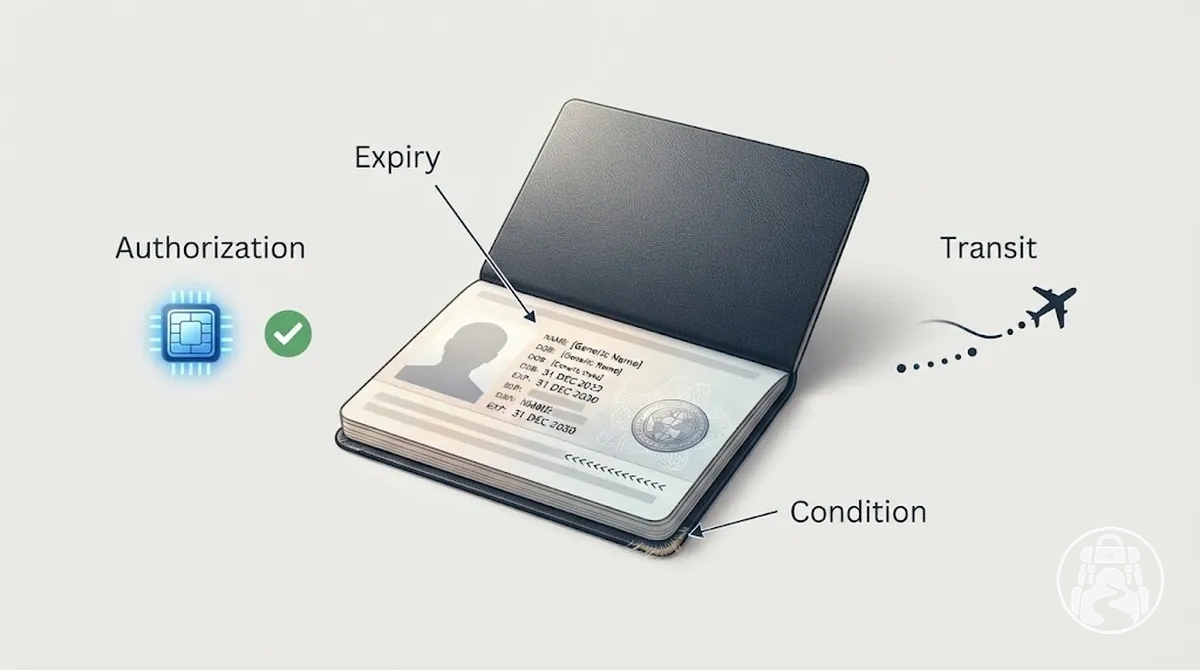
- Expiry date and passport condition: Check the expiry date and visible physical condition against the current requirements for every destination and transit point; classify the passport as valid for the itinerary or as needing renewal or replacement before departure.
- Blank pages where applicable: Confirm whether any destination or transit rule requires blank passport pages and whether the passport satisfies that specific requirement.
- Visa or electronic authorisation: Determine the permission required for the traveller's nationality and itinerary, then record its current status as approved, pending, not required, or action needed.
- Transit points: Check each transit point separately for any visa, electronic authorisation, or passport condition that applies to the connection rather than assuming the destination rule also covers transit.
- Passport-permission match: Where a visa or authorisation has been issued, confirm that it corresponds to the passport being used and identify any unresolved status that requires action.
Validity periods, blank-page rules, visa requirements, electronic-authorisation rules, and transit conditions depend on factors such as nationality, destination, and route, so one fixed rule cannot be applied across every itinerary.
A passport can therefore be unexpired yet still fail an applicable destination or transit condition, while a visa or authorisation remains usable only according to its verified current status and relevant entry rules.
Any unresolved requirement should be checked against current official immigration, border, or foreign-affairs guidance for the relevant destination or transit point before departure.
Keep Required Travel Documents and Backup Copies Accessible
An original document can become unavailable through loss or damage, while a digital record can become inaccessible if a device fails or connectivity is unavailable.
Travel-document backup access therefore requires redundancy: keep secure, testable backup copies or records of passport identity details, visas, electronic authorisations, and other relevant entry documents through an access path separate from the originals.
The image illustrates the distinction between the original document, a backup copy, and alternate offline access.
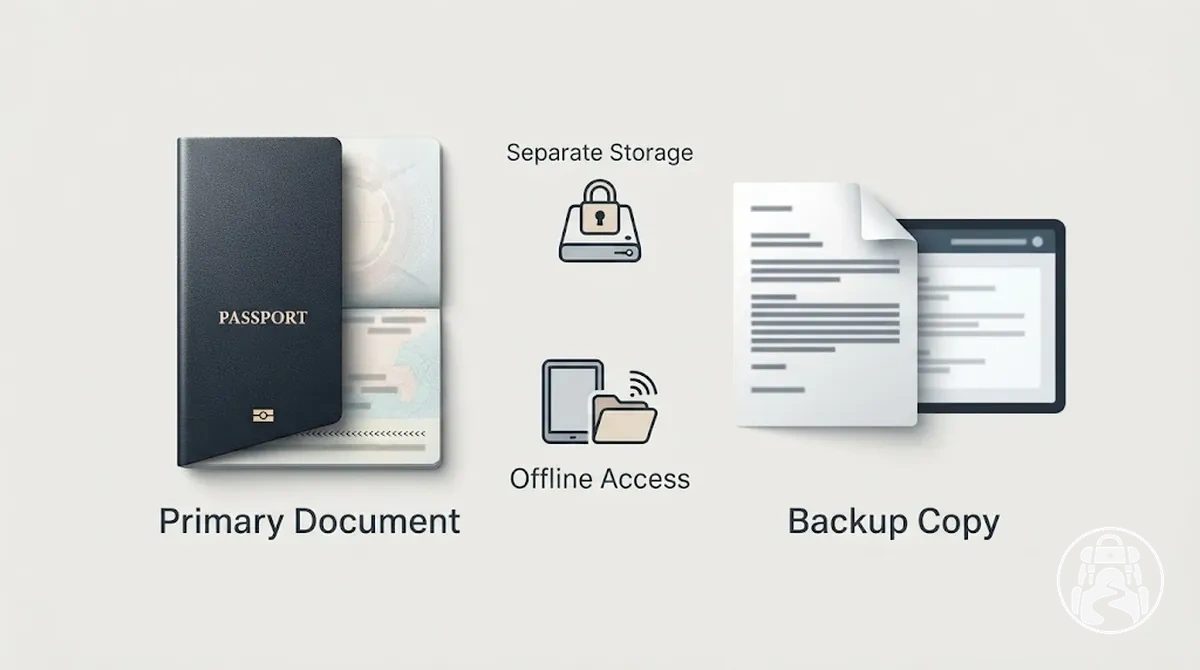
- Create: Make a clear backup copy or duplicate record of passport identity details, a visa, an electronic authorisation, and other entry-document information that may need to be retrieved.
- Separate: Store the backup through a different access path from the original document so one loss or access failure does not make both unavailable.
- Secure: Use secure storage appropriate to the sensitivity of the document and avoid leaving readable personal details unnecessarily exposed.
- Keep offline access: Where appropriate, maintain a local copy that can be retrieved without connectivity rather than relying on online access as the only backup path.
- Test: Confirm before departure that each backup can be opened, read, and retrieved and that it reflects the current document or authorisation.
A backup copy does not replace an original document, and whether a paper or digital copy is accepted for any official purpose depends on the document and destination.
The practical goal is verified access to current information through a separate secure path if the primary document or access method becomes unavailable.
Reconfirm Travel Bookings and First-Arrival Arrangements
Reconfirm each fixed booking confirmation against its current details so the departure and first-arrival chain still matches the intended trip.
Start with the primary departure or flight, then verify each commitment that the onward connection and first arrival depend on.
The image shows how confirmed departure, connection, and first-night arrangements form a dependency chain in which a changed detail can require action.
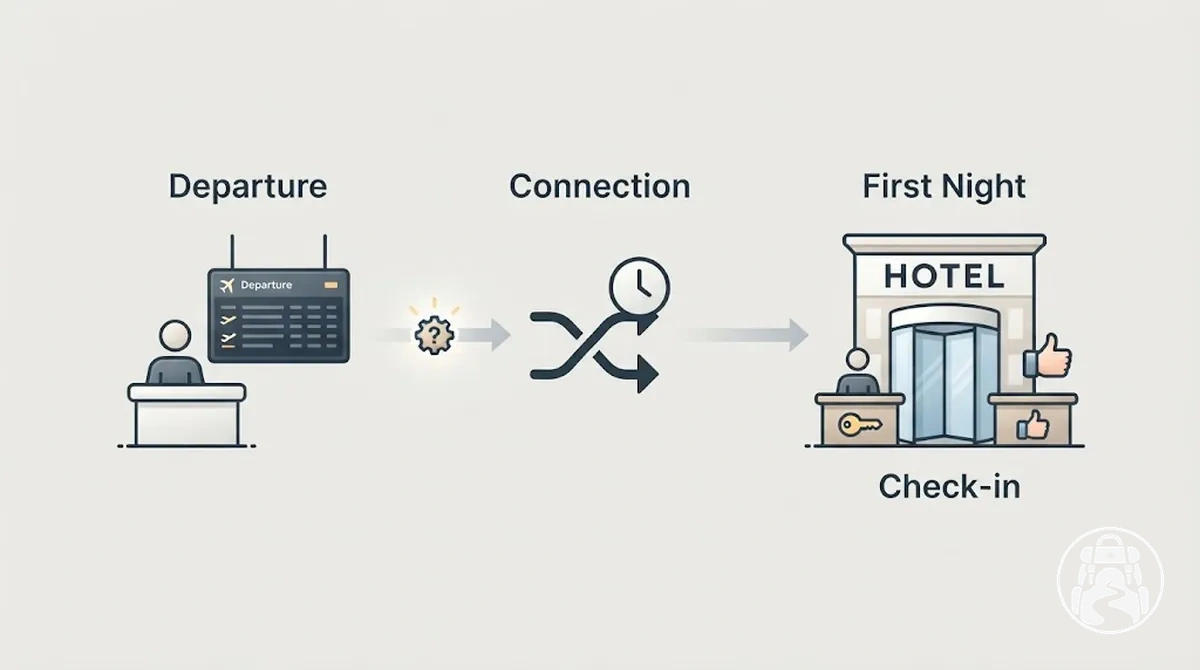
- Primary departure: Check the current booking confirmation for the departure date, time, departure point, and any listed terminal or station detail; resolve any schedule change that no longer matches the planned start.
- Flight or primary transport: Verify that the booked service and its current confirmed details still match the reservation being used for departure.
- Onward connection: Confirm the connection information that depends on the first service, and identify whether a changed arrival time or location requires action.
- First-night accommodation: Verify that the reservation is still confirmed for the intended arrival date and that the recorded address matches the place you expect to reach.
- Check-in and access: Recheck the current check-in or access instructions and confirm that the expected arrival time remains compatible with them; if not, identify the required follow-up before departure.
A schedule change can affect another commitment when the next step depends on it; for example, a different terminal or arrival time may affect an onward connection or first-night check-in.
Reconfirm these fixed commitments without reopening destination, route, or accommodation strategy, because broader planning sits outside this verification step.
The departure and first-arrival chain is ready when its current details are confirmed and every change that affects a dependent commitment has a clear action.
Verify Flight and Onward Transport Details
Only the international departure and any necessary onward transport leg need to be operationally confirmed here; a flexible itinerary can leave later legs undecided when they are not required for departure or initial continuity.
The image distinguishes a fixed flight or onward connection that needs current confirmed details from a later transport leg intentionally left flexible.
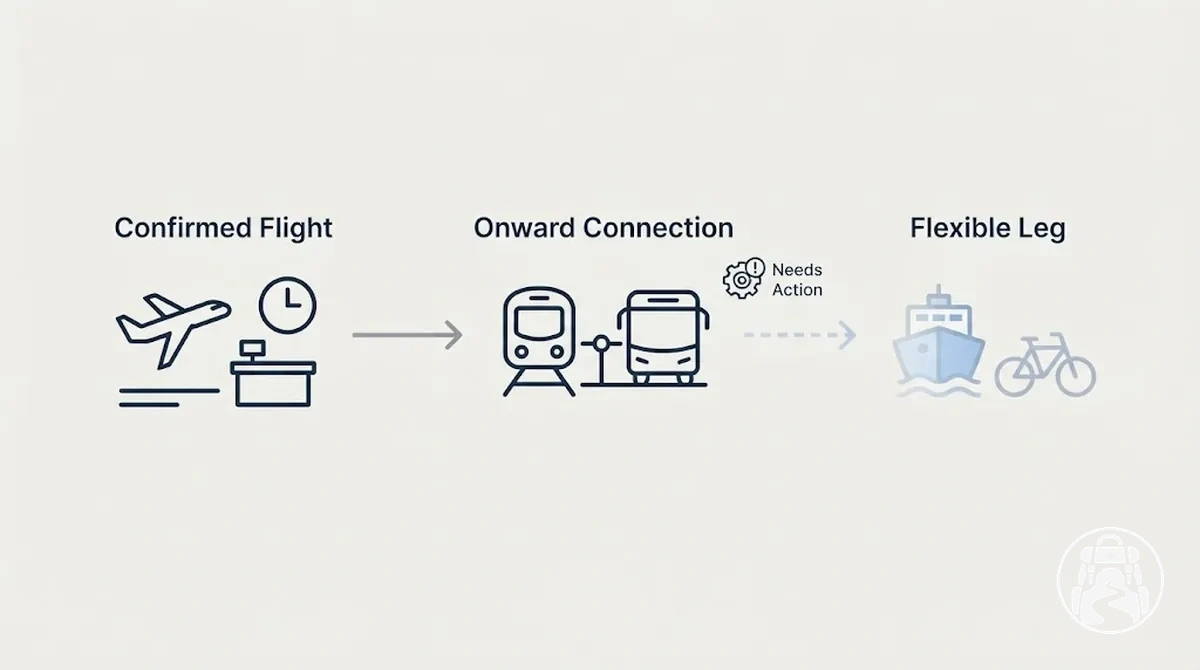
Must be confirmed
- Primary departure: Match the flight or other carrier or service to the booking, including the date, departure point, departure time, and terminal or station where that information is supplied; mark the transport leg as confirmed or needing action.
- Onward connection: For any necessary fixed connection, check its current service, departure location and time, and whether it still connects with the preceding transport leg; identify action if a confirmed detail has changed.
- Dependency: If a required leg has changed, identify the next booked connection or arrival commitment that depends on its timing or location and resolve the affected detail before departure.
Can remain flexible
- Uncommitted onward leg: A later transport segment can remain undecided when that flexibility is intentional and the leg is not required for departure or initial continuity.
- Later timing or route: Do not convert an intentionally flexible element into a fixed booking merely for this check; record its confirmation status as intentionally flexible rather than missing.
A changed fixed leg matters when another required transport leg depends on the altered arrival time or location; otherwise, an intentionally flexible element can remain open.
This check does not redesign the route or compare transport modes; it separates commitments that require a current confirmation from elements deliberately left flexible.
Before departure, each required leg should be confirmed and operationally usable or clearly identified as needing action.
Confirm First-Night Accommodation and Check-In Information
First-night accommodation is ready when the reservation status is confirmed and the traveller can find, reach, and access the property at the expected arrival time.
Verify the address, check-in conditions, and access instructions against the current booking confirmation so the arrival does not depend on an unresolved property-access detail.
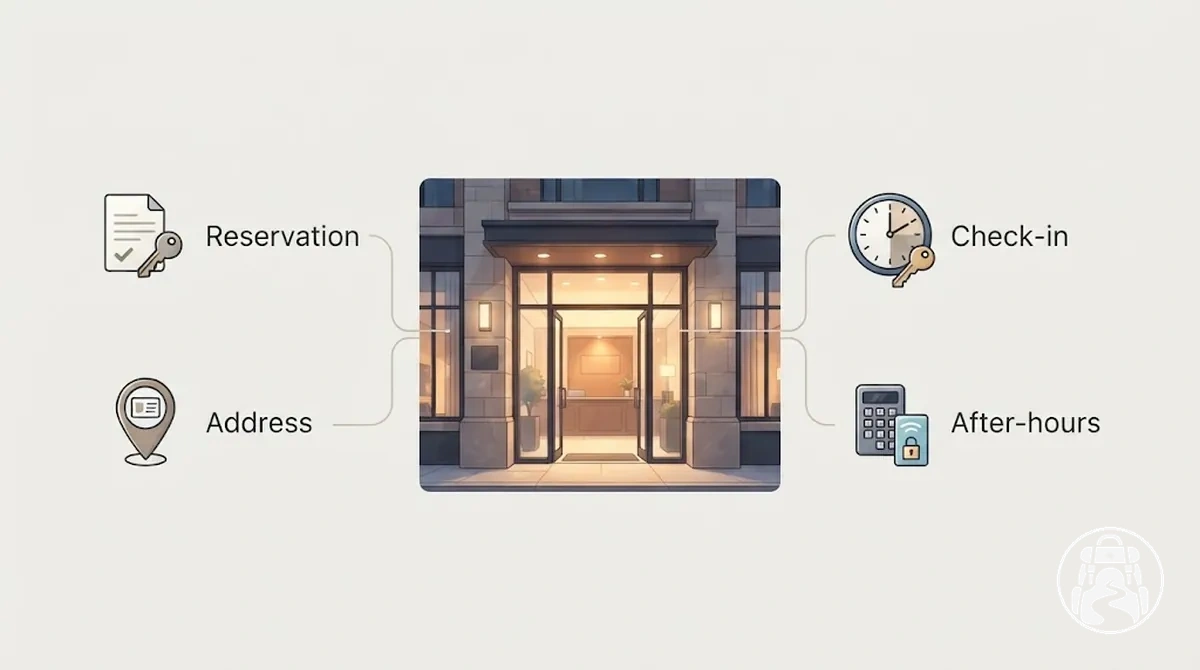
- Reservation and address: Confirm the reservation status and match the recorded address to the property you intend to reach after arrival.
- Check-in window: Verify the stated check-in window against the expected arrival time and identify whether the timing requires action.
- After-hours access: If arrival falls outside the stated check-in conditions, confirm whether after-hours access is available and what instructions apply.
- Arrival requirements: Check whether the property states any payment or identification requirement for check-in and confirm that any applicable requirement can be met on arrival.
- Directions and contact details: Keep the current directions, access instructions, and contact details needed to locate the property or resolve an arrival-access issue.
Check-in windows, after-hours access procedures, and arrival requirements vary by property, so use the explicit instructions attached to the current reservation rather than assuming a universal process.
For example, if a late arrival falls outside the stated check-in window, access may depend on a confirmed after-hours procedure or prior notification.
First-night readiness is complete when the stay is confirmed and the traveller has current information for reaching and entering the property at the expected arrival time.
Confirm Travel Money and Payment Access
Travel payment access is ready when the traveller has at least one usable primary payment method and a realistic fallback if that payment route fails.
The checklist below verifies payment-path resilience through account access, authentication, cash access, a backup payment method, and reachable emergency funds rather than setting a travel budget.
- Primary payment method: Confirm that the main card or other payment method is currently usable and that the traveller can access the associated account if a payment issue needs to be checked or resolved.
- Authentication: Confirm that any required authentication method is available during travel so account access or payment approval does not depend on an inaccessible device, number, or login route.
- Cash access: Verify that there is a practical way to obtain or use cash if needed, recognising that ATM availability, withdrawal access, and local acceptance depend on the destination and provider.
- Backup payment method: Keep a separate fallback payment route that remains usable if the primary payment method is declined, blocked, lost, or otherwise unavailable.
- Emergency funds: Confirm that emergency funds can be reached through an independent access path rather than depending entirely on the same account, card, or authentication route as the primary method.
Card acceptance, ATM access, fees, foreign-use controls, authentication requirements, and account restrictions can vary by destination and provider, so each relevant access path should be checked against its current conditions before departure.
Primary access covers the normal payment route, while backup access provides recovery when that route fails or cannot be used.
Payment readiness is established when essential expenses remain payable through a usable primary route or a reachable fallback without relying on one unresolved access point.
Check Cards, Cash Access, and Emergency Funds
Cards, cash access, and emergency funds should be independently usable before departure rather than merely available in theory.
Check each payment instrument or fallback source against the access condition that could make it unavailable, such as card expiry, failed authentication, blocked withdrawal access, or dependence on the same account.
- Primary card: Confirm that the card is active, that its card expiry covers the intended travel period, and that any required PIN or authentication method can be used while travelling.
- Cash withdrawal: Verify that cash withdrawal is enabled where relevant and that the traveller has a workable ATM access option, recognising that local availability, fees, and withdrawal limits depend on the destination and provider.
- Backup card: Keep a usable backup card or other fallback payment method separate from the primary card so one loss, block, or account-access failure does not disable both routes.
- Emergency funds: Confirm that emergency funds are accessible through a route that is not dependent on the same card, account, device, or authentication path as the primary method.
- First-hours fallback: Check that at least one payment or cash-access option remains practical for essential expenses during the first hours after arrival if the preferred method cannot be used.
Foreign-use controls, transaction approval, ATM access, withdrawal limits, fees, and local cash availability vary by provider and destination, so their current conditions should be verified directly rather than assumed.
Authentication also matters operationally: a usable card or account may still be inaccessible if the required PIN, device, number, or login route cannot be used abroad.
This check is complete when the traveller has tested access to the primary method and a separate, reachable fallback for the first hours after arrival.
Confirm Travel Insurance, Health, and Emergency Readiness
Travel insurance, health, and emergency readiness means having current insurance information, necessary medication and health information, and reachable emergency contacts that can actually be accessed if needed abroad.
Holding a travel insurance policy is not the same as knowing whether a situation meets its coverage conditions or how to reach emergency assistance, so confirm both policy status and usable access before departure.
- Policy status: Confirm that the travel insurance policy is in force for the planned travel period and that the relevant policy details, coverage conditions, and assistance contacts can be accessed when needed.
- Emergency assistance: Keep the applicable emergency assistance contact information in a form that remains usable if normal online access is unavailable.
- Medication and documentation: Confirm that necessary medication is prepared for the trip and that any relevant supporting documentation or health information is available where required.
- Destination requirements: Check whether any destination or transit point has health-entry, medication, or documentation requirements that apply to the traveller's circumstances.
- Emergency contacts: Verify that personal emergency contacts and any relevant assistance contacts are current, reachable, and available through a practical access method.
Travel insurance may exclude particular events or activities, while medication import rules, vaccination or other health-entry requirements, and emergency procedures can vary by destination, transit point, policy terms, and individual circumstances.
A medication or policy document that exists but cannot be accessed when needed may still create an avoidable problem, so readiness depends on both current information and practical access.
This check is complete when the traveller has verified the relevant conditions and can reach the insurance, health, medication, and emergency information needed for the trip.
Keep Travel Insurance Details and Emergency Contacts Accessible
Insurance information and emergency contacts are useful only if they can be retrieved quickly when connectivity is unavailable or stress makes searching difficult.
Store the insurer, policy identification, emergency assistance contact, and personal emergency contact details through a retrievable access path, including offline access where needed.
- Insurer and policy identification: Record the insurer name and enough policy identification to locate the correct cover, including the policy number where appropriate.
- Emergency assistance contact: Keep the relevant assistance line or contact information accessible so the traveller can identify the policy and contact emergency assistance without relying on a live internet connection.
- Coverage access conditions: Note any excess where applicable, material exclusion, or access condition that directly affects what the traveller needs to know or do before departure, without attempting to summarise the entire policy.
- Personal emergency contacts: Keep current contact information for the person or people who should be reached if assistance or escalation is needed, and make sure the details are retrievable through the chosen access path.
- Destination-specific information: Store any destination-specific emergency contact information the traveller reasonably expects to need, using an offline copy when loss of connectivity would otherwise prevent retrieval.
Coverage boundary: Being able to retrieve policy details does not establish that a particular situation is covered; coverage, excesses, exclusions, and claim paths depend on the applicable policy terms and circumstances.
Pre-departure readiness therefore means being able to identify the insurer, retrieve assistance and emergency contact information, and check any material access condition or exclusion that could affect how help is requested.
Prepare Medication and Essential Health Information
Medication readiness means confirming that necessary medication can be carried lawfully, that a sufficient supply is available where appropriate, that any required prescription or supporting documentation is prepared, and that storage and access remain workable during the trip.
The preparation sequence below connects medication requirements with documentation, transport conditions, and continuity through each destination and transit point.
- Confirm applicable requirements: Check the destination and transit conditions that apply to each medication, including any import restriction or requirement for prescription evidence or other supporting documentation; medication that is routinely prescribed or lawful at home may face different conditions elsewhere.
- Prepare supply and documentation: Arrange a sufficient supply where appropriate for the intended travel period and keep the prescription, supporting documentation, and essential health information such as relevant allergies or critical medical details identifiable and accessible.
- Arrange storage and transport: Confirm any storage requirement or transport condition that applies to the medication and choose a carrying method that allows those conditions to be maintained during departure, transit, and arrival.
- Verify transit access: Confirm that necessary medication and health information remain accessible during transit and that any documentation needed at a transit point or destination can be presented when required.
Import restrictions, prescription-document requirements, storage conditions, and permitted carriage can vary by medication, destination, transit point, and individual circumstances, so home-country acceptance does not establish that the same conditions apply elsewhere.
Scope: This is a logistical preparation check, not medical treatment advice.
Readiness is established when the applicable restrictions, supporting documentation, storage or transport conditions, and transit access have been confirmed for the trip.
Complete the Final 24-Hour Departure Check
The final 24-hour check is for revalidating departure conditions that can change or fail shortly before travel, not for rebuilding the trip plan.
Recheck each critical dependency against a current confirmation source, confirm that its current status remains acceptable, and identify corrective action for anything unresolved.
- Carrier and schedule status: Check the current carrier or transport confirmation for any schedule change, terminal change, cancellation, or other departure update; the acceptable state is a current itinerary that still supports departure, while any material change requires immediate follow-up.
- Local and external conditions: Recheck relevant weather, transport, or local-condition information from an appropriate current source where those conditions could affect imminent departure; any change that alters access, timing, or feasibility requires action.
- Baggage readiness: Confirm that baggage readiness still matches the current departure requirements and that no unresolved issue prevents the bags from being taken as planned.
- Offline access: Confirm that essential travel information remains available through offline access or another usable fallback if connectivity fails during departure.
- Departure timing: Reconfirm the planned departure timing against the current departure time, terminal or station information, and the time needed to reach the departure point; resolve any mismatch before leaving.
A condition that was previously confirmed can still change because of carrier operations, local conditions, or personal circumstances, so the relevant current status should be checked again when it could materially affect imminent departure.
If an item has changed, use the latest confirmation source to determine whether the condition remains acceptable and take corrective action when it does not.
Any unresolved item that still affects imminent departure requires immediate action. Issues that require route redesign, new bookings, or broader trip decisions belong in a separate planning review.
Recheck Weather, Travel Conditions, and Schedule Changes
Recheck only current travel conditions that could materially affect departure, transit, or the first arrival, because these may have changed since the original plan was made.
Use the latest relevant source for each condition so a weather forecast, carrier update, travel advisory, strike or closure, or other service change can be translated into a practical next action.
- Weather forecast: Check the latest relevant forecast for the departure point, transit locations, and first arrival where weather could affect transport or access; if conditions may disrupt timing or movement, adjust the immediate departure assumption or seek a more current operational update.
- Carrier or service status: Review the current carrier update or service notice for any confirmed delay, cancellation, terminal change, or schedule change; when a change is confirmed, reconfirm the affected service or revise the immediate departure or arrival timing.
- Strike or closure: Where applicable, verify any reported strike, transport closure, airport or station restriction, or other operational interruption through a current authoritative or service-specific source; if it affects the planned route, identify the required corrective action before departure.
- Travel advisory or official condition: Check current official guidance when an advisory, entry condition, or local restriction could materially affect departure or arrival; if the status has changed, follow the latest applicable guidance rather than relying on an earlier assumption.
- First-arrival conditions: Confirm that any external condition affecting the first stage after arrival, such as transport access or a local closure, still supports the planned arrival; if not, adjust the immediate arrival assumption without redesigning the wider itinerary.
Possible condition
A weather forecast or developing travel advisory indicates a possible condition, not certainty.
Confirmed operational state
A confirmed carrier change or official closure establishes a current operational state at the time checked.
When a material change is identified, connect it to a specific response such as leaving earlier, reconfirming a service, changing an arrival assumption, or checking current official guidance.
Stop once the departure, transit, and first-arrival implications are understood and the necessary next action is clear.
Verify Baggage Readiness and Transport Restrictions
Baggage readiness means confirming that the already-packed luggage complies with the actual carrier rule and transport conditions for departure rather than reopening item selection.
Check each bag and relevant item category against its baggage allowance, permitted placement, and any special handling requirement so a non-compliant condition can be corrected before travel.
- Size and weight allowance: Compare each carry-on and checked baggage item with the carrier's stated size limit and weight limit for the booked service; if a bag exceeds an applicable allowance, reduce, redistribute, or otherwise resolve it according to the carrier rule before departure.
- Restricted items: Check whether any packed item is prohibited, restricted, or subject to a specific transport condition for the carrier, route, jurisdiction, or mode; remove or handle any non-compliant item as the applicable rule requires.
- Carry-on versus checked placement: Verify that critical or regulated categories are placed in carry-on or checked baggage as required rather than assuming either location is acceptable.
- Battery and liquid categories: Check the applicable rule for any battery, liquid, or similar restricted item because permitted placement, quantity, packaging, or handling conditions may differ by carrier, route, and transport mode.
- Identification and security: Confirm that baggage can be identified and secured appropriately for the chosen transport and that any required tag, closure, or handling condition is resolved.
- Special handling: Verify any carrier-specific condition for equipment, oversized baggage, fragile items, or other categories requiring advance handling, and take corrective action if the packed baggage does not meet that condition.
Baggage compliance is a final verification task, while item selection and the broader packing list are separate.
Baggage allowance, size and weight limits, battery and liquid rules, restricted-item conditions, and special handling can vary by carrier, route, jurisdiction, and transport mode, so the applicable carrier rule should control the final check.
The baggage is ready when each relevant category is compliant or a specific corrective action has been completed.
Charge Essential Devices and Store Key Travel Information Offline
Essential devices and critical travel information should remain usable even when dependable connectivity is unavailable during departure or first arrival.
Prepare the phone or primary device in a simple sequence that confirms power readiness, local availability, and tested offline access rather than assuming a saved file or cloud account will remain reachable.
- Charge essential devices: Charge the phone or primary device before departure and confirm that the required charger is available; where relevant, verify that any adapter or power bank needed for the planned journey is also ready for use.
- Test power and access: Open the booking details, essential address, navigation information, and contact details needed for departure or first arrival, and confirm that any required authentication can be completed before connectivity becomes unreliable.
- Save essential information locally: Keep a local copy of the critical travel information that would otherwise depend on an online account or cloud-only storage, focusing on the documents, booking details, addresses, navigation information, and contacts needed to continue the journey.
- Verify offline retrieval: Disable or avoid network access temporarily and confirm that the locally stored information can actually be opened, read, and retrieved offline on the device that will be used during travel.
Information stored in an account or cloud service may still be inaccessible if connectivity fails or authentication requires a network connection, so saving it is not the same as verifying offline retrieval.
Charger, adapter, or power-bank needs depend on the device, destination, and journey conditions and should remain limited to the hardware required to keep the essential device operational.
Device readiness is complete when the necessary information has been saved locally and tested successfully through offline access.
Confirm Departure Time and Terminal Transport
Departure readiness requires knowing the confirmed departure time, the correct terminal or station, when to leave, and which check-in or reporting requirement affects the departure margin.
The final check should combine fixed departure details with realistic ground transport, processing time, and local conditions so the traveller can reach the departure point without relying on a universal arrival-time rule.
- Departure time and place: Confirm the current departure time and the exact terminal or station for the service being used, and resolve any missing or conflicting location detail before leaving.
- Ground transport plan: Confirm how the traveller will reach the terminal or station, where the transfer begins and ends, and whether the planned route remains usable under current local conditions.
- Travel time: Estimate the realistic travel time to the departure point using the planned transport and current traffic or service conditions, then use that estimate when deciding the leave time.
- Check-in or reporting requirement: Confirm any explicit carrier or operator reporting time, check-in requirement, or baggage-processing condition that must be completed before departure.
- Processing conditions: Allow for any applicable baggage, security or immigration process that can affect the required departure margin, using the actual route and departure point rather than a fixed generic allowance.
- Contingency: Identify a practical fallback for a foreseeable local disruption, such as traffic or a transport-service interruption, and adjust the leave-time decision if that contingency becomes necessary.
The required departure margin may vary with the carrier, route, terminal or station, baggage arrangements, security or immigration process, and local transport conditions, so one universal arrival time is not appropriate for every journey.
Confirmed reporting requirements should control where they apply, while variable ground-transport and processing conditions should be reflected in the planned leave time and contingency.
Departure access is ready when the traveller knows when to leave, where to go, how to get there, and which remaining detail, if any, still requires confirmation before leaving home.