
Planning Hostels and Accommodation for a Backpacking Trip
Choose backpacking accommodation by first ruling out properties that fail non-negotiable requirements, then compare location and access, room type, usable facilities, atmosphere, and total stay cost for that specific stop. The best fit is the option that works for the actual arrival, stay length, planned activities, and traveller priorities—not necessarily the cheapest room or highest-rated hostel.
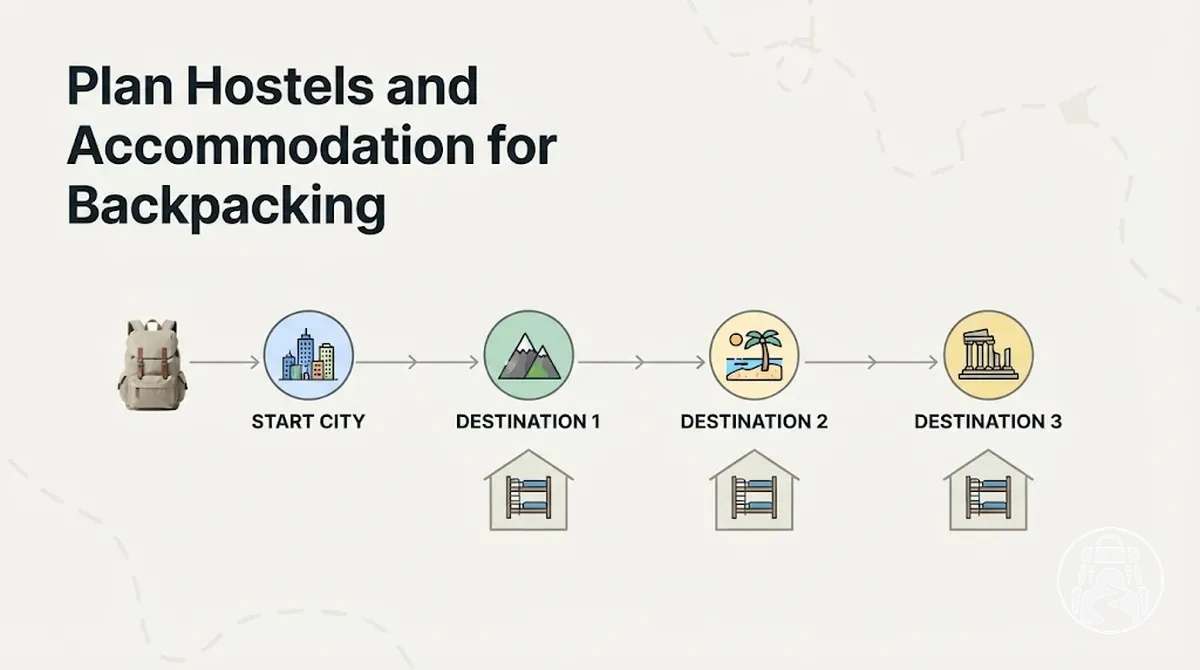
Choose a hostel in five checks
Use the same sequence for each stop so attractive extras do not hide a poor practical fit.
- Set the stop constraintsDefine the purpose and length of the stay, arrival and departure conditions, acceptable cost, and any requirement that would make an option unusable if missing.
- Check real accessCompare the actual journey from the arrival point and to the areas you expect to use, including service hours, luggage, transfers, walking burden, and repeated fares where relevant.
- Match the room and atmosphereChoose dorm or private accommodation by privacy, sleep sensitivity, social preference, companions, bathroom arrangement, and the property’s current atmosphere—not by room label alone.
- Verify usabilityConfirm that security, storage, kitchen, laundry, Wi-Fi, charging, common areas, reception, and house rules work under the planned stay conditions; use recent repeated reviews and guest photos to check current conditions.
- Compare total stay costAmong options that remain suitable, compare the applicable room rate, mandatory charges, extras you will actually use, useful inclusions, and accommodation-driven costs such as necessary extra transport.
Decision rule: exclude any property that fails a non-negotiable requirement, then rank the viable options by the priorities of that stop rather than by headline price or rating alone.
This page focuses on accommodation fit for each stop; booking timing, wider trip-budget allocation, and itinerary flexibility are separate planning decisions.
Table of Contents
Set Accommodation Priorities for Each Stop
Set accommodation priorities for the specific stop before comparing properties.
Rank the needs that could make a stay unsuitable first, then use preferences to distinguish between the options that remain workable.
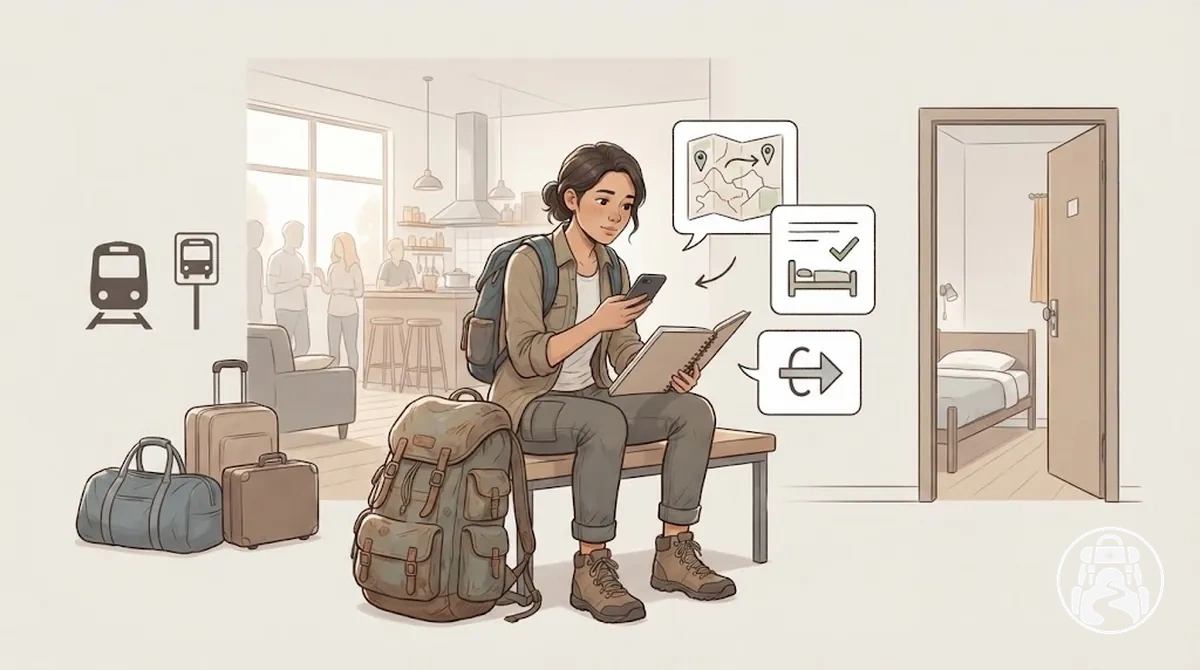
Stop purpose and stay length determine which needs deserve more weight, while arrival and departure conditions can make access or schedule compatibility more important.
Privacy and social preference affect whether the stay needs to favour separation, interaction, or a balance between the two.
Essential facilities should be treated as requirements when their absence would make the stay impractical, while acceptable cost sets the spending boundary within which the other priorities must fit.
The resulting priority order should reflect the circumstances of that stop rather than a fixed standard applied to every destination.
The following criteria organise the main stop-specific decisions rather than setting a universal ranking.
Order them according to the constraints of the individual stop, then verify that every non-negotiable requirement is covered before comparing properties.
- Stop purpose: give greater weight to the accommodation features that support what the stop is for, such as convenient access for a transit stop or usable common space when time at the property matters more.
- Stay length: weigh recurring needs more heavily on a multi-night stay because a minor inconvenience can affect several days rather than a single overnight stop.
- Arrival and departure: treat access conditions as a higher priority when late arrival, early departure, luggage, or a tight schedule would make a difficult connection impractical.
- Privacy and social preference: decide whether privacy, interaction, or a balance between them should help rank otherwise suitable accommodation options.
- Essential facilities: classify a facility as a requirement when its absence would make the planned stay unsuitable; otherwise treat it as a preference rather than an automatic exclusion.
- Acceptable cost: define the spending level that fits this stop and use it as a constraint when comparing options, rather than allowing a lower price alone to override more important requirements.
Match the Stay to the Length and Purpose of the Stop
Stay length and stop purpose can change which accommodation attributes deserve priority.
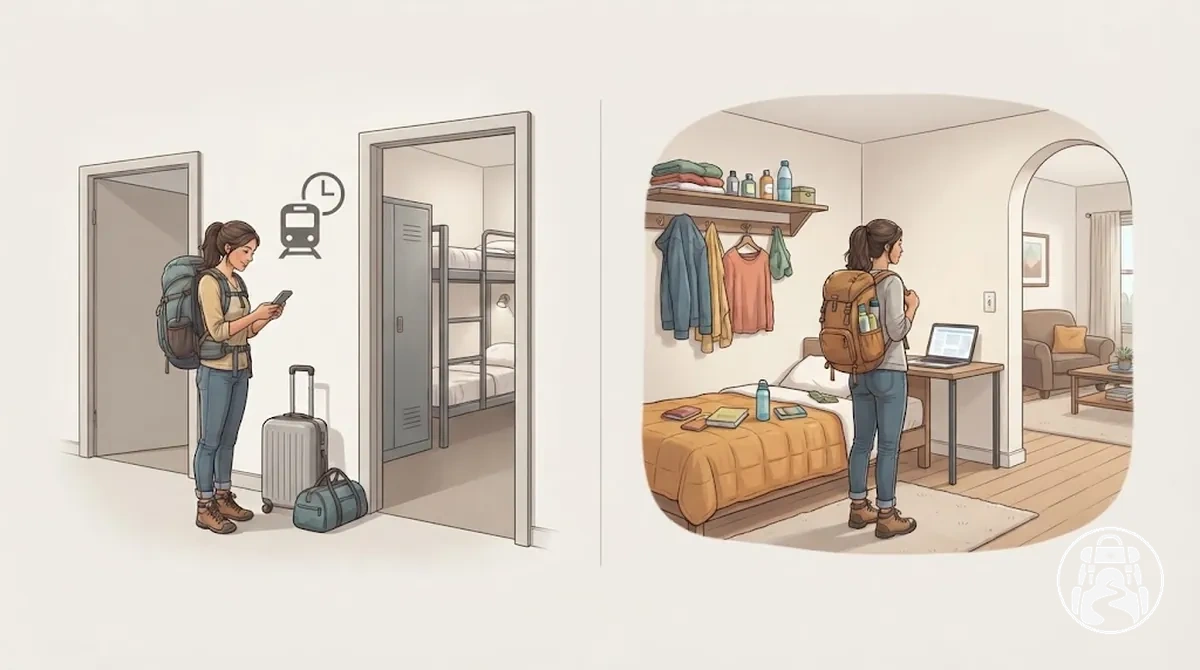
Short transit stop
Convenient access and simple luggage handling may carry more weight when the traveller needs to arrive, manage luggage, rest, and leave again with minimal friction.
Multi-night destination stay
Comfort, common-area usability, or workspace may become more important when the traveller expects to spend more time at the property, work there, or use shared spaces.
What changes the weighting: arrival timing, planned activities, work needs, luggage, and personal tolerance for shared facilities. The same hostel feature can therefore become more or less important as the purpose and duration of the stop change.
Separate Essential Requirements from Preferences
An essential requirement is non-negotiable when its absence would make a hostel unsuitable for the specific stay, while a preference is optional and helps improve the fit between otherwise workable options.
Classify each criterion by its condition and practical implication rather than by how attractive the feature appears.
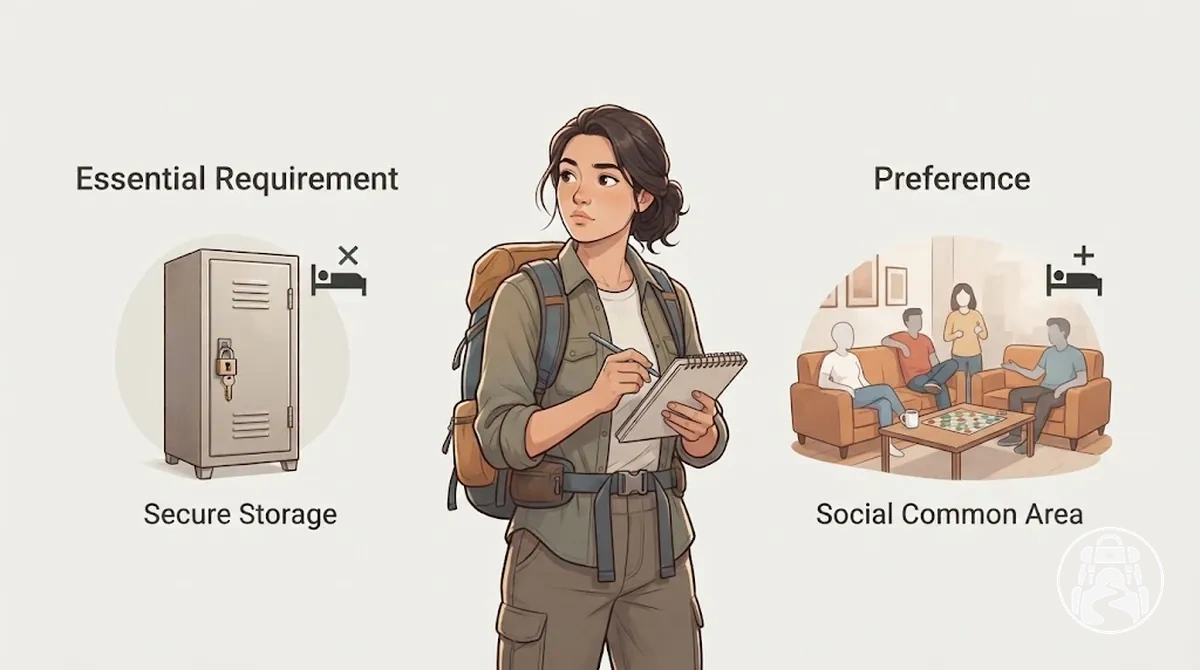
- Essential requirements: conditions that must be met for the accommodation to remain suitable; an unmet requirement eliminates that option from consideration.
- Preferences: optional features that improve comfort or suitability but do not by themselves make an otherwise workable stay unsuitable.
A preference can become an essential requirement when circumstances change.
Secure storage, for example, can be non-negotiable when valuables cannot remain with the traveller and no acceptable alternative is available, while a social common area may remain optional for someone prioritizing sleep over interaction.
Under a different condition, that social space could carry more weight if meeting other travellers is an important purpose of the stay.
Use essentials to exclude unsuitable options and preferences to rank the options that remain.
Match the Hostel Atmosphere to Your Travel Style
Hostel atmosphere should be judged by how well the social environment fits the traveller's expected use of the stay.
Higher social intensity may support interaction when meeting people is a goal, while a more rest-oriented setting may suit a traveller who values quieter evenings or sleep; neither is inherently better.

A busy common area and frequent organised activities can signal more opportunities for interaction, while a strong party focus may also increase the likelihood of evening activity and noise.
Stated quiet hours can indicate a rest-oriented policy, but they do not guarantee silence, and common-space culture can change with the guests present at the time.
Treat these features as evidence cues rather than fixed outcomes.
Use recent reviews and recurring guest descriptions to check whether the reported hostel atmosphere matches its marketing labels and your intended balance between interaction and rest.
Choose the Right Location Before Comparing Properties
A useful hostel location minimizes practical travel friction for the specific stay; it is not necessarily the most central address.
Evaluate property position together with transport access, the arrival point, and the intended areas the traveller expects to use during the stay.

Walking time and transit time can matter differently depending on luggage, arrival conditions, and how often the intended areas need to be reached.
A late arrival can make a seemingly convenient location less practical when the usable transport connection is limited, while repeated extra journeys can increase transport cost.
Compare these conditions as sources of travel friction rather than treating map distance or a central label as sufficient on its own.
- Transport access: check whether the hostel connects practically with the relevant arrival point and onward transport; a nearby station or stop is useful only when the connection works for the stay.
- Intended areas: consider how easily the property connects with the places likely to be used during the stay, because a central position may still require inconvenient extra journeys.
- Late arrival: weigh the location against the transport and walking conditions expected at the actual arrival time, since access that is simple earlier in the day may be less practical later.
- Walking burden: judge walking time in the context of carrying a backpack or other luggage rather than relying on straight-line distance alone.
- Transport cost: consider whether reaching the arrival point and intended areas is likely to require repeated paid journeys, because those extra trips can change the practical value of the location.
For example, a slightly less central hostel on a useful direct transport connection can be more practical than a central property that requires additional transfers or an awkward walk with luggage.
The aim is to evaluate accommodation access for the stay, not to design the wider transport journey.
Check Access to Transport and Arrival Points
Transport access should be judged by the actual journey between the hostel and the relevant arrival point or departure point, not by map proximity alone.
Check whether service hours, luggage, and the available connection make that journey workable at the time you expect to arrive or leave.

A nearby station or transport stop may still involve extra travel time when the route requires a transfer, a long walk with luggage, or a connection that does not operate during the required service hours.
For a late arrival, verify that the final connection remains usable at the expected time rather than assuming daytime access conditions will apply.
For an early departure, check whether the journey back to the departure point can begin early enough without relying on unverified transport availability.
Treat usable travel time and schedule compatibility as the relevant access measures because they affect how reliably the traveller can reach check-in or the departure connection.
Assess Access to the Areas You Expect to Use
A useful location reduces repeated daily travel to the places the traveller actually expects to use during the stay.
- Activity areas
- Compare realistic walking and transit time to each place you expect to use rather than assuming every traveller benefits equally from the same central location.
- Food and services
- Give access more weight when those places will be used repeatedly, because extra journeys add time and effort across the stay.
- Transport corridor
- If planned activities depend on a particular route or line, check how easily the property connects with it and how often that connection will be needed.
- Cumulative friction
- Include repeated walking, transit, and necessary extra fares. Judge the location by the combined burden of expected daily journeys, not simply by proximity to sightseeing areas.
Compare Room Types and Accommodation Trade-Offs
Hostel room types should be compared using the same practical criteria: cost, privacy, sleep disruption, social contact, security considerations, bathroom arrangement, and suitability for the specific stay.
A dorm bed and a private room offer different trade-offs across these attributes, so neither room type is universally preferable.
| Room Type | Cost | Privacy | Sleep Disruption | Social Contact | Security Considerations | Bathroom Arrangement | Suitable Context |
|---|---|---|---|---|---|---|---|
| Dorm bed | May have a lower solo cost than a private room; compare the actual nightly rate. | Sleeping space is shared with other occupants, so privacy is lower. | More room occupants can create more opportunities for sleep disturbance, although actual conditions vary. | Shared occupancy can create more incidental social contact without guaranteeing interaction. | Check room access and secure-storage arrangements because belongings are kept in a shared sleeping environment. | May use an ensuite or a separate shared bathroom; verify the specific room layout. | Can fit a short social stay or a stay where shared sleeping space and lower relative cost suit the traveller's priorities. |
| Private room | May have a higher solo cost than a dorm bed; the trade-off can change when the room is shared by companions. | A private sleeping space provides more separation from other hostel guests. | It reduces disturbance from roommates but does not guarantee quiet from corridors, common areas, or outside the property. | There is less incidental contact with roommates, although social contact may still occur in shared hostel spaces. | Fewer room occupants changes the security context, but door access and storage arrangements still need checking. | May have a private ensuite or use shared bathroom facilities; verify the specific room description. | Can fit a recovery night or work-heavy stay when greater sleeping-space privacy is more important than shared-room interaction. |
The main trade-off is how much shared occupancy supports or conflicts with the conditions of the stay.
Cost should be compared against the value of privacy, expected sleep conditions, desired social contact, and the property's actual security and bathroom arrangements rather than treated as the only criterion.
Choose the room type whose combination of attributes fits the traveller's priorities for that stop.
Choose Between Dorm Beds and Private Rooms
Choose between a dorm bed and a private room according to the privacy, sleep sensitivity, social preference, travel companions, and actual cost difference that apply to the stay.
Dorm bed
May suit a traveller who is comfortable with shared sleeping space and more incidental interaction, especially when the actual price advantage matters and shared occupancy fits the stay.
Private room
May suit a traveller who places greater weight on separation from other occupants or reducing roommate-related disturbance. It does not guarantee quiet, and the bathroom may still be shared.
Check regardless of room type: room access, secure-storage arrangements, bathroom setup, expected sleep conditions, social setting, and the real cost difference. Travel companions can change the cost comparison and make a private room more practical for a group.
Compare Dorm Size, Privacy, and Sleep Trade-Offs
Dorm size and layout can influence privacy and sleep conditions, but bed count alone does not determine either outcome.
- Open or partitioned layout
- A larger open dorm may create more opportunities for movement, noise, and incidental social contact, while a smaller or more partitioned dorm may reduce exposure to other occupants; either can still vary in actual noise and atmosphere.
- Bunk curtain or partition
- These features can add visual separation, but they do not isolate sound.
- Spacing and locker placement
- They can change how often other guests move close to the bed and therefore affect perceived privacy and disturbance.
- Bathroom access and circulation
- An ensuite serving the dorm can create different room traffic from a shared bathroom elsewhere, so circulation matters alongside bed count.
- Number of occupants
- A higher bed count may increase the number of possible disturbances, but the practical effect still depends on layout, occupant behaviour, and how movement through the room is arranged.
Compare these factors together rather than treating dorm size as a fixed measure of privacy or sleep quality.
Evaluate Facilities, Cleanliness, Security, and Hostel Rules
Operational fit depends on whether a hostel's facilities, cleanliness, security arrangements, and rules support the traveller's actual day-to-day needs.
A listed feature is useful only when its availability, condition, and access make it usable during the stay.
Hygiene conditions affect bathroom and shared-space usability, while security and storage arrangements affect how belongings can be managed.
Wi-Fi, a kitchen, laundry, and a common area matter when the traveller expects to use them regularly, and reception arrangements can affect check-in or help with property access.
House rules and access conditions can also limit when or how facilities are used, so evaluate their practical consequences rather than treating the feature list as sufficient.
- Cleanliness and hygiene: check the current condition of bathrooms, sleeping areas, and shared spaces because the presence of facilities does not show how usable they are.
- Security and storage: verify locker or storage availability, room or property access arrangements, and any conditions for using them rather than assuming a listed security feature provides a particular level of protection.
- Connectivity and charging: confirm that Wi-Fi and relevant charging access are available where needed, especially when connectivity is important for work, communication, or travel administration.
- Daily-use facilities: assess whether the kitchen, laundry, and common area are available under conditions that fit the stay, since restricted hours, capacity, or current condition can affect usability.
- Reception and rules: check reception availability, check-in procedures, property-access rules, and relevant house rules when they could affect arrival, departure, or normal use of the hostel.
Verify important facilities and operating conditions against current property information rather than relying only on a headline amenity list.
The useful question is whether each relevant feature or rule works under the conditions of the planned stay.
Check Cleanliness, Security, and Secure Storage
Verify cleanliness, security measures, and secure storage through multiple observable signals rather than inferring them from one rating or isolated comment.
A repeated recent review pattern supported by consistent guest photo evidence provides more useful context about current conditions than a single extreme review.
Cleanliness signals should be evaluated separately from security and storage features: bathroom condition and recurring hygiene comments describe property condition, while locker, room access, and luggage storage arrangements describe how belongings and access are managed.
These features can indicate whether the property meets the traveller's needs, but they do not establish a broader safety conclusion on their own.
- Cleanliness pattern: check whether recent reviews repeatedly describe similar cleanliness conditions, and compare those comments with recent guest photos where available.
- Bathroom condition: look for consistent evidence about hygiene, maintenance, and current bathroom condition rather than relying on one complaint or one positive comment.
- Locker availability and locker size: verify whether lockers are provided and whether the stated locker size is suitable for the belongings that need secure storage.
- Lock requirement: check whether a locker requires the traveller to provide a padlock or whether a locking method is supplied by the property.
- Room access: verify the stated room access arrangement, such as controlled guest access, and treat it as an observable feature rather than a guarantee of security.
- Luggage storage: when luggage must be stored before check-in or after check-out, confirm whether luggage storage is available and whether its access conditions meet the planned use.
Check Kitchen, Laundry, Wi-Fi, and Common-Area Access
Shared hostel facilities are useful only when they match the traveller's intended use and their access conditions make them practical during the stay.
Check more than whether a kitchen, laundry, Wi-Fi, charging point, or common area is listed, because hours, rules, coverage, and availability can change actual usability.
- Kitchen access: check the permitted hours and any cooking restrictions so the kitchen can be used when meals are likely to be prepared.
- Food storage: verify whether food storage is available and whether labelling, clearing, or access rules affect how it can be used during the stay.
- Laundry: confirm that laundry facilities are available when needed and check any stated access or timing conditions rather than assuming continuous availability.
- Wi-Fi reliability: look for current information about reliability and coverage, especially if connectivity is needed in the sleeping area, common area, or another specific part of the property.
- Charging access: check whether suitable charging points are available where the traveller expects to spend time, particularly when regular device access matters.
- Common-area usability: assess whether the common area provides the access, seating, and operating hours needed for the intended social use, rest, or workspace.
A listed kitchen may offer limited practical access when its hours conflict with the traveller's routine, while Wi-Fi may be useful only where its reported coverage is reliable.
Laundry and charging facilities matter most when their availability matches when they are actually needed, and common-area value depends on whether the space can support the intended use.
Compare each facility's stated presence with its access conditions rather than treating nominal availability as usable access.
Use Reviews and Guest Photos to Verify Current Conditions
Reviews and guest photos are most useful when they provide recent, repeated evidence about a specific accommodation attribute. Give more weight to a recurring pattern about cleanliness, noise, atmosphere, facilities, or location practicality than to an overall rating or one extreme item.
Weaker evidence
- One isolated complaint without similar recent reports.
- One guest photo without enough context to show whether the condition is current or representative.
- An overall rating or management response considered without relevant review details or corroboration.
Stronger corroboration
- A repeated pattern across recent reviews describing the same specific condition.
- Recent guest photos consistent with written feedback about the attribute being checked.
- Similar observations from travellers in relevant circumstances, supported where informative by a management response addressing the same issue.
Keep the uncertainty visible: recency matters because conditions and operating practices can change, and traveller expectations or room situations can affect how the same condition is experienced. Photos and responses can corroborate or explain a report, but no single item is definitive.
Compare Total Stay Cost, Not Just the Nightly Price
Total stay cost can differ from the displayed nightly price because a mandatory fee, paid extra, included service, or location-related cost can change the effective cost of the accommodation.
Compare the verified accommodation-related components for the specific stay rather than assuming the lowest quoted rate produces the lowest final amount.
| Cost Group | Cost Component | Condition to Check | Effect on Total Stay Cost |
|---|---|---|---|
| Paid directly to the property | Nightly price | Confirm the base rate for the required room type and number of nights. | Forms the starting accommodation cost before other applicable components are added or considered. |
| Paid directly to the property | Mandatory fee | Verify whether any compulsory property or local charge applies under the booking conditions. | Adds to the quoted base rate when it is not already included. |
| Paid directly to the property | Paid extra | Check whether an optional service such as a towel, locker-related item, laundry use, or breakfast would actually be used and charged separately. | Raises the effective cost only when the traveller needs or chooses the separately priced service. |
| Paid directly to the property | Included service | Identify services already included in the quoted rate and whether they replace something the traveller would otherwise pay for. | Can reduce additional accommodation-related spending without changing the displayed base rate. |
| Accommodation-driven cost incurred elsewhere | Location-related cost | Consider whether the property's location creates necessary extra journeys to the arrival point or places used during the stay. | May increase the effective cost when the accommodation choice requires additional paid transport. |
Costs paid directly to the property include the base rate and any applicable mandatory or optional charges, while accommodation-driven costs incurred elsewhere arise only when the property's characteristics create an additional expense.
An included service affects the comparison when it replaces a cost the traveller would otherwise incur, and a location-related cost matters only when an extra paid journey is actually required.
There is therefore no single universal amount beyond the nightly price without property-specific charges, inclusions, location conditions, and traveller usage.
Keep this comparison within the accommodation budget rather than extending it to the full trip budget.
Account for Included Facilities and Extra Charges
An included facility or extra charge changes the practical value of a quoted rate only when it applies to the traveller's actual needs and booking conditions.
Compare what the property states is included with any optional or mandatory items that would add to the accommodation cost.
- Breakfast: if breakfast is included in the quoted rate and the traveller would otherwise pay for a morning meal, the inclusion can reduce a separate expense; if it is charged separately, include it only when it will actually be used.
- Towel: verify whether a towel is included or subject to an extra charge when the traveller needs one, because the cost implication depends on both the property's policy and intended use.
- Locker or lock: check whether locker access is included and whether a separate lock or other paid item is required; only an applicable charge should affect the comparison.
- Laundry: treat laundry as a paid extra only when the property charges for it and the traveller expects to use the service during the stay.
- Luggage storage: verify whether luggage storage is included, separately charged, or subject to conditions when it is needed before check-in or after check-out.
- Deposit or local charge: include a deposit or local charge only when the specific property or booking conditions state that it applies, and distinguish any refundable deposit from an amount that remains part of the effective cost.
Inclusions such as breakfast, a towel, or locker access matter only when they replace something the traveller would otherwise need to arrange or pay for separately.
Optional items such as laundry or luggage storage affect the comparison only when they are used, while a deposit or local charge affects the quoted-rate comparison only when the stated conditions make it applicable.
Comparing like with like means checking the same applicable inclusions and extra charges for each quoted rate rather than comparing headline prices alone.
Recognize When a Cheaper Stay Creates Other Costs
A lower room price can create an additional expense or inconvenience when the accommodation shifts a needed journey, service, or facility outside the stay. The trade-off matters only when that changed condition affects what the traveller actually needs to do or pay for.
- Cheaper location → extra transport
- If reaching the arrival point or regularly used areas requires additional paid journeys, those fares can reduce the room-price advantage.
- Limited kitchen → more paid meals
- If planned cooking becomes impractical because kitchen access does not fit the stay, greater reliance on paid meals can become a secondary cost.
- Missing facility → replacement elsewhere
- If a needed facility is unavailable, compare the room saving with the cost or inconvenience of obtaining the replacement service elsewhere.
- Poor sleep fit → lower practical value
- When rest is important for the stop, unsuitable sleep conditions can reduce the practical value of the cheaper option even when they do not create a direct monetary charge.
Judge each trade-off from the specific condition and consequence rather than assuming that a lower-priced property necessarily costs more overall.
Common Backpacking Accommodation Planning Mistakes
An accommodation planning mistake usually comes from using weak criteria, failing to verify current conditions, or choosing a property that does not fit the traveller's needs for that stop.
The practical correction is to recognize the mismatch before booking and compare the relevant accommodation attributes directly.
The mistakes below follow the same pattern: identify the error, consider its possible consequence, look for the recognition cue, and correct the decision using the relevant criterion.
Each item links the planning mistake to the condition that makes it relevant and the corrective direction that addresses it.
Because the consequence depends on the circumstances of the stay, each correction should resolve the specific mismatch rather than apply a universal rule.
- Choosing on price alone: a lower headline rate can hide a poor trade-off when location, required extras, or unsuitable facilities create additional cost or inconvenience. The recognition cue is a decision based mainly on room price without checking total accommodation-related consequences. Correct it by comparing price with the conditions and services the traveller will actually use.
- Ignoring current reviews and guest photos: relying on an overall rating or old information can leave uncertainty about current condition, cleanliness, noise, or facility usability. The recognition cue is a property choice made without checking recent, repeated evidence. Correct it by using current reviews and guest photos to verify the specific attributes that matter to the stay.
- Mismatching the hostel atmosphere: a highly social or more rest-oriented environment can reduce fit when it conflicts with the traveller's intended balance between interaction and sleep. The recognition cue is choosing from general popularity or branding without checking recurring descriptions of the hostel atmosphere. Correct it by matching recent atmosphere signals to the purpose of the stay.
- Overlooking arrival access or house rules: inconvenient arrival access, reception conditions, check-in procedures, or house rules can interfere with a planned arrival or normal property access. The recognition cue is an itinerary that assumes access will work without verifying the property's stated conditions. Correct it by checking the relevant access and operating rules against the actual arrival, stay, and departure schedule.
- Choosing the wrong room type: a dorm bed or private room can become a mismatch when privacy, sleep sensitivity, social preference, companions, or bathroom arrangements differ from what the traveller needs. The recognition cue is selecting a room type mainly from price or availability. Correct it by comparing the room's actual attributes with the priorities of that stop.
- Assuming listed facilities meet actual needs: the presence of a kitchen, laundry, Wi-Fi, charging access, storage, or common area does not establish that its hours, rules, coverage, or usability fit the stay. The recognition cue is treating a facility label as sufficient verification. Correct it by checking how and when the relevant facilities can actually be used.
Booking timing and itinerary flexibility are separate planning boundaries rather than additional accommodation-fit mistakes.
Handle booking timing according to when accommodation needs to be secured, and consider itinerary flexibility separately when deciding how much commitment the wider trip can tolerate.