
Building a Flexible Backpacking Itinerary
Build a flexible backpacking itinerary by fixing only time-bound or high-consequence commitments as itinerary anchors, keeping lower-consequence stops, activities, timing, and duration adjustable, and placing buffer time around uncertain or demanding transitions. The right amount of flexibility and slack depends on trip length, dependencies, transport uncertainty, fatigue, and the consequence of being late—not on a universal number of free days.

Flexible itinerary planning framework
Classify each plan by the consequence of changing it, then protect only what genuinely needs protection.
- 1. Classify the plan
- Anchor: externally fixed timing, important downstream dependencies, high change consequence, or difficult rescheduling. Flexible: optional, movable, replaceable, or low-consequence with no essential dependency.
- 2. Protect the anchor
- Keep the required date, time, location, or sequence intact without automatically fixing unrelated activities around it.
- 3. Add slack where risk is higher
- Use buffer time or genuinely uncommitted time around uncertain travel, demanding segments, limited recovery time, and higher-consequence commitments.
- 4. Adapt locally and verify
- If a disruption threatens the next anchor, use available slack and change the lowest-consequence flexible element first. Then recheck the next anchor before adding more plans.
Decision rule: flexibility belongs where change is easy and low-consequence; structure belongs where timing, dependencies, or consequences make change costly.
A flexible itinerary is not an absence of planning: it is controlled adaptability. Protect the anchors that materially affect the trip, then let lower-consequence plans absorb changes without creating a cascade.
Table of Contents
Decide What to Fix and What to Keep Flexible
Itinerary elements should be fixed according to the consequence and difficulty of changing them, not simply because they can be arranged in advance.
The comparison graphic shows how changeability and consequence separate itinerary anchors from adjustable plans.

Classify each itinerary element by its timing rigidity, dependency on other plans, consequence of change, and ease of replacement or rescheduling.
A time-bound commitment that other plans depend on has a stronger case for becoming an itinerary anchor, while an optional activity with no downstream dependency can remain flexible.
The classification can change if an optional plan later gains a timing constraint or another plan begins to depend on it.
- Immovability: If an itinerary element has a fixed external timing constraint or cannot reasonably be moved within the trip, treat it as fixed; if its timing can shift without disrupting important plans, it can remain adjustable.
- Downstream dependency: If changing one element would force dependent plans to move as well, its case for anchor status becomes stronger; an element with no meaningful dependency is easier to keep flexible.
- Consequence of change: A high-consequence change that would disrupt an important commitment supports fixing the element, while a low-consequence change that leaves important plans intact supports keeping it flexible.
- Replacement or rescheduling difficulty: An element that is difficult to replace or reschedule is a stronger candidate for an itinerary anchor; an optional plan with practical alternatives can remain adjustable.
Fix Only Non-Negotiable Dates and Commitments
Only a commitment with meaningful timing or downstream consequences for moving it should be treated as non-negotiable.
The criteria distinguish a genuine fixed date and itinerary anchor from a preference that can be rescheduled without materially disrupting the trip.

A time-bound commitment imposed by an external schedule is a stronger constraint than a preferred activity time chosen for convenience.
For example, a scheduled event that another part of the itinerary depends on can qualify as a fixed commitment, while choosing a particular morning for an optional activity is usually a preference unless another constraint makes that timing important.
- Externally fixed timing: A commitment has a stronger case for being fixed when its date or time is set outside the traveller's control and moving it is not practically available within the trip.
- Downstream consequence: A commitment is more anchor-worthy when changing it would disrupt another important itinerary element rather than simply rearrange an optional plan.
- Rescheduling difficulty: Limited practical ability to reschedule strengthens fixed status, while a commitment that can move to another suitable time can remain flexible.
- Dependency: When other itinerary elements depend on a commitment occurring at its planned time, that dependency strengthens its role as an itinerary anchor; a self-imposed preference without such dependency remains adjustable.
Keep Optional Stops, Activities, and Timing Adjustable
Optional itinerary elements should remain adjustable when moving, shortening, or skipping them does not threaten a fixed anchor.
Flexibility can apply to whether an optional stop or activity is included, its timing, its duration, or its position in the sequence; the illustration shows these elements moving around unchanged anchors.
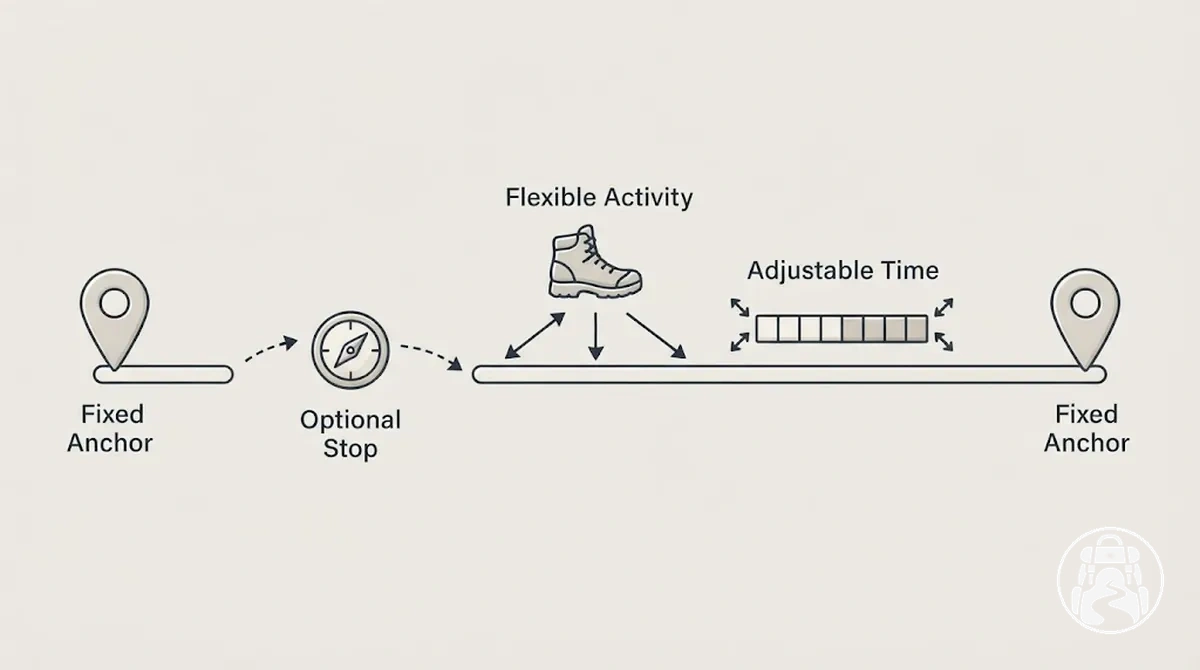
- Inclusion: An optional stop or activity can be skipped when doing so leaves fixed commitments intact, but it becomes less adjustable if another plan begins to depend on it.
- Timing: A flexible activity can move to another suitable time when delays, fatigue, weather, or another priority affects the original plan and no fixed anchor is threatened.
- Duration: Time allocated to an optional stop can be shortened or extended when the surrounding itinerary has enough room and the change does not interfere with a fixed commitment.
- Sequence: Optional elements can change order when their dependencies permit it, allowing one activity or stop to move around an unchanged itinerary anchor.
For example, a fixed commitment can remain unchanged while an optional afternoon activity moves to another day and a low-priority stop is shortened; the anchors stay intact while the adjustable parts absorb the change.
Use Advance Bookings as Anchors, Not a Full Schedule
An advance booking should act as one itinerary anchor rather than determine every surrounding activity.
The fixed date stays protected while optional stops and activities before and after it retain surrounding flexibility; the illustration shows that fixed point within otherwise adjustable time.
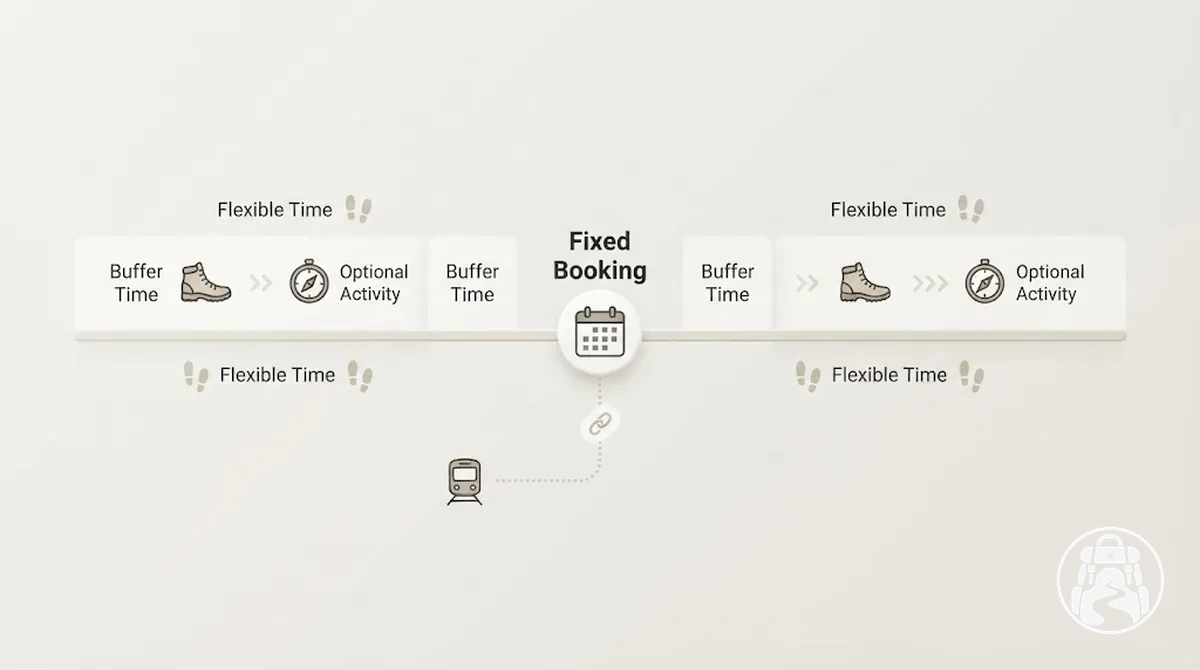
How much surrounding flexibility remains depends on the advance booking's changeability, its dependency with other plans, and the buffer time needed to reach the fixed date without constraining unrelated activities.
Deciding which accommodation to book ahead is a separate planning question; once a reservation exists, the task here is to structure flexible time around that commitment.
- Protect the fixed point: Treat the booking date and any genuinely dependent commitment as the local anchor without automatically fixing unrelated activities.
- Check changeability: If the reservation can be changed under its actual terms, it may leave more room for adjustment; if changing it is impractical, treat the booking as the firmer local constraint.
- Preserve buffer time: Leave enough uncommitted time before and after the anchor for ordinary adjustments, with the amount determined by the booking's rigidity and the consequences of arriving late or moving dependent plans.
- Limit dependencies: Keep optional activities independent where practical. For example, one fixed reservation can remain unchanged while an optional activity before it moves and a stop after it is shortened, leaving the itinerary anchor intact.
Build Buffer Days and Uncommitted Time Into the Itinerary
Buffer time should be placed deliberately around uncertainty and important commitments rather than added randomly.
A buffer day, shorter time margin, or block of uncommitted time creates slack between a high-risk transition and the next fixed anchor, giving a delay room to be absorbed without immediately shifting that commitment.

The amount of buffer time depends on trip length, transit complexity, fatigue, important deadlines, and the consequence of arriving late, so there is no single buffer quantity that fits every itinerary.
With no slack, the same delay may push later plans against the next fixed anchor; with deliberately uncommitted time, that disruption can instead use the available contingency period for recovery before the anchor.
Build the buffer deliberately
- Identify fixed anchors: Mark commitments whose timing needs protection so buffer time can be positioned in relation to the points that matter most.
- Locate high-risk transitions: Identify parts of the itinerary where uncertainty, demanding travel, or limited recovery time could allow a delay to affect the next anchor.
- Assign slack where consequences are greatest: Place a buffer day or smaller time margin around uncertain transitions according to the importance of the following commitment and the practical consequence of reaching it late.
- Leave some time genuinely uncommitted: Keep selected periods free from required activities so they can absorb a delay, provide recovery time, or accommodate a changed plan instead of becoming another packed part of the schedule.
- Verify the contingency: Test whether a modest disruption at a high-risk transition can use the available slack without threatening the next fixed anchor; if it cannot, the itinerary needs more recovery space or fewer commitments in that segment.
Place Buffer Days Around Important Commitments
Buffer time is most valuable near an important commitment when a delay or fatigue would create serious downstream consequences, so placement should follow consequence and uncertainty rather than be distributed evenly.
The diagram shows a buffer day positioned around a higher-consequence anchor, with visible slack separating the preceding travel segment from the commitment.
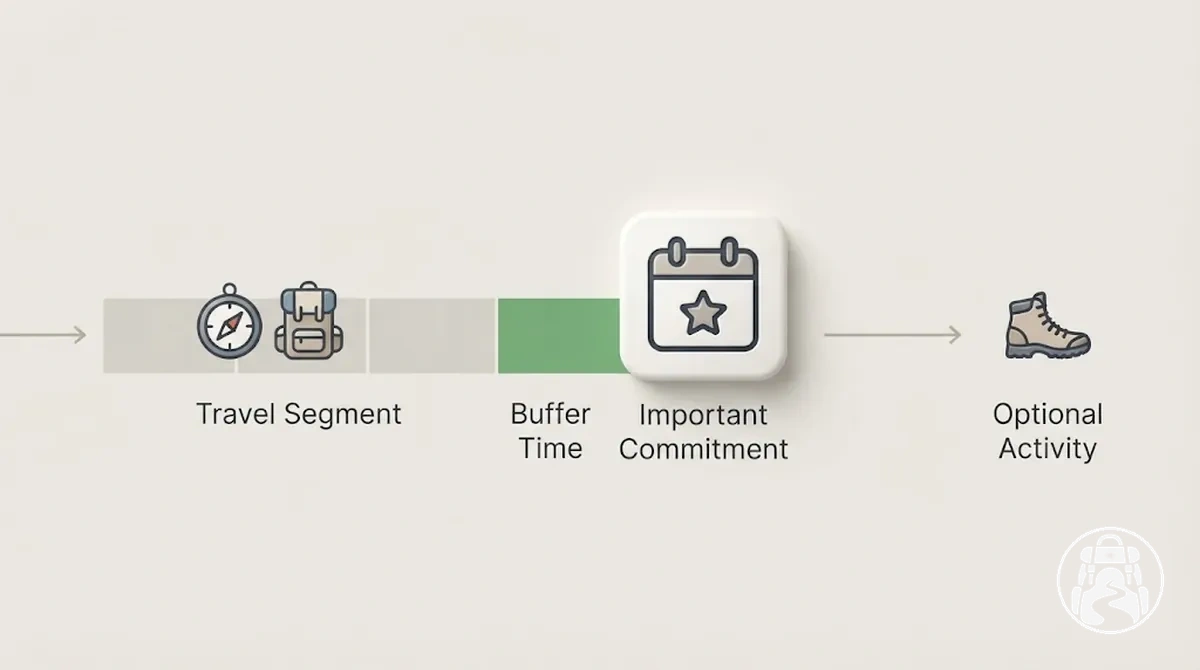
What changes the amount of buffer
- Consequence of delay: Preserve more slack around an important commitment when arriving late would disrupt a fixed departure, deadline, or dependent plan; low-stakes optional activities generally need less protection.
- Uncertainty: Buffer placement is more useful where the preceding segment has greater timing uncertainty because disruption has more opportunity to reach the next anchor.
- Travel intensity: A demanding travel segment can justify additional time margin before an important commitment when fatigue or limited adjustment options reduce the available recovery margin.
- Recovery time: Consider how much recovery time remains after a disruption; when little usable time exists before the next anchor, preserving slack closer to that commitment becomes more important.
For example, spare time before a time-critical departure protects a higher-consequence commitment, while the same margin around a low-stakes optional activity may provide less practical value because that activity can often move instead.
The appropriate buffer quantity depends on consequence, uncertainty, travel intensity, and available recovery time rather than a fixed number of days.
Leave Some Time Uncommitted for Delays, Rest, and Unexpected Changes
Uncommitted time is intentionally unallocated itinerary capacity that provides itinerary slack for recovery and adaptation rather than space that must be filled in advance.
It becomes more useful when a segment is uncertain or demanding because delays, fatigue, or an unexpected change have more opportunity to affect a later fixed plan.
What uncommitted time can absorb
- Delays: Uncommitted time can absorb a late arrival or other minor delay by leaving flexible time before the next fixed plan instead of forcing every later activity to shift.
- Rest and recovery: Spare time allows rest when fatigue makes the original schedule impractical, supporting recovery without automatically changing an important commitment.
- Unexpected changes: Flexible time can accommodate a closure, cancellation, or other unexpected change by leaving room to adjust an activity without creating an immediate cascade through the itinerary.
- New opportunities: Unallocated time can also accommodate a worthwhile activity discovered during the trip when doing so does not interfere with genuine constraints or a fixed plan.
For example, if a minor delay uses an intentionally uncommitted half-day, the traveller can recover that time without shifting the next fixed plan; without that slack, the same disruption could push several planned activities later.
The useful amount of uncommitted time depends on uncertainty, travel demands, and recovery needs rather than a required number of free hours or days.
Set Contingency Rules for What Can Be Delayed, Skipped, or Reordered
A contingency rule is a pre-decided response to a specific disruption that identifies which flexible element can change while the next fixed commitment remains protected.
A delay, cancellation, fatigue, or changed priority can trigger the rule. If the disruption threatens the next fixed commitment, adjust the lower-priority flexible element with the lowest consequence first; this keeps the response local instead of rebuilding the itinerary under pressure.
Contingency sequence
- Identify the trigger: If a delay, cancellation, fatigue, or changed priority affects the current plan, determine whether it threatens the timing of the next fixed commitment.
- Protect the fixed commitment: If the anchor would be affected, keep its required timing intact where practical and identify the surrounding plans that remain flexible.
- Select a flexible element: Choose a lower-priority activity or stop that you can delay, skip, shorten, or reorder without creating a greater dependency problem elsewhere in the itinerary.
- Apply the lowest-consequence adjustment: Select the change that sacrifices the least important flexible element while protecting the anchor. For example, if a transport delay threatens a fixed evening commitment, the contingency rule might skip a lower-priority afternoon activity rather than shift the fixed plan or several dependent activities.
Adapt the Itinerary When Plans Change
When plans change, protect the next fixed anchor first and make the smallest workable adjustment.
Choose that adjustment from what changed, how much slack remains, which flexible segment can absorb the disruption, and the consequence of moving each option; a delay, unexpected fatigue, or an extra stop can therefore require different responses.
Smallest-workable-change sequence
- Identify what changed: Define the changed condition clearly, such as a delay, fatigue, or an optional stop taking longer than planned, so the adjustment addresses the actual disruption rather than unrelated parts of the itinerary.
- Protect the next fixed anchor: Confirm which upcoming commitment has the least flexibility and keep its required timing or sequence intact while evaluating the surrounding plans.
- Reassess remaining slack: Check how much uncommitted time or flexible capacity remains before the anchor and which flexible segment can absorb some or all of the change without creating a larger consequence.
- Choose the smallest workable adjustment: Delay, shorten, skip, or reorder only the flexible element needed to restore a workable sequence. For example, if a delayed connection reduces available time before a fixed evening commitment, shortening one optional stop may be sufficient without changing the rest of the itinerary.
- Verify the revised sequence: Check that the revised sequence still fits the remaining time, preserves the fixed anchor, and does not create a new conflict with another important constraint. This verification confirms whether the adjustment is sufficient; if it is not, reassess the next-lowest-consequence flexible element.
Adjust Flexible Segments Before Changing Fixed Commitments
Lower-consequence flexible segments should normally change before high-consequence fixed commitments because they usually have greater changeability and fewer downstream consequences.
The hierarchy should also consider available slack, dependencies, and practical change difficulty. A transport disruption is only one trigger: use the remaining slack and relative consequence of each option to decide how far down the hierarchy the adjustment must go, and reconsider a fixed commitment only when protecting it would create a greater overall consequence.
Adjustment hierarchy
- Adjust optional timing or activities: Move, shorten, or skip a flexible segment when its timing has high changeability and changing it leaves important dependencies intact.
- Adjust movable stops or durations: If the first change is insufficient, reconsider a stop, duration, or other adjustable plan that can absorb more of the disruption without creating a larger downstream consequence.
- Use remaining slack: Apply available slack where it can accommodate the change while keeping higher-consequence commitments protected and the surrounding sequence workable.
- Reconsider the fixed commitment only if necessary: If flexible adjustments and available slack cannot produce a workable itinerary, evaluate whether moving the fixed commitment creates a lower overall consequence than forcing further changes elsewhere.
Reorder or Remove Optional Stops When the Route Changes
An optional stop can be reordered or removed when that route adjustment restores feasibility or protects a more important fixed anchor.
Decision rule: keep an optional stop when it still fits, move it when another position works with the changed constraints, and remove it when retaining it would create a greater downstream problem.
This is an adjustment to an existing itinerary rather than a new route-design exercise; the separate task is to start with a practical travel route before conditions change.
- Reassess the next fixed anchor: Confirm the timing or sequence that still needs protection and identify which optional stops now compete with the available time.
- Compare optional-stop priority and time requirement: Keep higher-priority stops that still fit, and identify lower-priority stops whose time demand creates the greatest pressure on the revised sequence.
- Reorder before removing when practical: Move an optional stop to another workable position if its sequence can change without threatening the fixed anchor or creating a new dependency problem.
- Remove if needed and verify feasibility: If reordering does not restore feasibility, drop the optional stop whose removal has the lowest consequence, then confirm that the revised sequence still fits the available time and protects the fixed anchor. For example, if a route change leaves insufficient time before a later fixed commitment, removing one low-priority stop can keep that anchor intact without altering the rest of the itinerary.
Recheck the Next Fixed Commitment After Each Change
Every itinerary change should be checked against the next fixed commitment before further plans are added.
This verification checks the revised itinerary's date and time, location, travel window, dependencies, and remaining slack before the traveller proceeds.
Verify before continuing
- Date and time: Confirm that the revised itinerary still reaches the next fixed commitment at its required date and time; if the change puts that timing at risk, another adjustment is required.
- Location: Check that the revised sequence still places the traveller in the correct location for the next fixed commitment; if it does not, revise the affected plan before proceeding.
- Travel window: Compare the available travel window with the movement still required to reach the next anchor; if the revised itinerary no longer fits that window, another adjustment is required.
- Dependency: Verify whether any activity, connection, or other dependency now conflicts with the fixed commitment; if one does, revise the affected flexible element before continuing.
- Remaining slack: Check whether enough slack remains for the revised itinerary to reach the next fixed commitment without immediately threatening it; if not, another adjustment is required.
If any check shows that the next fixed commitment is threatened, revise the itinerary again before adding or changing further plans.
Recognize and Correct an Overplanned Itinerary
An overplanned itinerary is structurally rigid enough that an ordinary delay, fatigue, or preference change can create a cascading problem across later plans.
It often appears when several elements depend on fixed timing, recovery margin is thin, or an optional choice has become an obligation. Detail alone is not overplanning: a detailed itinerary can remain flexible when clear anchors still have adjustable elements and recovery capacity around them.
Symptom → likely structure → corrective check
- Symptom: one small delay shifts several later plans. A likely structural cause is a chain of fixed dependencies with little separation between them. Check whether moving one activity forces multiple later commitments to move; if it does, correct the structure by making a lower-consequence dependency flexible or separating optional plans from the fixed chain.
- Symptom: fatigue leaves no practical way to slow down. The likely structural cause may be insufficient recovery margin rather than the amount of detail in the plan. Check whether any nearby activity or time block can absorb rest without threatening an important anchor; if none can, create recovery capacity by shortening, moving, or dropping a lower-priority obligation.
- Symptom: an optional activity now behaves like a mandatory commitment. This suggests an optional obligation has acquired dependencies or rigid timing. Check what later plans actually rely on it; if the dependency is not essential, correct the itinerary by restoring the activity's optional status or removing the unnecessary dependency.
- Symptom: the itinerary is detailed but ordinary changes remain contained. This does not by itself indicate overplanning. Check whether fixed anchors still have adjustable plans or recovery margin around them; if they do, no corrective adjustment is required simply because the itinerary contains detail.
Useful planning preserves enough recovery capacity for ordinary changes to remain local rather than becoming a cascading problem across later commitments.
Watch for Minute-by-Minute Scheduling and No Recovery Time
Minute-by-minute scheduling becomes a warning sign of scheduling rigidity when small delays repeatedly threaten later plans and little or no recovery time remains.
One tightly scheduled day does not by itself indicate overplanning; the stronger signal is a recurring pattern in which exact timing, back-to-back plans, and missing slack make ordinary changes difficult to absorb.
Rigidity signals
- Minute-by-minute commitments: Repeated dependence on exact timing suggests rigidity when a minor delay in one activity regularly pushes several later plans out of sequence.
- Back-to-back plans: A sequence of activities or travel with no usable recovery time indicates a risk of overplanning when one late finish immediately threatens the next commitment. Repeatedly arranging days this way can also make it harder to avoid an overpacked travel pace.
- Repeated exact-timing dependence: Exact timing becomes more significant when several later plans depend on each earlier activity ending as scheduled; the resulting dependency pattern makes small disruptions more likely to spread through the itinerary.
- No recovery time: A schedule with no time margin becomes problematic when delays, fatigue, or ordinary changes have nowhere to be absorbed before the next important commitment.
A tightly scheduled day can still remain workable when deliberate slack separates its most important commitments; by contrast, a similarly full day with no recovery margin is more rigid because even a minor delay can threaten later plans.
Remove Low-Priority Fixed Points
A low-priority fixed point should be reconsidered when its scheduling impact is high relative to its necessity or importance. The aim is to reduce rigidity by deciding whether a weak anchor can be shortened, moved, unfixed, or removed while genuinely consequential commitments remain protected.
Compare necessity, uniqueness, downstream dependency, change cost, personal importance, and scheduling pressure. A low-value commitment with large downstream effects is a stronger candidate for adjustment than an anchor whose movement would create serious consequences.
Criteria for a weak anchor
- Necessity and uniqueness: Reconsider a fixed point when it is optional, replaceable, or not unique but its fixed timing constrains several other plans; retain it when the commitment is genuinely necessary or difficult to substitute.
- Downstream dependency: Check how important later plans depend on the fixed point. A low-priority item that forces multiple later elements to remain rigid is a stronger candidate to move, shorten, or remove, while a consequential anchor with essential dependencies should stay protected.
- Change cost: Compare the practical difficulty or consequence of changing the fixed point with the disruption caused by keeping it. If loosening the commitment creates fewer problems than preserving its current timing, corrective adjustment becomes more reasonable.
- Personal importance and scheduling impact: A commitment with limited personal importance but a large scheduling impact can be treated as a weak anchor; a personally important commitment may justify remaining fixed even when it reduces flexibility elsewhere.
For example, if a low-value obligation fixes an entire afternoon and removes the slack needed before a more important later commitment, removing that obligation can restore slack while keeping the higher-priority anchor protected.
Restore Buffer Time Before Adding New Plans
Regained time should first rebuild itinerary slack around the next anchor before it is used for any optional addition.
The amount of restored buffer needed depends on the remaining uncertainty, travel intensity, recovery need, and the consequence of a future delay rather than on a fixed universal target.
This corrective order prevents newly freed time from immediately becoming another rigid commitment and keeps restored slack available until verification shows that the revised itinerary has enough resilience to absorb ordinary disruption.
Recovery order
- Restore a margin around the next anchor: Preserve regained time as buffer before the next important commitment instead of immediately filling it with another activity.
- Reassess recovery need: Check whether fatigue, demanding travel, or remaining uncertainty increases the need for recovery time; greater exposure to these conditions supports keeping more of the regained time uncommitted.
- Verify disruption capacity: Test whether a small delay or other ordinary change could be absorbed by the revised itinerary without threatening the next anchor. If it cannot, preserve more slack or make another adjustment before proceeding.
- Consider optional additions only afterward: Add an optional plan only when the remaining buffer still protects the next anchor and leaves adequate capacity for the identified recovery need and uncertainty.
For example, an itinerary may initially become fragile when every newly freed period is replaced with another activity; after that time is kept as a buffer around the next anchor and the revised sequence can absorb a small disruption, the same core itinerary becomes more adaptable without changing its main commitments.