
Planning a Realistic Backpacking Travel Pace
A realistic backpacking travel pace is one where total trip days minus transfer and non-destination time still leaves each destination enough usable time for its intended activities, recovery, and flexibility. There is no universal days-per-stop rule: plan from usable destination time, then reduce stops or simplify transfers whenever movement repeatedly prevents priority stops from getting the time they need.
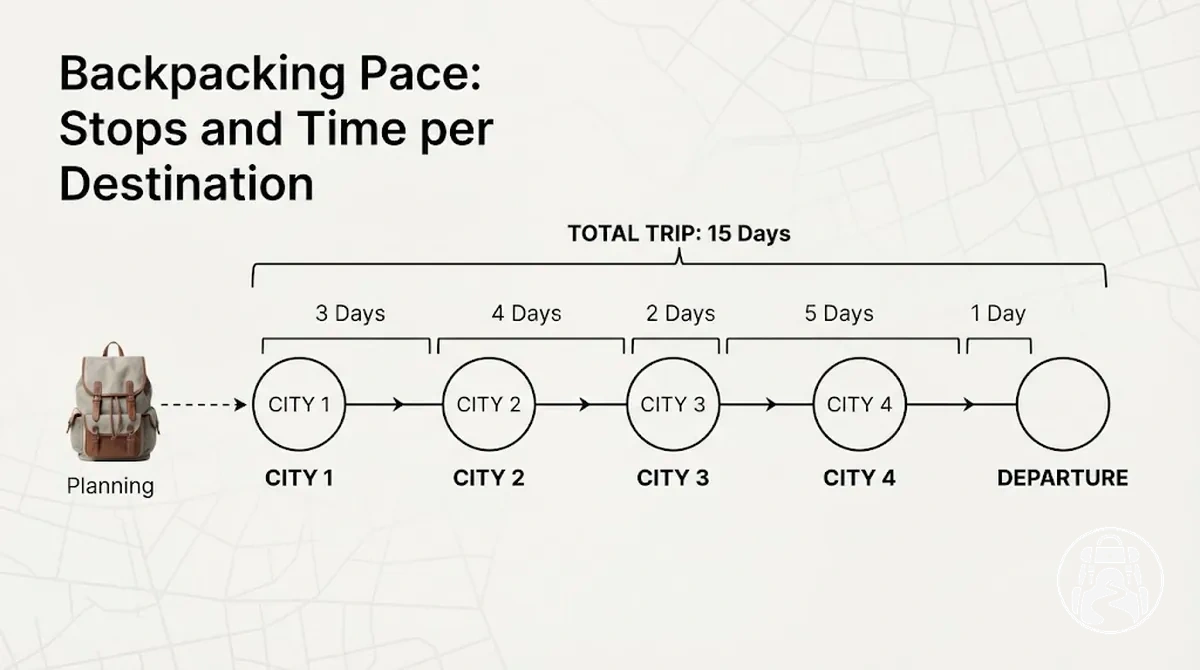
Plan from the time you can actually use
Backpacking travel pace planner
Enter the trip length, the estimated time consumed by inter-destination transfers and other non-destination logistics, and the number of planned stops. The result shows the time left for destinations and the average capacity per stop; it is a planning check, not a recommended stay length.
Interpret the average as capacity, not a target. Allocate more time to destinations with greater scope or higher-priority activities, and less to stops with a narrower purpose. Recheck the itinerary if transfers or repeated short stays keep displacing priority time.
Backpacking travel pace here means how quickly an international multi-destination trip moves between places, not walking or hiking speed. Trip length is the fixed time budget; usable destination time is the portion that remains at stops after movement, arrivals, departures, and related logistics are accounted for.
Stop count, transfer burden, destination priorities, desired depth of experience, recovery needs, and flexibility determine how that usable time should be divided. A pace is workable when each chosen stop retains enough time for its intended purpose without movement repeatedly displacing higher-priority time.
Table of Contents
How Trip Length Constrains Backpacking Travel Pace
Trip length sets the total time budget within which transfer days and destination days must fit.
Total trip days create an upper boundary for the time available across every stop, but they do not determine the exact stop count because transfer duration, destination priorities, and required stay length can differ.
Non-destination time reduces the portion of the calendar length that can be used at destinations.
Pacing choices therefore depend on how much usable destination time remains after those competing demands are accounted for.
Trip length becomes more useful for pacing when total days are separated into time that can be spent at destinations and time consumed by movement and trip logistics.
Transfer days, arrivals, departures, and other non-destination time draw from the same finite trip duration as destination stays.
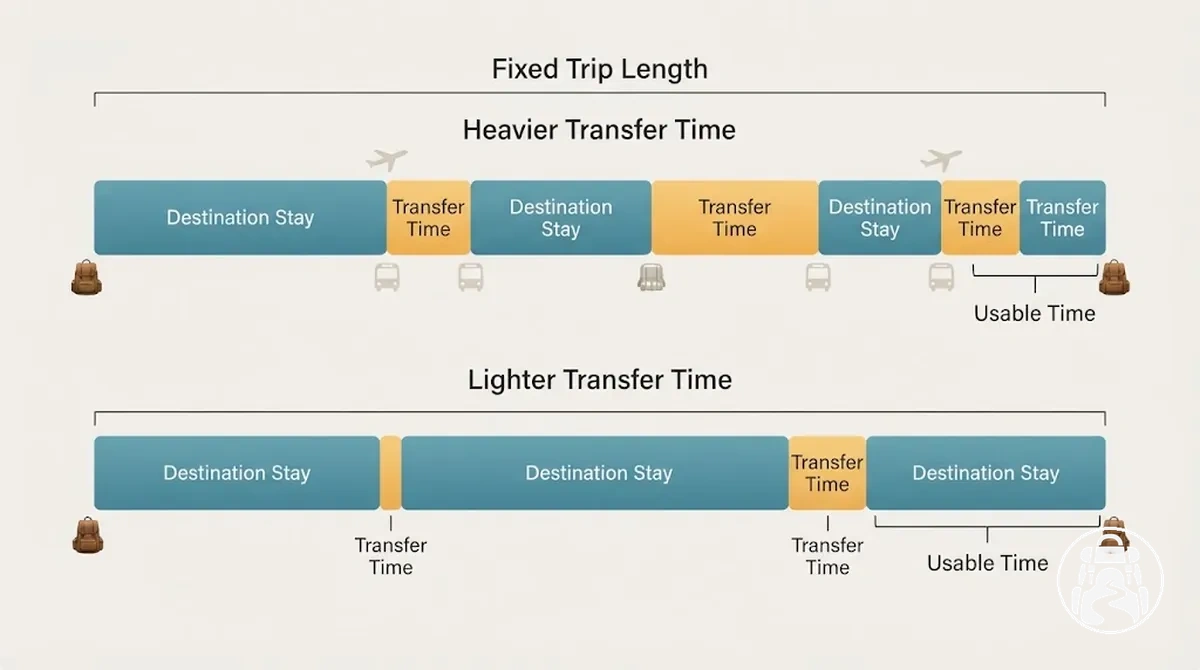 Usable destination time is what remains for the intended stay after those demands are accounted for.
A higher transfer burden leaves fewer usable days within the same calendar length, while a lower transfer burden leaves more time available at destinations.
The time categories below clarify how trip length becomes pacing capacity rather than a simple count of calendar days.
- Total trip days: the full calendar length available for both destination stays and movement between them.
- Transfer and non-destination time: time used by movement, arrivals, departures, and related trip logistics, which reduces the time available at destinations.
- Usable destination time: the remaining time available for stays at chosen destinations, which constrains how much destination time can be divided across the stop count.
Trip length can support different pacing choices even when two itineraries have the same calendar length.
A trip with more frequent or longer transfers can leave less usable destination time and may require shorter stays or fewer meaningful stops, while the same calendar length with fewer transfers can preserve more time at destinations.
The appropriate stop count remains conditional on transfer burden, destination priorities, and the amount of usable time each stop requires.
This relationship defines the trip-length constraint without determining the detailed treatment of individual transfer days.
Count Travel Days Separately From Full Destination Days
A travel day should be counted by how much usable destination time it removes, not by the calendar date alone.
A transfer day is therefore not automatically equivalent to a full destination day because some journeys leave substantial activity time while others consume most of it.
The practical value of a travel day depends on the transfer burden and the amount of usable destination time remaining after the journey.
Travel-day burden changes with departure time, journey duration, connections, waiting time, arrival time, and check-in.
An early departure followed by a short, straightforward journey may leave a meaningful part of the day available at the destination, while later arrival or multiple connections can reduce activity time substantially.
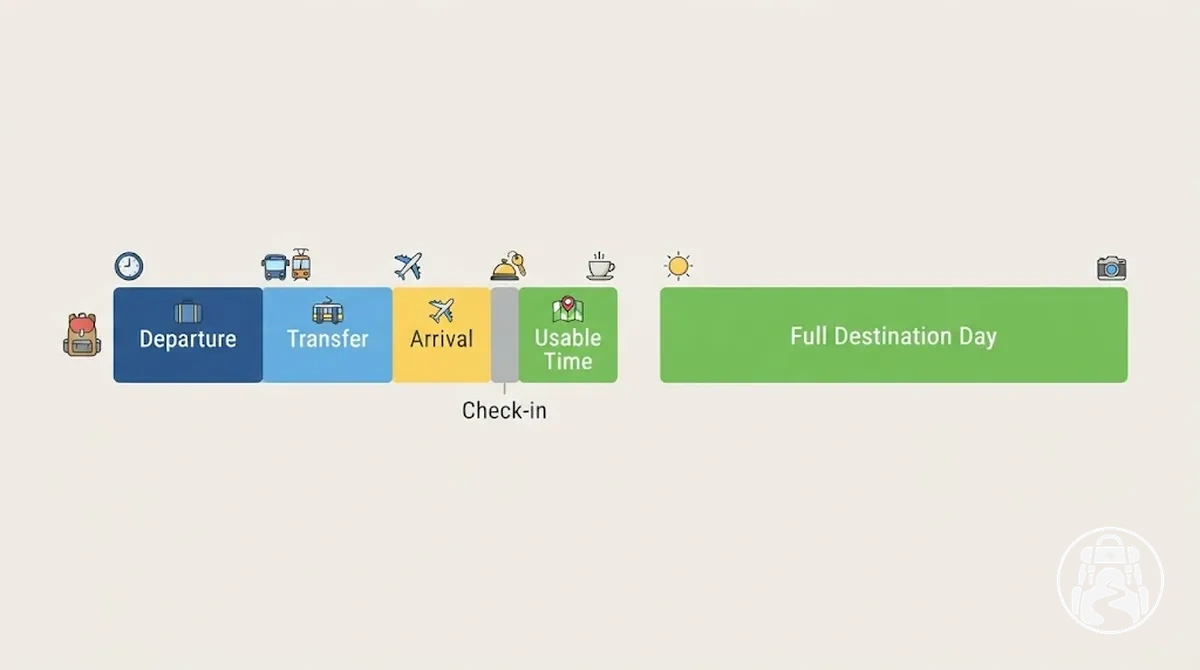 Check-in and onward movement after arrival can reduce usable time further even when the main journey itself is relatively short.
Each transfer day should therefore be evaluated by its actual effect on destination time rather than classified as either a complete day available or a complete day unavailable.
A light transfer day may still leave substantial usable destination time, whereas a long or multi-stage transfer may consume most of the day and function more like a travel-heavy day.
This distinction helps separate partial travel days from full destination days without imposing fixed thresholds that would ignore differences in schedules and transfer complexity.
Balance the Number of Stops With Time per Destination
The number of stops competes with time per destination for the same finite pool of usable trip days.
Adding another stop allocates some of that time away from existing stays and commonly adds another transfer, increasing transfer overhead.
A higher stop count can therefore reduce average stay length unless the trip has enough usable time to absorb the additional destination.
The trade-off is between broader coverage and enough time at each stop for its intended purpose.
The number of stops, transfer frequency, and average stay length are interdependent rather than separate planning choices.
More stops usually mean more movement between destinations, while fewer stops leave a larger share of usable trip days available for each stay.
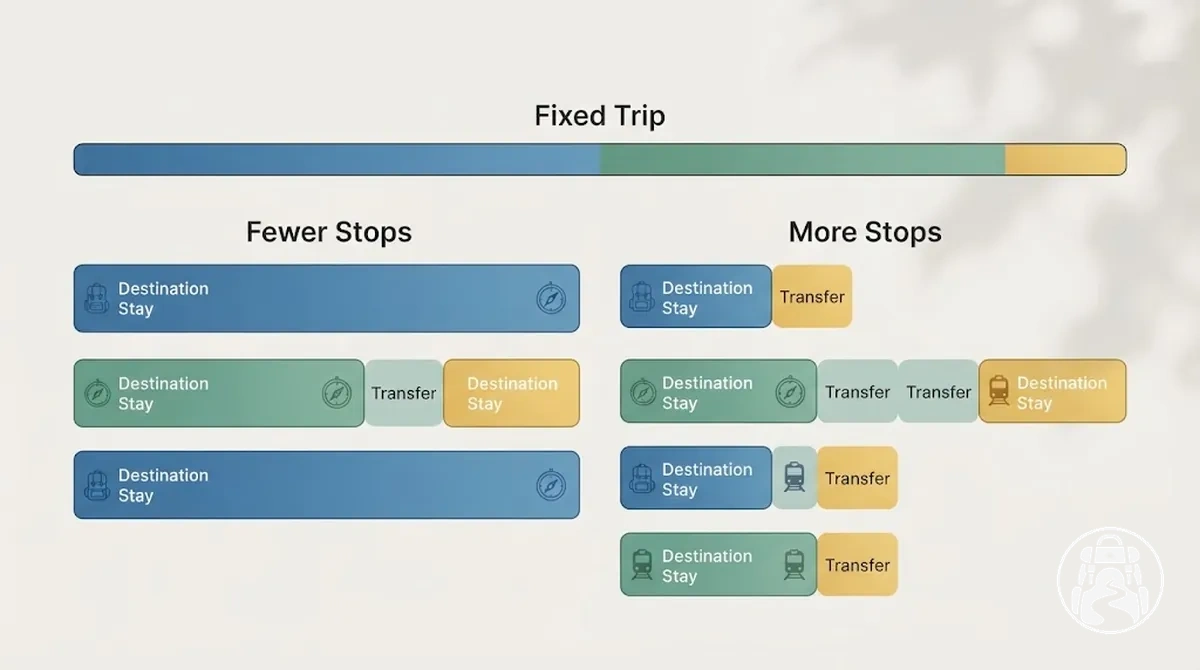 Destination priorities change how much time per destination is useful because the intended activities and desired depth of experience can require different stay lengths.
Travel distance also affects transfer overhead, so the same stop count can produce different pacing outcomes when transfers are shorter or longer.
The planning variables below show how each change affects the time available across the itinerary.
| Variable | If It Increases | Effect on Usable Destination Time | Planning Implication |
|---|---|---|---|
| Stop count | More destinations share the same pool of usable trip days. | Average time per destination decreases unless additional trip time is available. | Add another stop only when the remaining stays still have enough usable time for their intended purpose. |
| Transfer frequency | Movement between destinations occurs more often. | More of the available trip time is exposed to transfer overhead rather than destination activity. | Frequent transfers can make a higher stop count less practical even when all planned stops technically fit within the trip duration. |
| Average stay length | More usable time is allocated to each destination. | Less of the fixed time budget remains available for additional stops. | Longer stays favour greater depth at existing destinations rather than adding more stops. |
The number of stops may be worth increasing when the additional destination adds enough value without reducing the remaining stay lengths below what their intended activities require.
A destination that needs more time because of its scale, priorities, or planned activities raises the time requirement for that stop and leaves less capacity for others.
The practical decision is therefore not a fixed destinations-per-week rule but whether each stop still receives sufficient usable time after transfer overhead and other stays are accounted for.
If adding another destination makes that condition fail, reducing the stop count protects time per destination.
Use Full Days, Not Nights Alone, to Judge Stay Length
Full usable destination days are not the same measure as nights booked because the arrival day and departure day may provide only partial usable time.
A night count records overnight stays, while full days represent complete intervening days that can be used at the destination.
For a conventional continuous stay of N nights, the calendar contains N − 1 full intervening days, plus the usable portions of the arrival and departure days; transfer timing determines how much of those boundary days is actually available.
Stay length should therefore be judged by the usable destination time available across the arrival day, intervening days, and departure day rather than by nights alone.
The practical total remains conditional on itinerary timing and transfer burden.
Full usable destination days depend on when the traveller arrives and departs as well as how much time transfers consume.
An early arrival may leave substantial activity time on the arrival day, while a late arrival may leave little usable destination time.
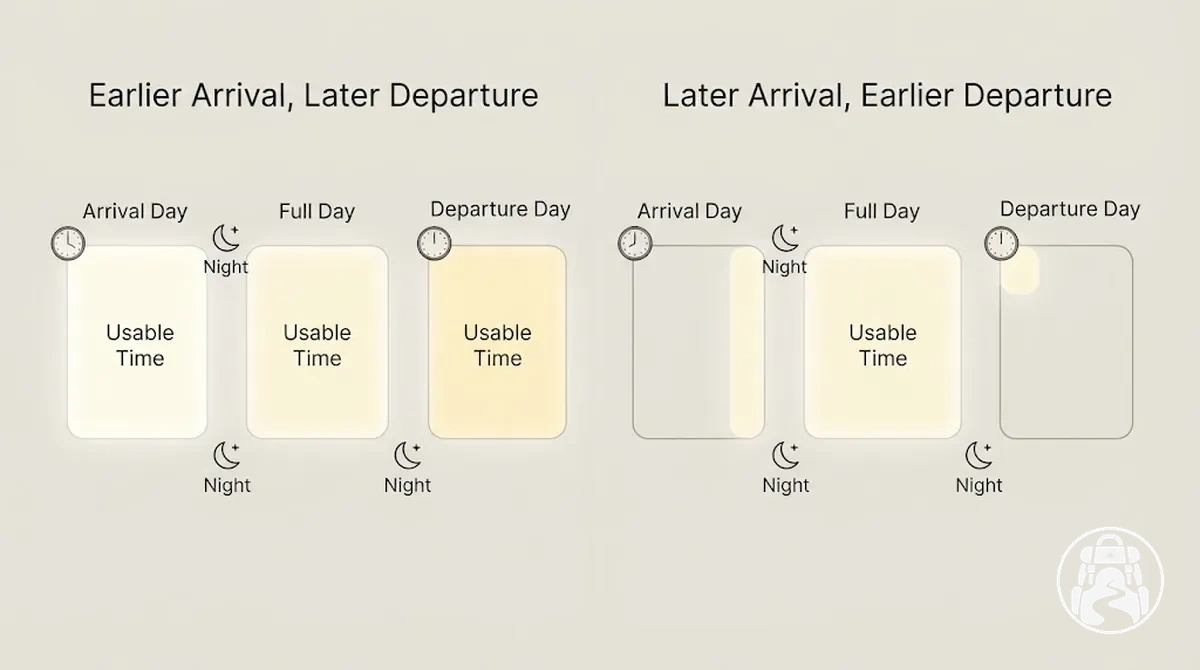 The departure day can likewise provide meaningful usable time when departure is later, or much less when an early transfer occupies the day.
Full intervening days provide the clearest measure of complete destination availability, while partial arrival and departure days should be evaluated according to their actual timing.
Transfer burden can further reduce activity time before arrival or before departure.
Because night count records overnight stays rather than usable daytime, it is only a proxy for time on the ground.
For example, two stays with the same number of nights can produce different practical stay lengths: one traveller who arrives early and leaves late may retain substantial usable time on both boundary days, while another who arrives late and departs early may rely mainly on the intervening full days.
Usable destination time should therefore be assessed from the actual arrival, departure, and intervening-day pattern rather than inferred directly from nights booked.
Adjust Stay Length to Destination Size and Priorities
Useful stay length should expand or contract according to destination size and the traveller's actual destination priorities rather than follow one universal minimum.
A destination with broader scope or more high-priority activities may require more usable days, while a stop with a narrower purpose can justify a shorter time allocation.
The relevant time requirement therefore depends on what the traveller intends to accomplish at that destination.
Stay length should reflect those demands without turning the pacing decision into a destination ranking.
Destination characteristics and personal priorities modify the amount of usable time a stop needs.
The main criteria are the scope of the destination, the activities that matter most, optional day trips, desired depth of experience, and any recovery time needed to maintain the intended pace.
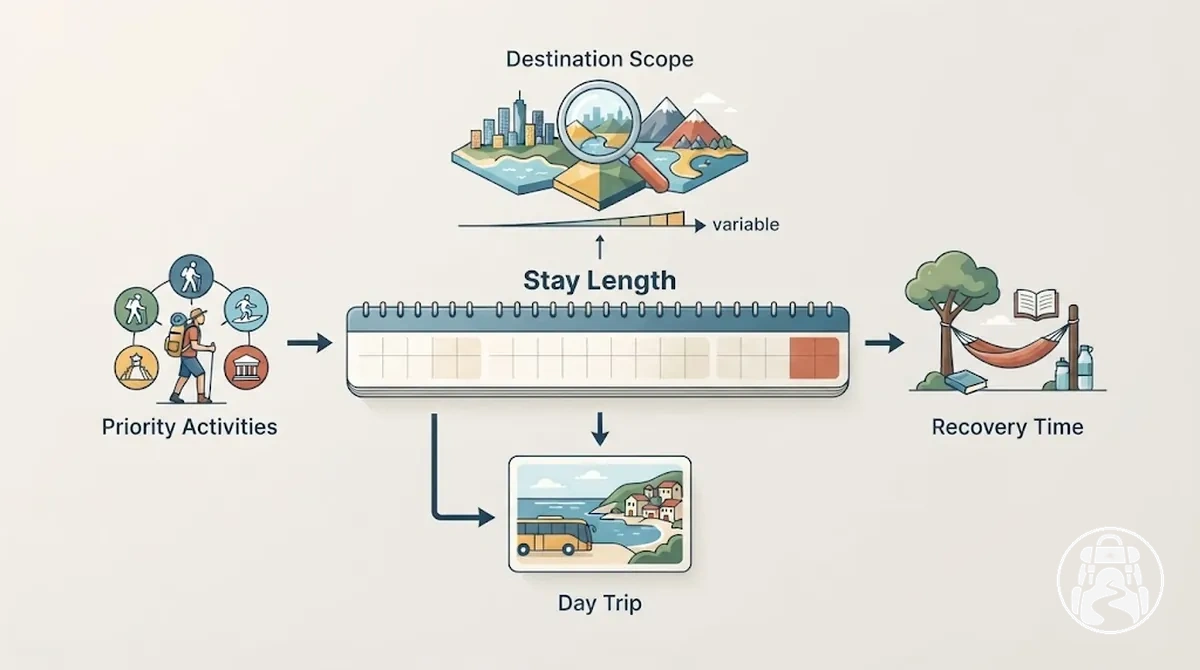 Each criterion changes the time requirement in a different direction, so the useful stay length comes from their combined effect rather than a fixed duration.
The criteria below show how those conditions affect the allocation of usable days.
- Destination size: a larger or more dispersed destination may require more usable days when reaching the traveller's intended areas takes additional time, while a more compact scope can support a shorter stay.
- High-priority activities: a longer list of activities the traveller considers important increases the time requirement; fewer priorities can justify a shorter stay when they fit comfortably within the available time.
- Day trips: adding a day trip consumes part of the stay and may require more usable days at the base destination, while skipping optional excursions can reduce the required stay length.
- Depth of experience: a preference for slower exploration or more time within each area may require a longer stay, while a narrower set of objectives can support a shorter allocation.
- Recovery time: planned rest or lower-intensity time increases the amount of calendar time needed to preserve the same activity priorities, while less recovery time leaves more of the stay available for planned activities.
Useful stay length is sufficient when the available usable days can support the intended purpose of the stop at the chosen pace.
If the destination's demands increase, the stay may need to lengthen; if the intended scope narrows, a shorter stay may be workable.
The pacing decision ends at that time-allocation boundary rather than extending into broader destination selection.
Fast vs Slow Backpacking Pace
Fast and slow backpacking pace describe different allocations of movement frequency and usable time per destination rather than a hierarchy of travel styles.
Fast travel tends to involve a higher transfer frequency and broader destination breadth within the same trip span, while slow travel tends to allocate more time to each stop and greater stay depth.
These patterns change how much time remains for recovery, activities, and adjustments within each destination.
Which pace fits a trip depends on the conditions under which those trade-offs are acceptable.
The useful comparison is based on the same criteria for both pacing styles: transfer frequency, stay depth, recovery time, flexibility, destination breadth, and planning rigidity.
These dimensions show where each pace allocates time and how that allocation affects the traveller's options.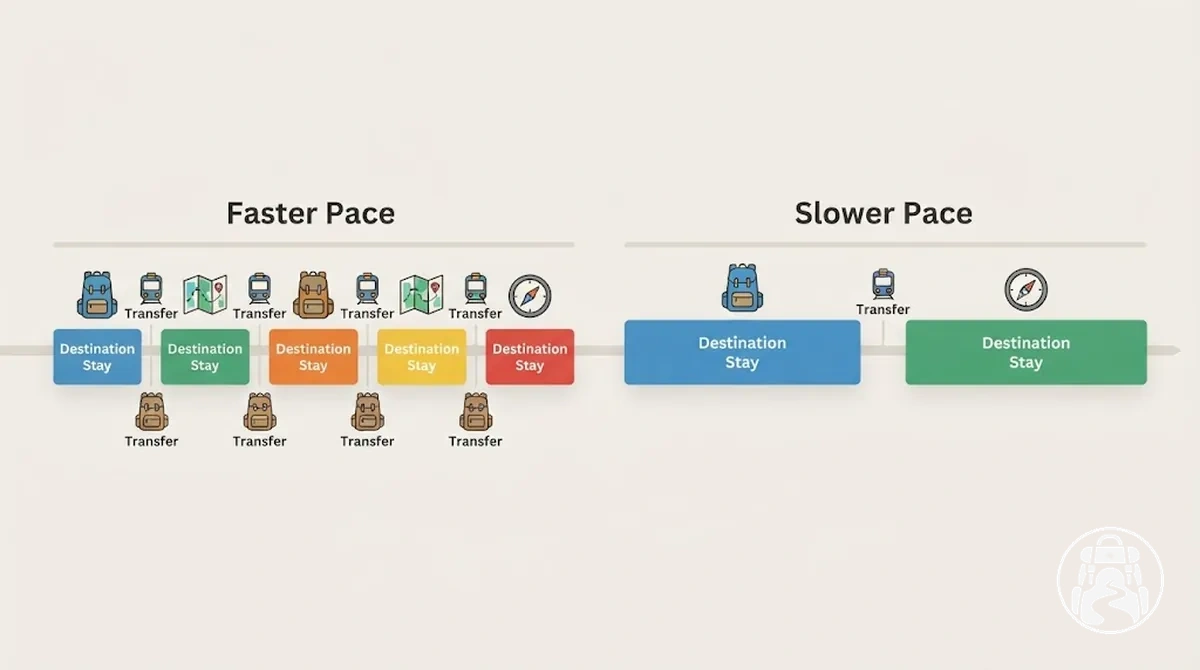
| Criterion | Faster Pace | Slower Pace | Why It Matters |
|---|---|---|---|
| Transfer frequency | More frequent location changes and more movement between destinations. | Less frequent location changes and longer intervals between transfers. | Transfer frequency affects how much of the trip is allocated to movement rather than time within destinations. |
| Average stay depth | Shorter stays tend to concentrate activities into a narrower period. | Longer stays allow more time for activities, exploration, or unstructured periods. | Stay depth affects how much usable time is available to pursue the intended purpose of each stop. |
| Recovery time | Frequent movement can leave less room between transfers for rest or lower-intensity periods. | Longer destination blocks can provide more room for recovery within the itinerary. | Recovery needs affect whether the pace remains workable across the full trip. |
| Itinerary flexibility | More scheduled moves can leave less room to change plans without affecting later stops. | Longer stays may provide more flexibility for spontaneous changes within a destination. | Flexibility determines how easily the itinerary can absorb changed priorities or unexpected opportunities. |
| Destination breadth | More destinations can be included when less time is allocated to each stop. | Fewer destinations tend to receive a larger share of the available trip time. | Destination breadth reflects the trade-off between covering more places and allocating greater depth to each one. |
| Planning rigidity | Frequent transfers may require tighter sequencing when later movements depend on earlier departures and arrivals. | Longer stays can reduce the number of movement points that constrain the itinerary. | Planning rigidity affects how much adjustment is possible without disrupting subsequent travel. |
Fast travel trades more frequent movement for greater destination breadth, while slow travel trades some breadth for greater stay depth and more time between location changes.
A faster pace may suit a trip when the chosen stops have narrower time requirements, travel distances are manageable, and the traveller is comfortable with frequent transfers.
A slower pace may suit priorities that require more usable time within destinations, more recovery time, or greater flexibility for unplanned changes.
Neither pattern is inherently the correct choice because the practical trade-off changes with the trip and the traveller.
Suitability depends on trip length, destination priorities, travel distances, recovery needs, and the amount of flexibility the traveller wants to retain.
Longer or more demanding transfers can make a high transfer frequency harder to accommodate, while shorter movements can make a faster pace more workable.
Travellers who value room to change plans may prefer a pace that leaves more unscheduled destination time, whereas those prioritising broader destination coverage may accept greater planning rigidity.
The appropriate pace is the one that keeps movement frequency, usable destination time, and desired flexibility consistent with the trip’s actual priorities.
Signs a Backpacking Itinerary Is Too Rushed
A rushed backpacking itinerary is more likely when several time-pressure signals occur together, not because of one fixed night count, stop count, or isolated diagnostic signal.
Frequent location changes, high transfer burden, short usable stays, repeated packing and check-in cycles, and too little recovery time or activity time can collectively suggest that the planned pace is overloaded.
One of these conditions on its own does not necessarily mean the itinerary is too rushed because the practical effect depends on transfer demands and destination priorities.
A stronger diagnostic signal comes from a repeated pattern in which movement and logistics consistently reduce the time available for the purposes of each stop.
The main signals should be interpreted by checking what is consuming usable destination time and whether that pressure repeatedly interferes with planned priorities.
Frequent location changes may indicate pressure when each move creates another packing, transfer, arrival, and check-in cycle within already short usable stays.
Long transfers beside major activity days can compress activity time, while arrival-and-departure-heavy stays can leave little time between movement periods.
Repeatedly dropping high-priority activities because the schedule cannot absorb them, especially alongside insufficient recovery time, strengthens the pattern of overload.
The diagnostic table distinguishes isolated constraints from signals that repeatedly reduce usable time.
| Signal | What It May Indicate | What to Check | Planning Implication |
|---|---|---|---|
| Frequent location changes | Repeated movement may be consuming a substantial share of otherwise usable stay time. | Check whether packing and check-in cycles repeatedly reduce activity time or recovery time at consecutive stops. | A recurring logistics burden suggests the overall pace may be placing too much time pressure on the itinerary. |
| Long transfers beside major activity days | The itinerary may be expecting substantial movement and high-priority activities to compete for the same usable time. | Check whether the transfer leaves enough activity time for the priorities assigned to that day. | If important activities repeatedly depend on a compressed post-transfer window, the pace shows a stronger overload signal. |
| Arrival-and-departure-heavy stays | A stay that looks adequate on the calendar may contain only a short usable period between arrival and departure demands. | Check how much usable destination time remains between the arrival day and departure day after transfer obligations are accounted for. | Several consecutive stays with little usable time between movements suggest the itinerary may be overpacked. |
| Repeated dropped priorities | Consistently abandoning intended activities may indicate that the planned time requirement exceeds the usable time available. | Check whether priorities are being dropped because of time pressure rather than a deliberate change in interest. | Repeated time-driven omissions strengthen the diagnostic pattern that the pace does not support the traveller's stated priorities. |
| Insufficient recovery time | Little space between demanding travel and activity periods may indicate that the itinerary has limited capacity for rest. | Check whether recovery time is repeatedly displaced by transfers, check-ins, or planned activities. | When recovery pressure appears alongside other signals, it adds evidence that the planned pace may be difficult to sustain. |
A short usable stay does not necessarily mean the itinerary is overloaded if transfers are manageable, the destination has a narrow purpose, and the available activity time still supports the traveller's priorities.
A similar-length stay can indicate more time pressure when a long transfer, repeated packing and check-in cycles, limited recovery time, and several competing priorities consume much of its usable time.
The decisive distinction is whether the itinerary repeatedly leaves enough usable destination time for what each stop is meant to accomplish.
A pattern of several diagnostic signals is more meaningful than any single short stay or frequent transfer considered in isolation.
How to Rebalance an Overpacked Backpacking Itinerary
Rebalancing an overpacked backpacking itinerary starts by identifying the variable consuming the most usable destination time before making smaller cuts elsewhere.
The highest-impact constraint may be an excessive stop count, high transfer burden, compressed stays, or too many optional activities competing with priority destinations.
The corrective direction should target that main source of time pressure rather than assume every itinerary needs the same change.
This keeps the adjustment proportional to the actual source of overload.
Check stop count, transfer burden, and compressed stays together while protecting priority destinations. Then adjust the highest-impact constraint first and verify whether the recovered time fixes the pressure without creating a new bottleneck.
- Identify the biggest source of time loss: locate the stop, transfer pattern, or compressed stay that is creating the greatest time pressure.
- Check the main adjustable variable: determine whether stop count, transfer burden, or stay compression is responsible for most of the lost usable destination time.
- Protect priority destinations: keep enough usable time for the stops and activities that matter most before reducing lower-priority demands.
- Reduce lower-value demands: remove or shorten optional activities, simplify a transfer, or reduce a lower-priority stop when that change addresses the highest-impact constraint.
- Verify the result: check whether the revised itinerary now leaves more usable destination time and reduces pressure on the remaining stays without creating a new bottleneck elsewhere.
The main correction should come before multiple small adjustments because removing one high-impact constraint can recover more usable destination time than trimming many activities across the trip.
Reducing stop count may help when repeated moves are the main source of overload, while simplifying transfer burden may be more effective when a few difficult journeys consume disproportionate time.
If priority destinations already have adequate time, reducing optional activities can relieve pressure without changing the broader route.
After each adjustment, verify whether the remaining stays have enough usable time for their intended purpose before making another change.
For example, if one low-priority stop creates a demanding transfer and compresses the stays on both sides, removing that stop may recover more usable destination time than shortening activities at several destinations.
If smaller timing corrections cannot resolve the overload because the sequence of destinations itself creates the problem, the next boundary is to adjust your backpacking route rather than continue making minor cuts.
Route restructuring is therefore a later corrective direction, not the default first response.
The rebalanced itinerary is workable when the main source of time pressure has been reduced and priority destinations retain sufficient usable time.
Reduce Stop Count Before Compressing Every Stay
Removing one lower-priority stop can sometimes recover more usable destination time than compressing several stays, particularly when that candidate stop also carries a meaningful transfer cost.
The adjustment can recover both the time allocated to the stop and time otherwise spent reaching or leaving it, giving neighbouring stays more room.
Removal is a test rather than a universal rule because another adjustment may recover enough time with less impact on the itinerary.
The candidate stop should therefore be evaluated by its priority, transfer cost, time recovered, and effect on the remaining destinations.
Test a lower-priority stop by estimating both the destination time and transfer burden its removal would recover, then compare that gain with smaller alternatives and check whether the change helps neighbouring and priority destinations rather than shifting the pressure elsewhere.
- Identify the candidate stop: choose the lowest-priority stop that is contributing meaningful time or transfer demands to the itinerary.
- Estimate the time recovered: compare the usable destination time and transfer cost removed with the time that would be gained by compressing several stays instead.
- Check the remaining itinerary: determine whether neighbouring stays and priority destinations receive more usable time without creating a new scheduling constraint.
- Compare smaller alternatives: remove the candidate stop only if its effect is more useful than shortening one long stay, simplifying a transfer, or making another lower-complexity adjustment.
For example, if a lower-priority stop requires a substantial detour and leaves both neighbouring stays compressed, dropping it may recover transfer time as well as destination time for those stays.
If simplifying the transfer or shortening one less important long stay produces a similar benefit while preserving the stop, removal may not be the preferable adjustment.