Plan an international backpacking trip by fixing the least-reversible constraints first—travel dates and usable trip time, applicable entry or transit requirements, the budget ceiling, and any immovable commitments—then shape destinations, route, pace, transport and accommodation around them. Commit early only when scarcity, dependency or high change cost makes delay consequential; keep lower-risk choices reversible, then stress-test the final plan against a delay, extra cost or missed connection before departure.
International backpacking planning sequence
Use the sequence in order: later decisions inherit the constraints established earlier, while reversible choices stay open until committing them has a clear benefit.
1
Lock the hard frameSet travel dates, usable trip time, immovable commitments, budget boundaries and applicable entry or transit requirements.Output: the conditions the rest of the trip must satisfy.
2
Shape destinations, route and paceFit stop order, transit burden, destination time, recovery time and buffers inside the usable travel window.Output: a route that is workable in time, not just on a map.
3
Align budget and logisticsCompare transport and accommodation by their combined effect on total cost, location, transit time and schedule flexibility.Output: a logistics pattern that stays inside the spending and time constraints.
4
Commit selectivelyBook earlier where scarcity, arrival dependency or high change cost makes unavailability consequential; keep lower-risk choices reversible.Output: fixed reservations only where commitment protects the trip.
5
Verify departure readinessConfirm documents, critical bookings, payment access and backup, communications, health needs, luggage and departure-critical details.Output: no unresolved condition that could block departure or break the first fixed dependency.
6
Stress-test the planTest what happens if one connection is delayed, one expected cost rises, or one fixed arrangement changes.Output: identify the earliest assumption that causes downstream failure and adjust that bottleneck.
Decision rule: if a later choice conflicts with an earlier constraint, repair the earliest conflicting assumption before adding more commitments.
Trip length and dates define the available time; destination conditions and applicable entry requirements narrow what is feasible; and the budget ceiling affects transport, accommodation, pace and the room available for unexpected changes.
Because flexibility also depends on uncertainty and traveller experience, the aim is to keep reversible choices open where uncertainty remains while anchoring the trip to conditions that cannot easily change. Changing one major constraint can therefore reshape several later decisions.
Table of Contents⌄
Core Parts of an International Backpacking Trip Plan
A workable international backpacking trip plan combines destination selection, route and travel pace, budget, transport, accommodation, booking flexibility, and readiness as interdependent planning components.
Each component performs a different function, but its practical value depends on how it fits the rest of the trip.
The illustration places these planning elements within one international travel context so their relationships are easier to see.
Destination choices shape the route, while the route and travel pace affect how much time is spent at stops versus in transit.
Budget constrains which transport and accommodation options remain practical, and booking availability can affect how much flexibility is realistic on fixed dates.
Readiness supports the whole plan by confirming that major travel logistics and required preparations are consistent before departure.
These relationships make the components useful as a connected set rather than as isolated planning tasks.
Planning system at a glance
Destination selection: establishes where the trip will go; trip length, destination conditions, budget, and entry constraints can narrow the workable choices and therefore affect the route.
Route and travel pace: connect destinations within the available time; longer or more complex transit between stops reduces the time available at destinations and affects transport and accommodation needs.
Budget: sets the spending boundary for the trip; available funds constrain transport, accommodation, travel pace, and how much financial room remains for changes.
Transport: makes the route physically workable between destinations; connection availability, travel time, and cost can require changes to the sequence or pace of the trip.
Accommodation: provides a workable place to stay at each stop; location, availability, and cost interact with the route, transport connections, budget, and booking flexibility.
Booking flexibility: determines which travel commitments remain adjustable; fixed dates or limited availability may justify firmer bookings, while reversible arrangements preserve more freedom to change the trip.
Readiness: checks whether the main travel arrangements and required preparations agree with the intended trip; unresolved conflicts between dates, logistics, documents, or bookings need attention before departure.
Here, international backpacking means backpacking travel abroad rather than backcountry or wilderness travel, so these components focus on destinations and travel logistics rather than trail-based planning.
Their relative importance can change with trip length, season, budget, destinations, and traveller constraints, but each remains connected to other parts of the plan.
Planning Priorities and Constraints Across the Trip
Planning priorities and constraints should be separated according to how strongly they can reshape or invalidate an international backpacking trip.
Fixed dates, trip duration, entry requirements, budget limits, destination feasibility, and other hard constraints deserve greater weight when they restrict which plans are actually workable, while preferences that can change without undermining the trip can remain flexible.
Hard constraints are conditions that can make a destination, timing, or route impractical or unavailable.
Strong preferences influence the shape of the trip but can usually be adjusted when they conflict with a harder limit, while flexible choices can remain open without changing the trip's basic feasibility.
The appropriate priority therefore depends on the consequence of ignoring the criterion rather than on a universal ranking.
The illustration distinguishes trip-shaping constraints from adjustable choices within one travel plan.
Constraint hierarchy
Hard constraints: conditions such as fixed dates, limited trip duration, applicable entry requirements, firm budget limits, or immovable commitments become high priority when violating them would make the intended trip unworkable.
Strong preferences: destination priorities, seasonal conditions, preferred travel pace, or accommodation preferences can reshape the itinerary, but they may remain negotiable when a harder constraint conflicts with them.
Flexible choices: stop order, booking flexibility, some transport options, and non-essential activities can remain adjustable when alternatives still satisfy the trip's fixed conditions.
Fixed dates and total trip duration become high-impact when they leave too little usable time for the intended destination or route.
Destination feasibility can also change when seasonal conditions, applicable entry requirements, transport practicality, or accommodation availability make the intended timing difficult to execute.
Budget limits and must-do commitments become high-impact when exceeding them would require a change to the route, timing, destination, or other major planning decision.
For example, a traveller with fixed dates but flexible destinations can change where they go when seasonal or logistical conditions are unfavourable, whereas a traveller committed to one destination with limited trip duration may need to adjust travel pace, transport, or other preferences instead.
The highest priority belongs to the condition that most strongly limits the remaining workable choices.
International Requirements That Can Change the Plan
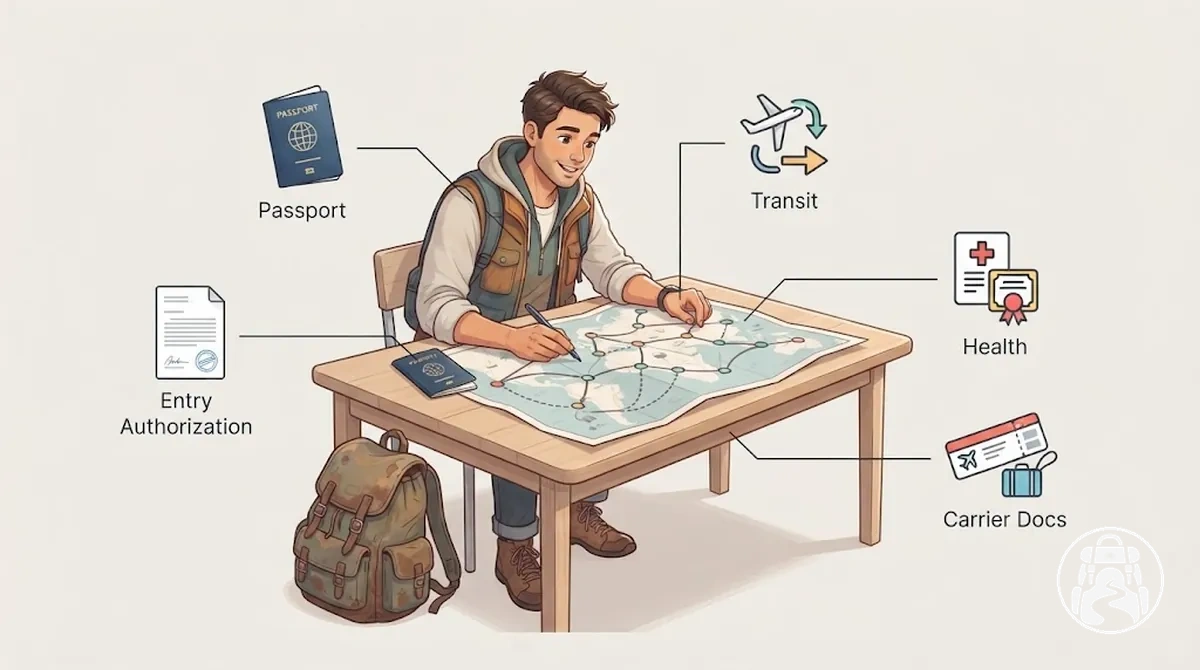
Applicable international travel requirements can change an international backpacking route, timing, transit choice, or booking plan even when the broader itinerary appears workable.
Passport validity, a visa or entry authorisation, transit conditions, health-related entry requirements, and carrier documentation must therefore be checked for the traveller's nationality, destination, transit country, carrier, and travel date before dependent bookings become difficult to change.
Mandatory requirements apply when the relevant destination, transit, or carrier rule covers the traveller, while conditional requirements apply only in specified circumstances.
Practical checks confirm whether those conditions are met before money or time is committed to arrangements that may be difficult to change.
The illustration groups the main document and entry checks without implying that every requirement applies to every traveller.
Requirement checks
Passport validity: confirm that the passport satisfies the current validity conditions for each destination and relevant transit country; if it does not, the affected route, connection, or travel date may need to change.
Visa or entry authorisation: confirm whether a visa or authorisation applies to the traveller's nationality, destination, purpose, length of stay, or transit situation; when required, eligibility and application timing can affect bookings and route choices.
Onward-travel rule: confirm whether evidence of onward or return travel is required for the relevant entry or transit situation; when it applies, a fully open-ended departure arrangement may need to be replaced with acceptable evidence.
Health-related entry requirement: confirm whether current health documentation or another health-related entry condition applies to the destination or transit route on the travel date; if it applies, the required evidence must be available for that journey.
Carrier documentation: confirm any document checks imposed by the transport provider for the specific international connection; failure to meet an applicable carrier requirement can affect boarding even when the broader itinerary remains unchanged.
Because international travel requirements can differ by nationality, destination, transit country, carrier, and date, there is no universal passport-validity period, visa status, onward-travel condition, or health requirement for every trip.
Verify current entry and transit rules with the relevant government's immigration authority, embassy, consulate, or other official source, and confirm carrier-specific documentation with the transport provider before relying on dependent bookings.
The Main Planning Stages and When to Handle Them
Backpacking trip planning stages should follow decision dependency rather than one universal calendar countdown.
High-impact constraints should be established before dependent choices, while lower-risk details can remain flexible until their inputs are clearer.
The required lead time therefore depends on what must be decided first and how difficult a decision will be to change later.
The progression moves from trip-shaping constraints through route and logistics decisions toward commitments, flexibility checks, and final preparation; the ordered phases below make those dependencies explicit.
Dependency order
Establish constraints: confirm the dates, trip duration, major priorities, budget boundaries, and applicable administrative requirements that can restrict later decisions.
Shape the destination and route: choose a workable destination pattern and route after the main constraints are clear enough to judge what can fit within the trip.
Align costs and logistics: check whether transport, accommodation, travel pace, and expected costs can support the proposed route without conflicting with the established limits.
Decide bookings: commit to arrangements when availability, administrative requirements, or other fixed conditions make delaying the decision more likely to reduce workable options.
Check flexibility: identify which remaining choices are reversible and which commitments would make later route, timing, or logistics changes difficult.
Complete final preparation: verify confirmations, documents, and departure-critical arrangements after the major trip structure and necessary commitments are settled.
Scarcity, administrative deadlines, and reversibility determine when a planning stage needs attention.
A visa or entry authorisation with an applicable processing requirement may move administrative preparation earlier, while scarce transport or peak-period accommodation may require more lead time for booking decisions.
More reversible choices can usually remain open longer when practical alternatives still exist.
Lead time therefore increases when delaying a decision could remove workable options or jeopardize a requirement that later stages depend on.
For a first international backpacking trip, allowing more planning margin can make dependencies easier to identify before commitments accumulate, but it does not create a universal preparation timeline.
The useful question is not how many months every traveller should plan ahead, but which constraints, administrative deadlines, scarce arrangements, and less reversible decisions in the specific trip require earlier attention.
Define Trip Length, Dates, and Non-Negotiables
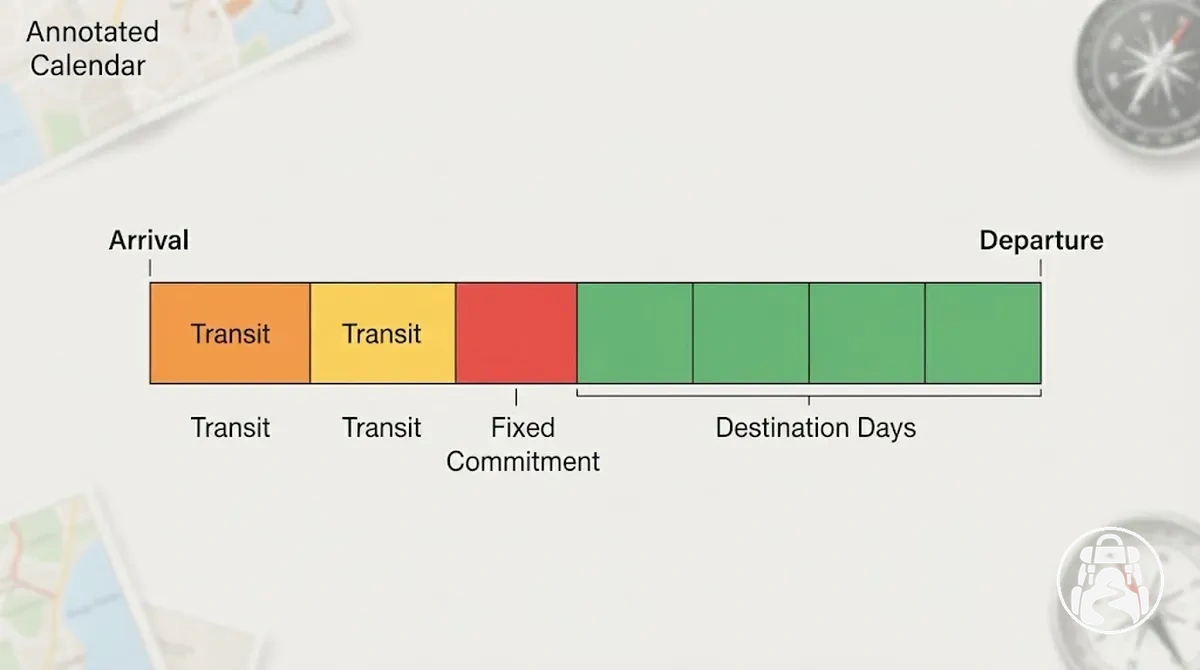
Usable trip time is the calendar window between arrival and departure minus transit days, fixed commitments, and other time that cannot be used for destinations.
Trip length therefore describes the nominal window, while usable travel days show how much time remains for later planning decisions.
What changes usable trip time
Travel dates: fixed arrival and departure dates establish the outer calendar limits, so later choices must fit inside that time window.
Transit days: international arrivals, departures, and transfers consume part of the calendar window, reducing the usable travel days available for destinations.
Fixed commitments: immovable appointments, visits, events, or other obligations reserve specific periods and constrain where the traveller can be at those times.
Seasonal dates: an event, seasonal condition, or other date-dependent priority can reserve a particular part of the trip and limit when adjustable activities can occur.
Non-negotiables: conditions that the traveller is unwilling or unable to change further reduce the set of workable timing choices.
Must-see priorities: preferred destinations or experiences remain adjustable unless their timing is fixed; giving them priority reserves part of the remaining usable time for later decisions.
Fixed inputs are the dates or obligations that later planning must respect, while adjustable preferences can move when they do not conflict with those limits.
A must-see priority can become more restrictive when it is tied to seasonal dates, but it can remain flexible when only the destination matters.
The purpose is to establish the usable time window before detailed route choices are made, not to prescribe an ideal trip length.
Shape the Destination Sequence and Travel Pace
Destination sequence and travel pace must be evaluated together because stop order determines how much transit time and connection effort sit between destinations, while pace determines how much usable time remains at each stop.
A geographically plausible route can still become impractical when frequent transfers, border friction, or compressed time per destination consume too much of the trip.
Stop order should limit unnecessary backtracking where practical, but geography is only one constraint: transport schedules, connections, transfers, border processes, recovery time and later commitments determine how much usable destination time remains. The paired criteria below keep route order and travel pace connected without prescribing a universal route pattern.
Route-and-pace checks
Stop order and connections: sequence destinations so geographic order and available connections work together; an awkward stop sequence can add transfers or repeated travel even when the destinations themselves remain feasible.
Transit burden and border friction: account for transit time, transfers, and any applicable border process as time and logistical effort; additional friction reduces usable destination time and can make tightly linked bookings more vulnerable to disruption.
Time per destination and recovery time: assess whether the remaining time at each stop still supports the intended activities and an appropriate recovery pace; frequent movement compresses destination time even when each individual transfer is workable.
Buffer time and later commitments: leave adjustable space where uncertainty in transport or connections could otherwise cascade into later arrangements; the useful amount of buffer time depends on the route, transport conditions, and how difficult later bookings are to change.
Travel pace becomes more demanding as more of the trip is consumed by movement, while buffer time and recovery time can make the sequence less dependent on every connection running exactly as planned.
An overloaded itinerary with many closely spaced stops and little spare time is more exposed to one delay compressing later destination time, whereas a more realistic sequence leaves usable time and flexibility for the planned stops without relying on a fixed number of days per destination.
The workable pace therefore depends on the actual transit burden, destination priorities, and reversibility of later commitments.
Align Budget, Transport, and Accommodation
Budget, transport, and accommodation should be evaluated by their combined effect on total trip cost, transit time, location, and schedule flexibility rather than as separate planning tasks.
A choice that lowers one cost can increase another cost, consume more usable time, or reduce flexibility elsewhere in the itinerary.
The budget ceiling is the maximum planned amount for the trip, while transport and accommodation costs determine how much of that ceiling remains for other parts of the trip.
Changes in transport or lodging can therefore shift both the cost distribution and the practical shape of the itinerary.
The grouped cross-effects below show how one logistics decision changes another planning variable and which conditions determine its implication.
Cross-effects to compare
Budget ceiling → transport or accommodation choice: a tighter budget ceiling can constrain which combinations of transport cost and accommodation cost remain workable; the resulting trade-off depends on whether lower-cost alternatives add transit time, reduce schedule flexibility, or shift the traveller to a less practical location.
Transport choice → time and accommodation: a transport option with extra transfers or less convenient departure and arrival times can add transit time and may require accommodation in a different location or for a different part of the schedule; the effect depends on connection timing and the availability of suitable lodging.
Accommodation choice → transport and usable time: lower accommodation cost in a less convenient location can add local travel, transfer effort, or time away from planned activities; the implication depends on how the location connects with the intended transport and daily schedule.
Availability → flexibility: limited transport or accommodation availability can turn an otherwise adjustable choice into a fixed reservation; once that happens, later itinerary changes may become harder or more costly when alternatives are limited or change conditions are restrictive.
Transport and accommodation therefore interact through timing, location, availability, and the degree to which bookings can still change.
Schedule flexibility is greater when workable alternatives remain available and commitments are reversible, while fixed reservations can constrain later adjustments.
For example, a lower headline transport cost may involve additional transfers and longer transit time, or a lower accommodation cost may place the traveller farther from useful connections; the relevant trade-off is the combined effect on cost, time, and itinerary flexibility rather than price alone.
Decide What to Book Ahead and What to Keep Flexible
Book ahead when scarcity, arrival dependency, or a high change cost makes unavailability consequential, while lower-risk trip elements with strong cancellation flexibility and practical alternatives can remain flexible.
The useful balance between early commitment and flexibility therefore depends on how difficult a booking would be to replace or change, not on a rule to fix everything early or leave everything open.
Evaluate scarcity, route certainty, arrival dependency, cancellation flexibility, reversibility, and change cost together; the commitment rules below show when those conditions support booking ahead, selective commitment, or keeping the choice flexible.
Commitment decision rules
High scarcity or peak-date demand → book ahead: when an important option has limited availability and losing it would materially disrupt the trip, earlier commitment reduces the risk that the required capacity is unavailable.
Strong arrival dependency → book ahead: when another confirmed part of the itinerary depends on a specific arrival, connection, or first-night arrangement, fixing the dependency can reduce the chance of an avoidable gap in the sequence.
High route certainty but meaningful change cost → commit selectively: when dates and sequence are stable, a booking may be reasonable to fix, but restrictive cancellation terms reduce reversibility and raise the cost of later changes.
Low route certainty with flexible cancellation → keep flexible: when timing or stop order may still change and suitable alternatives remain available, a reversible reservation can retain options without fully fixing the itinerary.
Low consequence of unavailability → keep flexible: when several practical substitutes exist and losing one option would not disrupt dependent bookings, delaying commitment can leave more of the trip adjustable.
Itinerary flexibility is highest when fixed reservations are limited to high-consequence dependencies and adjustable choices retain practical alternatives.
For example, a capacity-limited arrival connection during peak dates may justify early commitment, while an activity with multiple substitutes and flexible cancellation can remain open because its unavailability would have a smaller effect on the rest of the trip.
Finish Packing and Pre-Departure Preparation
Pre-departure readiness is the final verification that an already-planned trip can actually be executed.
Before leaving, verify the conditions that could block departure or disrupt the first stages of the trip rather than treating final packing as a new planning exercise.
Check valid documents, critical reservations, money access and a payment backup, communications, health needs, luggage, and essential confirmations against the trip that is actually planned. Because the applicable requirements vary with the traveller, destinations, transport arrangements and trip conditions, verify departure-blocking or dependency-breaking items first, then lower-impact recoverable items.
Departure-readiness checklist
Valid documents and entry conditions: verify that required travel documents are valid for the intended journey and that any applicable entry or transit requirements have been satisfied; an unresolved requirement can block departure, boarding, transit, or entry.
Critical reservations: confirm that essential transport and accommodation bookings match the intended dates and traveller details, and that the confirmations can be accessed when needed.
Money access and payment backup: confirm that the primary payment method is usable for the trip and that a separate payment backup or contingency is available if the primary method cannot be used.
Communications: check that essential contact details, booking information, and a workable communication method are accessible during travel, especially for arrival arrangements or changes.
Health needs: confirm that any traveller-specific medication, documentation, or other health preparation required for the journey is available and consistent with the applicable trip conditions.
Luggage: check that packed luggage suits the expected trip conditions and contains the necessary travel essentials without expanding the final check into a separate packing inventory.
Final confirmations: verify the latest departure-critical details for transport, accommodation, meeting points, and other fixed arrangements so the planned sequence can begin as intended.
If a critical check is unresolved, resolve it before treating the trip as departure-ready; lower-impact recoverable items can remain secondary.
Readiness means the essential documents, bookings, money access, communications, health needs, luggage, and confirmations have been checked against the trip that is actually planned.
Common International Backpacking Planning Mistakes
International backpacking planning mistakes are avoidable decisions or omissions that materially reduce a trip's feasibility, resilience, or usability.
They become planning errors when they conflict with known constraints, hide important dependencies, or leave too little room to absorb predictable travel demands rather than simply reflecting a normal personal trade-off.
Mistake → consequence → recognition cue → corrective direction
A warning sign matters when it shows that the current plan is compressing usable time, leaving a mandatory condition unresolved, increasing rigidity, or creating cost or luggage friction that affects the wider trip.
The items below stay within pre-trip planning; unrelated on-the-road behaviour, destination-specific conduct, and detailed packing technique belong outside this section.
Too many stops:Consequence: frequent movement increases transit time and can compress the time available at destinations. Recognition cue: the itinerary depends on repeated transfers, tightly spaced arrivals, or little buffer between stops. Corrective direction: reduce or reposition stops until the remaining sequence has workable destination time and room for disruption.
Underestimated travel days:Consequence: treating transfer periods as if they were fully usable destination days can create a rushed pace and may cause later delays to cascade through the itinerary. Recognition cue: planned activities assume substantial destination time on days already occupied by transport, transfers, border processes, or arrival and departure logistics. Corrective direction: account for the actual transit burden before assigning the remaining usable time.
Late handling of mandatory requirements:Consequence: an unresolved applicable entry, transit, document, or other mandatory requirement can force changes to bookings, timing, or the intended route. Recognition cue: dependent arrangements are becoming fixed while a requirement that could affect the journey is still unverified. Corrective direction: verify applicable mandatory requirements before commitments that depend on them become difficult to change.
Excessive non-flexible bookings:Consequence: too many fixed reservations reduce reversibility and can increase change cost when dates, connections, or the itinerary need adjustment. Recognition cue: one change would require altering several dependent bookings rather than one isolated arrangement. Corrective direction: keep lower-consequence choices flexible where practical and reserve firm commitments for elements whose scarcity or dependencies justify them.
Underestimated total costs:Consequence: focusing on headline transport or accommodation prices while overlooking associated transfers, local travel, booking conditions, or other trip expenses can create budget pressure later. Recognition cue: the budget ceiling covers major bookings but leaves little margin for costs created by the chosen route, locations, or logistics. Corrective direction: evaluate total costs together with the time and logistical consequences of each major choice.
Overpacking:Consequence: unnecessary luggage can create avoidable travel friction during repeated transfers, accommodation changes, and local movement. Recognition cue: packed items exceed what the trip conditions and realistic needs justify, or the luggage makes routine movement unnecessarily difficult. Corrective direction: match luggage to the actual trip conditions and remove items that do not serve a clear travel need.
Planning mistakes can compound when one weak assumption supports another: underestimated travel days can make too many stops feel workable, and the resulting tight sequence can become harder to correct when it is tied to non-flexible bookings.
The corrective direction is therefore to fix the earliest constraint or assumption that is creating downstream pressure rather than treating each consequence as an isolated problem.
How to Check Whether the Overall Trip Plan Is Realistic
A realistic trip plan remains feasible when plausible disruption affects timing, cost, bookings, or connections rather than working only under best-case assumptions.
Feasibility therefore depends on whether the trip can absorb ordinary variation without one small change making the wider itinerary unworkable.
Test time, route, total cost, booking flexibility, international requirements and available buffers together, because weakness in one area can expose dependencies elsewhere.
Transit time versus destination time and tight connections expose schedule dependency. Budget margin is the part of the budget ceiling left after expected essential costs; it shows whether an unexpected expense can be absorbed without displacing another essential cost. Inflexible bookings show how difficult corrective changes may be, while unresolved international requirements or missing buffers become especially important when later bookings depend on them.
Stress-test signals
Repeated movement leaves little destination time
Interpretation
The itinerary may be too compressed
Differentiate by
Check whether realistic transit time, transfers, and recovery still leave usable time at each stop
Corrective direction
Reduce or reposition a stop if the route only works when every transfer is unusually efficient
Tight connections leave little room for delay
Interpretation
Later bookings may be vulnerable to one disruption
Differentiate by
Check whether a missed connection would affect only one segment or cascade into fixed reservations
Corrective direction
Add buffer time or loosen the dependent booking where the consequence is material
The budget has little or no margin beyond expected total cost
Interpretation
An unexpected expense may force changes elsewhere
Differentiate by
Check whether essential transport, accommodation, and required costs could still be covered if one cost increases
Corrective direction
Create more budget margin or adjust a discretionary part of the plan rather than relying on best-case spending
International requirements remain unresolved while dependent bookings are fixed
Interpretation
An administrative issue may affect route or timing feasibility
Differentiate by
Check whether the unresolved requirement can change entry, transit, boarding, or booking validity
Corrective direction
Resolve the requirement or keep dependent arrangements reversible until it is confirmed
Several inflexible bookings and little recovery or buffer time occur in the same sequence
Interpretation
The plan has low reversibility
Differentiate by
Check whether one delayed arrival would require changing several later commitments
Corrective direction
Loosen the most consequential dependency rather than rebuilding the entire itinerary
As a compact stress test, imagine one connection is delayed enough to remove the available buffer before a fixed booking: if that single change compresses destination time and triggers several later changes, the plan needs adjustment.
Removing one stop, adding buffer time, or changing one inflexible booking may be enough to restore feasibility when the diagnostic criteria identify that specific bottleneck.